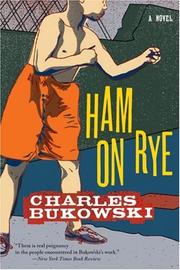

In one sentence
Ham on Rye presents coming of age not as moral development or social integration, but as the formation of a defensive outsider: Henry learns to distrust family, school, popularity, work, patriotism, and the American Dream. His alienation is both a response to real brutality and a posture that can reproduce cruelty.
Overview
The novel is narrated by Henry Chinaski, Bukowski’s recurring alter ego, and is generally described as semi-autobiographical rather than a straightforward memoir. It moves from Henry’s early years in Germany and Los Angeles through adolescence and the approach of World War II, emphasizing formative humiliations more than conventional plot.
Core ideas
An anti-bildungsroman
Traditional coming-of-age fiction often turns experience into maturity, belonging, or insight. Bukowski reverses that pattern: Henry’s experiences make him more suspicious, isolated, and resistant to respectable adulthood. The result is an anti-coming-of-age novel—less a journey toward identity than an account of identity hardening around refusal.
Abuse and the inheritance of violence
Henry’s relationship with his father gives the book’s alienation a material source. Domestic authority, school authority, and social hierarchies repeatedly appear as versions of domination. Henry is both victimized by violence and tempted to measure himself through violence, creating an important tension rather than a simple story of heroic rebellion.
The American Dream under Depression
Economic insecurity undermines the belief that hard work reliably produces dignity or success. Henry sees poverty, status, appearance, and power operating together, so his cynicism is directed not only at individuals but at the social story that explains inequality as personal failure.
The body as social fate
Acne, illness, ugliness, and embarrassment are not incidental obstacles: they determine how Henry is seen and treated. The novel’s crude physicality challenges polished literary and social ideals, showing how quickly people convert bodily difference into shame, exclusion, and cruelty.
Reading as an unofficial education
Libraries and writers offer Henry an alternative to school’s status games and his family’s hostility. Literature does not redeem him or make him socially successful; it gives him language, solitude, and a way to recognize that respectable narratives may be false.
Voice, comedy, and moral ambiguity
The flat, direct prose and deliberately offensive humor create distance from sentimentality. The voice can make suffering vivid and absurd, but it also encourages readers to ask whether Henry’s observations are insight, self-protection, performance, or rationalization. Bukowski’s position should not simply be equated with Henry’s.
Practical takeaways
- Alienation can begin as self-protection and gradually become a worldview; the novel is alert to both sides of that process.
- Social rejection does not automatically make the rejected person perceptive or morally superior.
- A hostile environment can explain a person’s defenses without excusing the harm those defenses later cause.
- Pay attention to the contrast between Henry’s blunt judgments and the evidence of his own limitations.
- The book’s reading life suggests that private intellectual discovery may matter even when it produces no obvious social reward.
- The title’s plainness fits the novel’s anti-romantic stance: ordinary, cheap, bodily, and unglamorous experience is treated as literary material.
Caveats and counterpoints
- “Semi-autobiographical” is the useful category: Henry is a fictional construction, so the novel should not be treated as a verified record of Bukowski’s childhood.
- The book’s treatment of women, sex, animals, alcohol, and violence is intentionally abrasive but can also be read as misogynistic, emotionally evasive, or ethically limited; its transgressive posture is not beyond criticism.
- The novel’s social criticism is powerful but partial. Its contempt for conformity can blur distinctions between oppressive institutions, ordinary vulnerability, and people simply trying to survive.
- Publisher descriptions calling it Bukowski’s “finest” novel reflect reputation and marketing, not an objective consensus.
Questions worth revisiting
- Where does Henry’s skepticism accurately diagnose hypocrisy, and where does it become an excuse not to risk tenderness or responsibility?
- How does the novel distinguish poverty from humiliation, and humiliation from poverty?
- Is reading presented as liberation, withdrawal, or both?
- What does Henry gain—and lose—by refusing the values of the people and institutions around him?
- How does the comic tone alter your response to scenes that would otherwise invite pity?
- Does the novel critique masculinity, reproduce its brutality, or deliberately leave that contradiction unresolved?
Return to this when…
Return to it when thinking about anti-coming-of-age fiction, autobiographical invention, literary outsiders, class resentment, abusive family systems, or the ethics of a narrator whose honesty and cruelty are inseparable.
Highlights
“Daddy, we have enough,” said my mother. “Like hell.” He kept yanking.
So, that’s what they wanted: lies. Beautiful lies. That’s what they needed. People were fools. It was going to be easy for me.
Then she turned a page and crossed her legs very fast and her skirt flipped back exposing her pure white thighs. She was just like buttermilk! Unbelievable! She was best of all!
The whole college scene was soft. They never told you what to expect out there in the real world. They just crammed you with theory and never told you how hard the pavements were.
It was a Saturday night in December. I was in my room and I drank much more than usual, lighting cigarette after cigarette, thinking of girls and the city and jobs, and of the years ahead. Looking ahead I liked very little of what I saw. I wasn’t a misanthrope and I wasn’t a misogynist but I liked being alone. It felt good to sit alone in a small space and smoke and drink.
References
- Ham on Rye - Charles Bukowski - Google Books
- Ham On Rye: A Novel - Charles Bukowski - Google Books
- Ham On Rye - Charles Bukowski - Google Books
- books.google.com
- support.google.com
- Ham on Rye
- supersummary.com
- books.google.com.ec
- Ham on Rye by Charles Bukowski | Goodreads
- blinkist.com
- Ham On Rye by Charles Bukowski – Canongate Books
- interactive.cornish.edu