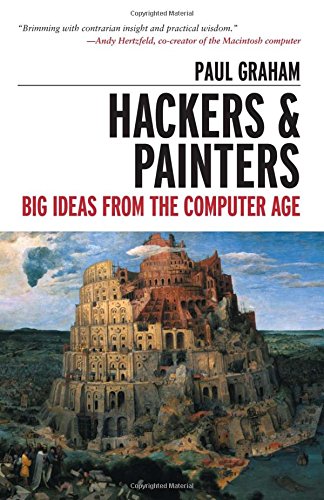

In one sentence
Computing is not merely an engineering discipline or industrial activity: it is a medium for creative work, independent thought, and wealth creation. The people best positioned to exploit it are makers who value taste, experimentation, expressive tools, and freedom from conventional institutional rules.
Overview
The book gathers fifteen essays written mainly around Graham’s experiences as a programmer, Viaweb cofounder, and student of painting. It moves from school culture and unpopular ideas to hacker identity, web software, startups, economic inequality, Bayesian spam filtering, aesthetic judgment, programming-language design, and the tension between research, design, and industry. The essays are connected more by Graham’s perspective than by a single sustained argument.
Core ideas
Hackers are makers, not merely technicians
Graham compares hackers with painters, writers, architects, and composers: all work by iterating toward something good. The important distinction is not art versus science but making versus merely analyzing. This implies that programming quality depends on judgment, taste, and sustained personal engagement—not only formal correctness.
Unpopularity can protect independent thinking
In “Why Nerds Are Unpopular,” Graham interprets school status partly as a reward for conformity to adolescent social priorities. Students absorbed in difficult, intrinsically rewarding work may be badly matched to that status system; later achievement can depend on preserving rather than suppressing this independence.
Question accepted language and consensus
“What You Can’t Say” argues that some beliefs become difficult to express because social penalties suppress them before they can be examined. Graham’s proposed discipline is to distinguish what is genuinely unthinkable from what is merely socially costly to say. The essay is a case for intellectual experimentation, not automatic contrarianism.
Small teams and web software create leverage
Graham sees browser- and server-based software as a major opportunity because distribution and infrastructure can let small teams compete with much larger organizations. His startup model favors rapid building, direct contact with users, and control over the product rather than waiting for institutional approval.
Wealth is created through useful production
In “How to Make Wealth,” Graham treats startup success primarily as the result of creating something people value, rather than simply transferring existing wealth. The practical model is to find a scalable way for a small number of capable people to produce substantial value. His economic argument is deliberately opinionated and not a comprehensive treatment of inequality.
Programming languages shape the space of possible work
The language essays reject the idea that languages are interchangeable once they are computationally universal. Abstraction, expressiveness, and the ability to modify or extend a language affect what programmers can build and how much accidental complexity they must manage. Graham uses Lisp as his strongest example.
Good design requires taste and iteration
“Taste for Makers” treats design judgment as a practical capability: notice what is wrong, understand why it is wrong, and improve it through repeated revision. Good work often emerges from accumulated small corrections rather than from applying a fixed formula.
Innovation often conflicts with institutional best practice
Several essays argue that organizations optimize for safety, consensus, and established procedure, while breakthroughs often come from people willing to pursue unusual approaches. This is useful as a warning against cargo-cult process, but Graham sometimes presents hacker culture as more uniformly virtuous than the evidence warrants.
Practical takeaways
- Treat programming as a design and craft activity: build, inspect, revise, and develop taste rather than relying only on specifications.
- Choose tools by the leverage and expressiveness they provide, not solely by popularity or organizational familiarity.
- For product work, get something useful in users’ hands early and learn from direct feedback.
- Protect time for difficult, intrinsically motivating work; social approval is a poor proxy for long-term value.
- When evaluating a startup idea, ask what value is being created, for whom, and why a small team can deliver it unusually well.
- Separate genuine technical constraints from inherited conventions, especially in tools, workflows, and organizational practices.
- Use contrarian thinking as a method for investigation, not as an identity or substitute for evidence.
Caveats and counterpoints
- The book dates from 2004, so its discussion of web software, programming languages, startups, spam, and the technology industry reflects an earlier stage of computing; its principles are more durable than many of its concrete predictions.
- Graham writes as an advocate, not as a neutral social scientist. His claims about wealth, inequality, schools, hacker culture, and institutional failure are broad and often lightly evidenced; the contemporary review explicitly notes the book’s lack of balance.
- The entrepreneurial model favors unusually capable, technically oriented founders and can understate capital, regulation, labor, luck, maintenance, and social infrastructure.
- The book’s celebration of rule-breaking needs boundaries: unconventional thinking can produce insight, but norms also encode safety, accountability, and accumulated experience.
- The programming-language arguments are especially tied to Graham’s Lisp-centered preferences and should be read as a strong design philosophy rather than a settled comparison of all languages.
Questions worth revisiting
- Which of Graham’s claims are principles about making, and which are contingent predictions about the early web?
- Where does independence improve product judgment, and where does it become resistance to useful feedback or governance?
- What forms of wealth creation are omitted when value is defined mainly through scalable software products?
- How much of good software design comes from language choice versus architecture, team practice, testing, and domain knowledge?
- Which current technology institutions most resemble the “small groups of makers” Graham favors—and where does that model fail?
- Can the book’s hacker ideal be reconciled with accessibility, security, labor rights, and responsibility to people affected by software?
Return to this when…
Return to the essays on hackers and painters, wealth creation, programming languages, taste, and “Revenge of the Nerds” when evaluating a technical product, choosing tools, starting a company, or questioning an industry convention. Revisit the caveats before applying its startup or economic claims directly to present conditions.