In one sentence
Sustainable growth begins before promotion: build something a specific group genuinely wants, discover a repeatable way to reach them, make sharing part of the experience, and continually improve acquisition and retention. Marketing is therefore not merely communication; it is product development, distribution, measurement, and iteration working as one loop.
Overview
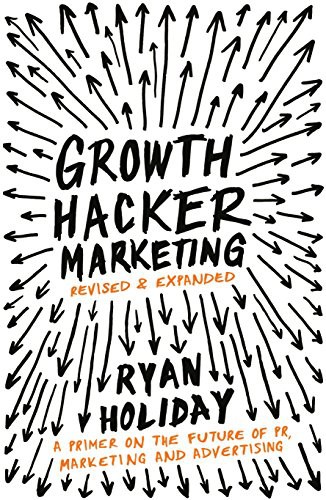
The expanded 2014 edition is organized around four steps: product–market fit; finding a growth hack; turning one user into more through virality; and closing the loop through retention and optimization. It then applies the framework to Holiday’s own book launch, followed by a glossary, FAQs, and next steps.
Core ideas
1. Product–market fit precedes scale
Do not spend heavily trying to manufacture demand for a weak or poorly targeted product. Define the customer narrowly, learn what they need, and modify the product until it creates strong enough value that promotion becomes easier. Holiday treats these as marketing decisions, not only product decisions.
2. Growth hacking is a mindset, not a bag of tricks
The “hack” is a repeatable, measurable route to growth—not necessarily a clever gimmick. Test channels and product changes, keep what works, and favor activities that are trackable, scalable, and economical. The underlying attitude is experimental and cross-functional: marketers, engineers, designers, and founders share responsibility for growth.
3. Distribution should be designed into the product
The strongest acquisition mechanisms are native to how the product is used: referrals, invitations, sharing, integrations, or other features that expose the product to new people. Holiday’s examples include Hotmail’s email signature and referral or platform-based mechanisms associated with companies such as Dropbox and Airbnb.
4. Virality spends users’ social capital
People recommend products at a reputational cost. Asking for sharing is therefore insufficient; the product must make the recommendation useful, natural, or identity-enhancing. Virality is a property of the customer experience and incentive structure, not simply a publicity outcome.
5. Retention makes acquisition meaningful
Acquiring users who do not return produces a misleading growth story. The process must loop: observe behavior, find friction, improve activation and retention, then reassess acquisition. Holiday’s structure explicitly ends with retention and optimization rather than treating launch as the finish line.
6. Start with a small, responsive audience
Rather than trying to reach everyone immediately, identify a concentrated group of likely enthusiasts, learn from them, and use their feedback and advocacy to refine the offering. Holiday describes using this approach for the book itself: an initial digital version served as a minimum viable product before expansion.
Practical takeaways
- Before buying traffic, specify the target customer and the behavior that would demonstrate genuine value.
- Interview early users and watch what they do; use the evidence to change the product, positioning, onboarding, or audience.
- Choose one acquisition hypothesis at a time and define the metric that would confirm or reject it.
- Ask whether the product naturally creates invitations, referrals, collaboration, sharing, or other exposure to new users.
- Track the full path from acquisition to activation, retention, referral, and revenue; do not celebrate sign-ups alone.
- Run small launches and experiments before committing major budget or organizational effort.
- Treat marketing as a shared operating responsibility across product, engineering, design, sales, and communications.
Caveats and counterpoints
- The book is a primer, not a rigorous causal study. Its famous company examples are largely success stories, so they can understate failed experiments, timing, competition, capital, and survivorship bias.
- “Product–market fit” is presented as a practical goal, but the book does not offer a universally reliable test for when fit has been achieved; teams can mistake enthusiasm, novelty, or paid acquisition for durable demand.
- Built-in virality is not available to every category. B2B, regulated, luxury, privacy-sensitive, and high-consideration products may grow through sales, partnerships, reputation, or service quality rather than user referrals.
- Cheap, measurable channels are not automatically strategically good channels: optimizing clicks or sign-ups can damage trust, attract low-value users, or encourage manipulative tactics.
- The framework is especially suited to digital products and startup-style iteration. Established brands may still need long-term positioning, creative development, distribution power, and offline marketing.
Questions worth revisiting
- What evidence would convince me that my product solves a painful problem for a specific customer group?
- Which single step is currently weakest: acquisition, activation, retention, referral, or revenue?
- What product change could make customer advocacy more natural instead of merely requesting promotion?
- Which metric reflects lasting value rather than attention or inflated top-of-funnel activity?
- Am I testing a real growth hypothesis, or just producing more marketing activity?
- Where does this framework fail or need supplementation in my market—especially around trust, regulation, privacy, or long sales cycles?
Return to this when…
Return to the four-step sequence when a launch or campaign is underperforming: verify product–market fit, isolate a repeatable acquisition mechanism, examine whether the product supports sharing, and fix retention before scaling spend. Also revisit Holiday’s own book-launch example when considering how to test an idea with a small minimum viable product before investing in a larger release.
Highlights
The end goal of every growth hacker is to build a self-perpetuating marketing machine that reaches millions by itself.
Our delusion is that we should be Transformers and not The Blair Witch Project.
This little feature changed everything. It meant every e-mail that Hotmail’s users sent would be an advertisement for the product. And that advertisement was effective not because it was cute or creative but because it showcased an amazing product that many people wanted and needed. Each user meant new users; each e-mail meant more e-mails and more happy customers. And most crucially, all this could be tracked and tweaked and improved to drive as many users as possible into the service.
But after adopting Draper’s suggestion—which the founders resisted for the first few months because it seemed so simple—growth was exponential: 1 million members within six months. Five weeks after that, membership had doubled again. By December 1997, with nearly 10 million users, Hotmail was sold to Microsoft for $400 million. It took just thirty months from launch for Hotmail to accumulate its thirty millionth user.
A growth hacker is someone who has thrown out the playbook of traditional marketing and replaced it with only what is testable, trackable, and scalable. Their tools are e-mails, pay-per-click ads, blogs, and platform APIs instead of commercials, publicity, and money. While their marketing brethren chase vague
notions like “branding” and “mind share,” growth hackers relentlessly pursue users and growth—and when they do it right, those users beget more users, who beget more users. They are the inventors, operators, and mechanics of their own self-sustaining and self-propagating growth machine that can take a start-up from nothing to something.
One Harvard Business Review study found that 80 percent of marketers are unhappy with their ability to measure marketing return on investment (ROI). Not because the tools aren’t good enough, but because they’re too good, and marketers are seeing for the first time that their marketing strategies are “often flawed and their spending
Make stuff people want.
You know what the single worst marketing decision you can make is? Starting with a product nobody wants or nobody needs.
Airbnb had a good idea in 2007. The founders could have spent all their time and energy trying to force the “let people crash on your floor and feed them breakfast” angle and created a small business around it.
They went from a good idea to an explosive idea and, soon, a billion-dollar valuation. It was undoubtedly the best marketing decision they ever could have made.
The service soon retooled to become Instagram as we know it: a mobile app for posting photos with filters. The result? One hundred thousand users within a week of relaunching. Within eighteen months, the founders sold Instagram for $1 billion.
As Evernote’s founder, Phil Libin, told a group of entrepreneurs in a now-classic talk “people [who are] thinking about things other than making the best product, never make the best product.”
To be successful and grow your business and revenues, you must match the way you market your products with the way your prospects learn about and shop for your products.
This pressure comes from our clients, and many marketers have internalized these self-destructively ambitious goals. I know the feeling: I want to be everywhere. I want millions of video views. I want to become a trending Twitter topic. They try to go everywhere and end up going nowhere. What’s the point? Most of those people never become your customers.
This means that our outward-facing marketing and PR efforts are needed simply to reach out to and capture, at the beginning, a group of highly interested, loyal, and fanatical users. Then we grow with and because of them. If they are geeks, they are at TechCrunch or Hacker News or Reddit or attending a handful of conferences every year. If they are fashionistas, they are regularly checking a handful of fashion blogs like Lookbook.nu or Hypebeast. If they are _______________, like you and your founders are, they are reading and doing the same things you do every day. Catch their attention and pull them in. It’s as simple as that. Uber, a car service start-up founded by Travis Kalanick and Garrett Camp, has been giving out free rides during Austin’s SXSW Conference for several years. During a single week, thousands of potential Uber customers—tech-obsessed, high-income young adults who cannot find a cab—are motivated to try out this service. One year Uber offered free rides.
That’s thinking like a growth hacker—it’s how you get the most bang for your buck and how you get it from the right people.
- You can reach out to the sites you know your potential customers read with a pitch e-mail: “This is who we are, this is what we’re doing, and this is why you should write about us.”* 2. You can upload a post to Hacker News, Quora, or Reddit yourself.
- You can start writing blog posts about popular topics that get traffic and indirectly pimp your product. 4. You can use the Kickstarter platform for exposure and bribe your first users with cool prizes (and get some online chatter at the same time). 5. You can use a service like Help a Reporter Out (www.helpareporter.com) to find reporters who are looking for people to include in stories they are already writing about your space. 6. You can literally find your potential customers one by one and invite them to your service for free or with some special incentive (that’s how small we’re talking).
- You can create the aura of exclusivity with an invite-only feature (as Mailbox did). 2. You can create hundreds of fake profiles to make your service look more popular and active than it actually is—nothing draws a crowd like a crowd (as Reddit did in its early days). 3. You can target a single service or platform and cater to it exclusively—essentially piggybacking off or even stealing someone else’s growth (as PayPal did with eBay).
- You can host cool events and drive your first users through the system manually (as Myspace, Yelp, and Udemy all did). 5. You can bring on influential advisers and investors for their valuable audience and fame rather than their money (as About.me and Trippy did—a move that many startups have emulated). 6. You can try to name a Planned Parenthood clinic after your client or pay D-list celebrities to say offensive things about themselves to promote your book (OK, those two were me).
Let’s be honest, a traditional marketer would not even be close to imagining the integration above—there’s too many technical details needed for it to happen. As a result, it could only have come out of the mind of an engineer tasked with the problem of acquiring more users from Craigslist.
All of which is to say a simple truth that we try to deny too often: If you want to go viral, it must be baked into your product.
You need the kind of objectivity that makes you forget everything you’ve heard, clear the table, and do a factual study like a scientist would.
Lean Startup Marketing by Sean Ellis
The Lean Startup by Eric Ries The Lean Entrepreneur by Brant Cooper and Patrick Vlaskovits Founders at Work by Jessica Livingston Viral Loop by Adam L. Penenberg Contagious by Jonah Berger Lean Startup Marketing by Sean Ellis
References
- Review: "Growth Hacker Marketing: A Primer on the Future of PR, Marketing, and Advertising" 10/30/2014
- blinkist.com
- goodreads.com
- Growth Hacker Marketing | Penguin Random House Retail
- successsummaries.net
- 601media.com
- tubarksblog.com
- juststartwith.com
- Medium
- ryanholiday.net
- screvi.com
- ideandigest.com
- profilebooks.com