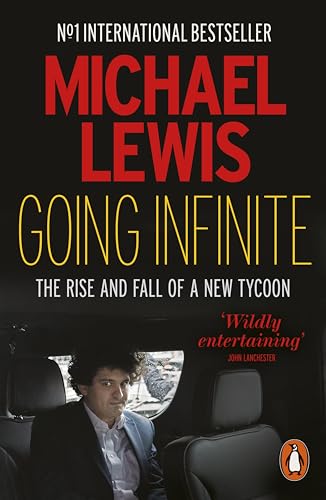

In one sentence
The book’s central subject is less cryptocurrency than the interaction between an unusually unconventional personality, an ideology of maximizing future good, and institutions that rewarded speed, charisma, apparent genius, and rapid growth before demanding basic controls. Lewis presents Bankman-Fried’s self-understanding and decision-making in close detail, but the resulting portrait is more psychologically suggestive than financially conclusive.
Overview
Published on October 3, 2023, the book traces Bankman-Fried from his early trading career and effective-altruist commitments through the creation of Alameda Research and FTX, their expansion into global crypto finance, and the collapse that left customers, employees, and investors exposed. Lewis had unusually extensive access to Bankman-Fried before the collapse, which gives the narrative immediacy but also makes the author’s proximity part of the story’s problem.
Core ideas
A person can be legible without being exonerated
Lewis tries to show how Bankman-Fried understood himself: as a consequentialist optimizing money-making for philanthropic ends, relatively indifferent to conventional status markers, and comfortable with unconventional behavior. Understanding that internal logic does not establish that his conduct was ethical or lawful; later criticism of the book argues that Lewis sometimes gives SBF’s explanations too much narrative weight.
Effective altruism becomes an operating system
The book treats effective altruism not merely as a charitable preference but as a decision framework: judge actions by expected consequences, discount ordinary social conventions, and prioritize scalable impact. Its danger in this setting is that impressive projected benefits can be used to rationalize present violations, weak safeguards, or treating other people’s losses as variables in an optimization problem.
Growth and intelligence can disguise missing controls
FTX’s rise illustrates how a compelling founder, sophisticated technical language, celebrity endorsements, political access, and rapid revenue growth can create an aura of legitimacy. The practical lesson is not that intelligence is irrelevant, but that intelligence and growth are poor substitutes for segregation of funds, independent oversight, reliable accounting, clear authority, and transparent risk limits. Reviews praised the storytelling while criticizing the book’s limited granular financial analysis.
Narrative access creates both insight and distortion
Lewis’s close access produces memorable scenes and a detailed sense of Bankman-Fried’s habits, conversations, and reactions. But access is not neutrality: the author’s early exposure to SBF’s worldview may help explain why some reviewers found the book unusually sympathetic or insufficiently analytical about victims, governance, and the mechanics of the collapse.
The collapse is also a failure of collective judgment
The story is not only about one founder’s decisions. It also concerns employees, investors, counterparties, regulators, media figures, political donors, and customers who inferred competence from social proof and momentum. A useful systems-level reading asks why so many observers accepted extraordinary claims without demanding ordinary evidence.
Practical takeaways
- Separate a founder’s stated mission from the controls protecting other people’s money.
- When evaluating a fast-growing financial business, inspect custody, liabilities, related-party transactions, governance, and audit quality before admiring the product or leader.
- Treat unconventionality as neither proof of genius nor proof of fraud; test claims against records, incentives, and independent verification.
- Be wary of moral arguments that invoke enormous future benefits to excuse concrete present harms.
- Read this book as a close character study and a case study in institutional credulity, then consult more technical reporting for the financial architecture and legal findings.
Caveats and counterpoints
- The book was written amid the collapse and published on the first day of Bankman-Fried’s criminal trial, so it is necessarily a pre-verdict account rather than a final history.
- Several serious reviews argue that Lewis is too willing to entertain Bankman-Fried’s self-description and does not fully explain the financial mechanics or the scale of the alleged misconduct.
- The book’s strengths—access, scene-setting, and psychological detail—are also limitations: they can make one person’s perspective feel more representative or persuasive than the broader evidence warrants.
- The title and narrative structure may invite a morality tale about crypto, but the book does not function as a comprehensive history of crypto markets, regulation, or FTX’s bankruptcy.
Questions worth revisiting
- Which parts of Bankman-Fried’s self-explanation does Lewis substantiate independently, and which are presented mainly as reported belief?
- What specific controls would have exposed the relationship between FTX and Alameda earlier?
- How did effective-altruist reasoning interact with ordinary incentives such as power, reputation, competition, and access to capital?
- Which institutional actors had enough information to intervene, and what prevented them from doing so?
- Where does narrative empathy clarify responsibility, and where might it soften judgment?
- What would a more technically detailed account of FTX’s balance sheet, governance, and customer-funds practices add to Lewis’s portrait?
Return to this when…
Return to this book when you want to examine how charisma, ideology, access, and institutional weakness can combine around a financial founder—or when comparing a vivid narrative profile with more forensic accounts of the FTX collapse.
Highlights
But even MIT, where he eventually landed, had a humanities requirement. A single liberal arts class, which he satisfied by taking film history, but even that grated on him. “Whatever cease-fire existed earlier in my life was gone,” he said. “I was starting to get a little bit of a whiff of ‘I don’t have to put up with it anymore.’ ” The very first question on the final exam set him off. What’s the difference between art and entertainment? “It’s a bullshit distinction dreamed up by academics trying to justify the existence of their jobs,” wrote Sam, and handed the exam back.
“He did zero management and thought that if people had any questions, they should just ask him. Then in his one-on-ones with people, he’d play video games.”
Roughly one hundred fifty different venture capital firms invested. All of them caved to Sam’s refusal to give them a seat on the board (he had no board) or any other form of control over the business.
References
- All Book Marks reviews for Going Infinite: The Rise and Fall of a New Tycoon by Michael Lewis Book Marks
- ‘Going Infinite’ Review: Michael Lewis Can’t Make a Hero Out of Sam-Bankman Fried - The New York Times
- Going Infinite: The Rise and Fall of a New Tycoon - Michael Lewis - Google Books
- books.google.com
- theguardian.com
- Michael Lewis’s “Going Infinite: The Rise and Fall of a New Tycoon” - The Washington Post
- Going Infinite: The Rise and Fall of a New Tycoon - Michael Lewis - Google Books
- irishtimes.com
- newyorker.com
- theguardian.com
- lightfootcfo.com
- latimes.com