
In one sentence
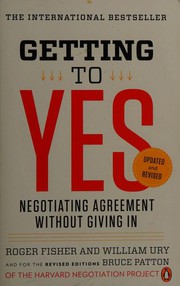
Good negotiation is neither aggressive haggling nor passive accommodation. Treat the parties as collaborators solving a shared problem, while judging any proposed agreement against independent standards and each side’s best alternative to agreement. This aims to produce wise, efficient, and relationship-preserving outcomes rather than victories based on pressure.
Overview
The book’s method, usually called principled negotiation or negotiation on the merits, is organized around four rules: separate people from the problem; focus on interests rather than positions; invent options for mutual gain; and insist on objective criteria. It also emphasizes preparing a BATNA—your best course if no deal is reached—so you can recognize when agreement is beneficial and resist an unacceptable one.
Core ideas
Separate people from the problem
Negotiations contain both substantive issues and relationship issues: emotions, identity, assumptions, miscommunication, and perceived disrespect. Address the human dynamics explicitly rather than allowing them to distort the practical problem. Listen for how the other side sees the situation, communicate clearly, and work against the problem together. This does not mean being agreeable at the expense of your interests.
Focus on interests, not positions
A position is a stated demand; an interest is the need or concern that makes the demand matter. Two apparently incompatible positions may conceal compatible interests—such as different priorities concerning timing, risk, privacy, convenience, or recognition. Ask why a position matters, identify your own interests, and discuss them openly rather than arguing over fixed demands.
Invent options before deciding
Premature evaluation narrows creativity. Generate several possible arrangements first, separating brainstorming from judgment. Look for trades across issues, differences in priorities, and ways to expand the total value available. Mutual gain does not require identical benefits; it requires an arrangement that improves each side’s position compared with its alternatives.
Use objective criteria
When interests genuinely conflict, do not rely solely on willpower, threats, or incremental concessions. Use standards independent of either party’s preference—such as market value, precedent, professional norms, expert assessment, legal principles, or a fair procedure. Agreement becomes easier to defend when the reasoning is transparent and not simply a contest of power.
Prepare and improve your BATNA
The relevant comparison is not merely whether the other side accepts your proposal, but whether the proposal is better than your best alternative without an agreement. List alternatives, develop the strongest one you can, estimate their consequences, and avoid accepting less than the value your BATNA provides. A stronger BATNA improves both judgment and bargaining leverage.
Handle difficult tactics by making them discussable
Misrepresentation, psychological pressure, and positional tactics should be identified rather than answered in kind. Ask what the tactic is intended to accomplish, question its legitimacy, and redirect the discussion toward interests, standards, and consequences. The method seeks firmness about substance without turning firmness into hostility.
Practical takeaways
- Before negotiating, write down: my interests, their likely interests, several possible options, objective standards, and my BATNA.
- Replace “What should they concede?” with “What problem are we both trying to solve?”
- Ask “What makes that important?” to uncover interests beneath stated demands.
- Brainstorm multiple packages before debating which one is best.
- For each proposal, ask: Is it better than my BATNA? Is it acceptable from the other side’s perspective? Can both sides explain why it is fair?
- Separate relationship repair from substantive bargaining: clarify perceptions, acknowledge emotions, and correct misunderstandings without automatically conceding the underlying issue.
- Use objective criteria as a shared reference point, not as a pretext for disguising your preferred outcome.
Caveats and counterpoints
- The framework assumes enough good faith, communication, and decision-making authority for parties to explore interests and options. It is less sufficient when the other side’s goal is domination, delay, deception, or exploitation.
- “Mutual gain” can be misunderstood as guaranteeing a win-win result. Some negotiations are genuinely distributive: one side’s gain may be the other’s loss, making standards, reservation points, and BATNAs especially important.
- Objective criteria are not automatically neutral. Parties may disagree about which standards apply, how they should be measured, or whose experts and precedents are credible.
- Separating people from problems is analytically useful but practically difficult: identity, power, trust, and history can be part of the problem itself, not merely distractions from it.
- The book’s clarity and influence make it a strong foundation, but later negotiation literature often gives more attention to culture, structural power, emotion, implicit bias, and situations where interests cannot be safely disclosed.
Questions worth revisiting
- What are the other side’s underlying interests, and what evidence supports that interpretation?
- What is my best alternative if no agreement is reached—and what can I do now to improve it?
- Which issues could be traded because we value them differently?
- What independent standards could both sides accept before discussing numbers or concessions?
- Am I treating a relationship problem as a substantive dispute, or a substantive dispute as a relationship problem?
- What would make the agreement durable after the meeting ends?
Return to this when…
Return to these notes before salary discussions, contracts, purchases, workplace conflicts, boundary-setting, mediation, or any negotiation where preserving the relationship matters but giving in is not acceptable. The core checklist is: people/problem, interests/positions, options, criteria, BATNA.
References
- en.wikipedia.org
- juststartwith.com
- Getting to Yes by Roger Fisher, William L. Ury, Bruce Patton: 9780143118756 | PenguinRandomHouse.com: Books
- litcharts.com
- Books – WILLIAM URY
- researchgate.net
- vejdani.org
- readever.app
- simonandschuster.com
- scholarship.law.missouri.edu
- penguin.co.uk
- arrowpointwealth.com
- beyondintractability.org