
In one sentence
Productivity improves when commitments are removed from working memory and converted into clearly defined outcomes, next physical actions, and reliably reviewed reminders. The goal is not to do everything, but to create enough trust in one’s system to focus on the task at hand.
Overview
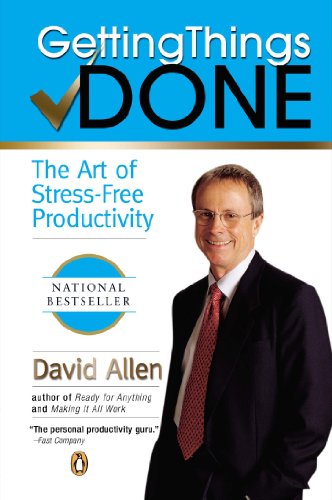
Allen presents GTD as a workflow for managing “stuff”: anything that has captured your attention but has not yet been decided or handled. The method separates thinking from remembering. You first collect inputs, then decide what each means, place the result where it can be retrieved, review the whole system, and act with confidence. The 2015 revised edition updates the original 2001 book for contemporary digital work while preserving the central method.
Core ideas
Capture open loops
Collect commitments, ideas, requests, and obligations in a small number of trusted capture tools rather than trying to retain them mentally. Capture is not prioritizing; it is preventing attention from being repeatedly hijacked by unfinished thoughts.
Clarify the meaning
Process each item by asking what it is and whether it is actionable. If actionable, define the desired outcome and the next visible, physical action. If not, discard it, keep it as reference, or defer it. Vague projects create more stress than clearly bounded ones.
Organize by retrieval needs
Put results into appropriate categories: calendars for time-specific commitments, next-action lists for available actions, project lists for outcomes requiring multiple steps, waiting-for lists, reference, and someday/maybe material. The system should show what can be done in the current context.
Use the two-minute rule carefully
If clarifying an item reveals an action that can be completed in roughly two minutes, do it immediately instead of tracking it. This is a processing shortcut, not a universal command to interrupt important work for every small task.
Review creates trust
A system is useful only if it is current. Regular review—especially a comprehensive Weekly Review—clears capture points, updates projects and waiting-fors, and reconnects actions to larger commitments. Skipping review turns an external system into another source of uncertainty.
Plan naturally from outcome to action
For projects, Allen’s Natural Planning Model moves through purpose and principles, vision of the desired result, brainstorming, organization, and identification of next actions. It combines creative freedom at the front end with concrete execution at the end.
Engage with situational judgment
Once the system is trusted, choose what to do using context, available time, energy, and relative priority—not a single rigid master ranking. GTD therefore supports flexible execution rather than prescribing one fixed order of tasks.
Practical takeaways
- Create one dependable inbox for incoming tasks and ideas; empty it by deciding the next action, not merely by rereading it.
- Rewrite “work on presentation” as a physical next step such as “open the presentation file and list the three sections needing evidence.”
- Maintain a complete list of projects—defined as outcomes requiring more than one action—so commitments do not disappear after the first step.
- Keep calendar entries for actions that must happen on a particular date or at a particular time; keep merely desirable actions on context-appropriate lists.
- Schedule a weekly review to gather loose inputs, update project statuses, check waiting-fors, and refresh someday/maybe items.
- Choose a task from the system based on current context, time, energy, and importance rather than relying on memory or whichever item feels loudest.
Caveats and counterpoints
- GTD is primarily a management and execution framework, not a theory of motivation, habit formation, attention disorders, organizational design, or deciding what deserves priority.
- The system can become administratively heavy: many lists, reviews, and categories may create friction, especially for people with few commitments or low tolerance for maintenance.
- Externalizing tasks does not resolve conflicting goals, unrealistic workloads, unclear authority, or insufficient resources; those require negotiation and prioritization beyond workflow control.
- The two-minute rule and context lists can encourage reactive work if used without protected time for deep work, strategic planning, or high-value projects.
- The method’s effectiveness depends on consistent review and trustworthy tools. A beautifully designed system that is not updated is worse than a simpler system that is maintained.
- Some readers and reviewers find the revised edition less tied to particular technologies, which improves durability but leaves implementation details to the reader.
Questions worth revisiting
- Which commitments are currently living only in my head?
- What does “done” look like for each significant project?
- What is the next physical action, and where will I see the reminder?
- Am I using my calendar for true time commitments rather than wishful scheduling?
- What part of my system do I avoid reviewing, and what does that avoidance reveal?
- Would fewer lists and categories make this system easier to trust and maintain?
- Which priorities cannot be solved by better organization and instead require a decision, conversation, or renegotiation?
Return to this when…
Return when your task list feels vague, your mind is repeatedly rehearsing unfinished commitments, or you are confusing projects with actions. The most useful refresher is the workflow sequence: capture, clarify, organize, reflect, engage—then apply the smallest version you can reliably maintain.
Highlights
Life is denied by lack of attention, whether it be to cleaning windows or trying to write a masterpiece.
Your ability to generate power is directly proportional to your ability to relax.
In karate there is an image that’s used to define the position of perfect readiness: “mind like water.” Imagine throwing a pebble into a still pond. How does the water respond? The answer is, totally appropriately to the force and mass of the input; then it returns to calm. It doesn’t overreact or underreact. If your mind is empty, it is always ready for anything; it is open to everything. —Shunryu Suzuki
This constant, unproductive preoccupation with all the things we have to do is the single largest consumer of time and energy.
Most often, the reason something is “on your mind” is that you want it to be different than it currently is,
Vision is not enough; it must be combined with venture. It is not enough to stare up the steps; we must step up the stairs. —Vaclav Havel