
In one sentence
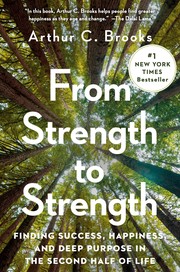
The central task of later life is not to preserve the exact strengths that produced earlier success, but to redirect effort toward strengths that tend to deepen with age—especially knowledge, judgment, teaching, love, service, and transcendence. Brooks calls this a move from the “first curve” to a “second curve” of life.
Overview
Brooks writes primarily for ambitious people who identify strongly with achievement and fear becoming irrelevant. Drawing on social science, philosophy, biography, theology, and interviews, he argues that many people suffer because they treat declining speed, novelty-generation, or status as evidence that life is losing value. His proposed answer is an intentional change in work, identity, relationships, and ultimate priorities—not passive retirement or denial of decline.
Core ideas
Two curves of intelligence
Brooks distinguishes fluid intelligence—rapid reasoning, innovation, and solving unfamiliar problems—from crystallized intelligence—the accumulated knowledge and experience used to interpret situations and exercise judgment. He presents fluid abilities as generally more vulnerable to age-related decline, while crystallized abilities can remain strong or grow. The practical implication is to shift from producing novelty to applying knowledge: teaching, advising, integrating, explaining, and mentoring.
The striver’s curse
Past success can become psychologically dangerous when identity is fused with winning, recognition, or being the smartest person in the room. The more one depends on a particular form of excellence, the more ordinary aging feels like personal failure. Brooks’s remedy is to redefine success before circumstances force the issue.
Jump before you are pushed
A career transition works best when it begins while one still has energy, credibility, and resources—not only after performance has visibly deteriorated. Look for roles in which experience is an advantage: coaching, leadership, counsel, synthesis, education, stewardship, or mission-driven work. This is a strategic reallocation of strengths, not an admission of defeat.
From accomplishment to contribution
Later-life fulfillment is framed less as accumulating achievements and more as using one’s knowledge for other people. Brooks emphasizes service, mentoring, advising, and teaching as ways to convert experience into social value. The question changes from “What can I prove?” to “What can I give?”
Invest in relationships and love
The book treats close relationships as central—not as a consolation prize after work, but as a major source of meaning and resilience. A successful second half requires deliberately protecting time for family, friends, community, and emotional intimacy rather than allowing achievement to consume the available attention.
Transcendence and deeper purpose
Brooks argues that durable purpose requires commitments larger than the self: service, faith or spiritual practice, moral responsibility, and concern for future generations. His account is explicitly receptive to religious and theological interpretations, though readers need not accept every element of that framing to use the broader idea of transcending status and ego.
Success must be redefined
The book’s mature definition of success combines earned competence with wisdom, love, generosity, and inner freedom. Aging becomes less threatening when one stops evaluating every stage by the standards of youth—speed, novelty, competition, and public recognition.
Practical takeaways
- List the abilities your current work rewards, then separate those likely to weaken from those likely to deepen through experience.
- Identify a “second-curve” role in which judgment, synthesis, credibility, teaching, or relationships matter more than speed and constant innovation.
- Start transferring knowledge now: mentor someone, document your methods, teach a class, advise a colleague, or take on stewardship responsibilities.
- Create a definition of success that includes relationships, service, and meaning—not only income, rank, influence, or visible output.
- Treat declining enthusiasm for competition as information about changing values, not automatically as evidence of failure.
- Schedule recurring time for close relationships and practices that connect you to purposes larger than achievement.
- Use the book as a planning framework, not a promise that every transition will be voluntary or financially easy.
Caveats and counterpoints
- The fluid/crystallized-intelligence model is useful as a broad organizing metaphor, but it should not be read as a precise timetable for every individual. Aging varies substantially by health, education, occupation, stress, disability, and opportunity; crystallized knowledge does not automatically produce wisdom.
- Brooks writes especially well for affluent, educated professionals whose main problem is loss of status or stimulation. People facing insecure work, caregiving burdens, discrimination, illness, or inadequate retirement resources may need structural support before they can “jump the curve.”
- The book sometimes moves from correlations in happiness and aging research to confident prescriptions about what causes fulfillment. Its advice is best treated as informed interpretation rather than experimentally established rules.
- Its emphasis on service, spirituality, and transcendence may resonate strongly with religious readers but feel less demonstrated or too prescriptive to secular readers. The underlying recommendation—decenter status and invest in contribution—can be separated from the theological claims.
Questions worth revisiting
- Which parts of my identity depend on being fast, novel, admired, or indispensable?
- What knowledge or judgment have I accumulated that would be more valuable to others than to my own résumé?
- What would a credible second curve look like in my actual financial and family circumstances?
- Am I postponing relationships and service until after an imagined final professional victory?
- Which ambitions are still genuinely mine, and which are habits inherited from an earlier version of myself?
- What would I want people to remember receiving from me, apart from my accomplishments?
Return to this when…
Return to this book when a career plateau, public irrelevance, or fear of aging makes earlier definitions of success feel unstable. Its most useful reminder is that decline in one form of ability can be the signal to cultivate another form of contribution—not proof that contribution is over.
Highlights
The old . . . should, it seems, have their physical labors reduced; their mental activities should be actually increased. They should endeavor, too, by means of their counsel and practical wisdom to be of as much service as possible to their friends and to the young, and above all to the state.
Cicero believed three things about older age. First, that it should be dedicated to service, not goofing off. Second, our greatest gift later in life is wisdom, in which learning and thought create a worldview that can enrich others. Third, our natural ability at this point is counsel: mentoring, advising, and teaching others,
The drive to achieve worldly success for positional reasons can easily become an obsessive passion. The problem is that this kind of success—like all addictive things—is ultimately Sisyphean and unsatisfying. No one is ever famous enough, rich enough, or powerful enough. “Wealth is like sea-water; the more we drink, the thirstier we become, and the same is true of fame”—that’s philosopher Arthur Schopenhauer, writing in 1851, more than a century and half before social media was invented and made the whole problem ten times worse.
But it doesn’t work: they forget you. People move on. In the popular Jack Nicholson movie About Schmidt, the lead character is a retiring successful actuary, stunned to find that no one seeks out his advice; when he drops by the office to help out a few days after retirement, he finds them throwing all his old work in the dumpster. It’s a scene with a lot of pathos, but it is based on truth. As one retired CEO told me as I was writing this book, “In just six months I went from ‘Who’s Who’ to ‘Who’s He?’ ”
In short, imagine it’s your last year of life, as well as of work. On the Sunday afternoon before the first day of each month, contemplate these questions: If I had one year left in my career and my life, how would I structure this coming month? What would be on my to-do list? What would I choose not to worry about? I am willing to guess that “taking an extra work trip at the expense of seeing my spouse” and “staying late to impress the boss” are not items that will be on your schedule. More likely, “take a weekend away” and “call my friend” will show up instead.
Much more useful are the factors we can influence and that matter a great deal for late-life wellness. There are seven big predictors of being Happy-Well that we can control pretty directly:[6] 1. Smoking. Simple: don’t smoke—or at least, quit early. 2. Drinking. Alcohol abuse is one of the most obvious factors in the Grant Study leading to Sad-Sick and putting Happy-Well out of reach. If there is any indication of problem drinking in your life, or if you have drinking problems in your family, do not wonder about it or take your chances. Quit drinking right now. 3. Healthy body weight. Avoid obesity. Without being fanatical, maintain a body weight in the normal range, eating in a moderate, healthy way without yo-yo dieting or crazy restrictions you can’t maintain over the long run. 4. Exercise. Stay physically active, even with a sedentary job. Arguably the single best, time-tested way to do this is walking every day. (More on that later.) 5. Adaptive coping style. That means confronting problems directly, appraising them honestly, and dealing with them directly without excessive rumination, unhealthy emotional reactions, or avoidance behavior. 6. Education. More education leads to a more active mind later on, and that means a longer, happier life. That doesn’t mean going to Harvard; it simply means lifelong, purposive learning, and lots of reading. 7. Stable, long-term relationships. For most, this is a steady marriage, but there are other relationships that can fit here. The point is having people with whom you grow together, whom you can count on, no matter what comes your way.
But people at the top often miss out on true workplace friendships and suffer mightily as a result. According to one finding in the Harvard Business Review, for example, half of CEOs experience loneliness on the job, and most of them feel loneliness hinders their work performance.[22] Studies also have shown that loneliness is linked to burnout among leaders.
Loneliness at the top doesn’t come from physical isolation—who spends more time in meetings than a CEO?—but from an inability to make deep human connections at work as a result of the leader’s position. At work, successful people are lonely in a crowd.
Promiscuous roosters notwithstanding, the romance of companionate love seems to make people happiest when it’s monogamous. I say this as a social scientist, not a moralist: in 2004, a survey of sixteen thousand American adults found that for men and women alike, “the happiness-maximizing number of sexual partners in the previous year is calculated to be 1.”
And that new stage? It is called vanaprastha, which comes from two Sanskrit words meaning “retiring” and “into the forest.”[1] This is the stage at which we purposively begin to pull back from our old personal and professional duties, becoming more and more devoted to spirituality and deep wisdom, crystallized intelligence, teaching, and faith.
References
- From Strength to Strength
- arthurbrooks.com
- Review: ‘From Strength to Strength’ by Arthur C. Brooks
- goodreads.com
- deepaksood619.github.io
- sixtyandme.com
- goodreads.com
- kirkusreviews.com
- Father Time Is Undefeated: Intelligence, and How a Judge Advocate Can Prepare for Its Inevitable Decline
- arthurbrooks.com
- podcasts.apple.com
- arthurbrooks.com
- files.eric.ed.gov