
In one sentence
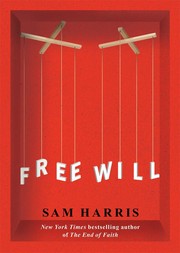
Harris argues that no one is the ultimate author of their thoughts or actions. Whether events are determined by prior causes or include randomness, neither possibility supplies the kind of self-originating control usually meant by “free will.” Accepting this should weaken blame and retribution without eliminating deliberation, accountability, prevention, or political freedom.
Overview
The book is a short, deliberately provocative argument rather than a survey of the free-will literature. Harris begins with the everyday experience of choosing, then asks where thoughts, motives, and intentions come from. His answer is that they appear in consciousness as the result of brain states, biology, history, and circumstance. Neuroscience is used to challenge the idea that conscious intention is the independent initiator of action; meditation and introspection are used to show that thoughts cannot simply be summoned at will. He then applies the position to moral judgment, criminal justice, personal achievement, and social policy. The 2012 Free Press edition is roughly 83–96 pages, depending on cataloguing and format.
Core ideas
The conscious self is not the ultimate author
You can choose what to think about, but you do not choose the thoughts, desires, or intentions that initially arise. Harris treats this gap between awareness and authorship as central: consciousness witnesses and evaluates mental events, but does not originate them from nowhere.
Determinism and randomness both fail to create free will
If a decision is fully caused by prior conditions, you did not ultimately choose those conditions. If it is partly random, randomness is not authorship either. Harris therefore rejects the attempted escape from determinism through indeterminacy.
Neuroscience supports, but does not alone establish, his case
Harris discusses experiments in which measurable brain activity precedes subjects’ reported awareness of deciding. He presents these findings as evidence that conscious intention may follow rather than initiate action. The broader argument, however, depends more fundamentally on his philosophical analysis of authorship and control.
Moral responsibility should become less retributive
If people are shaped by genes, brains, upbringing, and circumstances they did not choose, hatred and the desire to make offenders suffer become harder to justify. Harris still supports protecting society, discouraging harmful behavior, rehabilitation where possible, and assigning consequences based on future effects rather than metaphysical desert.
Causation remains important even without ultimate freedom
Rejecting free will does not mean that reasoning, effort, education, punishment, or encouragement are useless. They are among the causes that influence later behavior. The practical distinction is between changing conduct and expressing vengeance.
Political freedom is a different issue
Harris does not recommend political passivity or coercion. The absence of ultimate free will does not make imprisonment, civil liberties, or democratic institutions irrelevant; people still experience coercion and benefit from conditions that expand their effective options.
The argument aims at compassion and humility
Luck becomes morally salient: people differ in temperament, opportunity, intelligence, health, and restraint partly because of factors beyond their control. Harris thinks this should reduce pride, contempt, and personal hatred while preserving the motivation to improve oneself and society.
Practical takeaways
- When judging yourself or someone else, separate three questions: What caused the behavior? How can it be changed? What response best protects and improves future outcomes?
- Treat thoughts and impulses as events to examine rather than commands or proof of character.
- Use consequences instrumentally—deterrence, protection, rehabilitation, boundary-setting—not primarily to make someone suffer because they “deserve” it.
- Keep making plans and weighing reasons: deliberation matters as a causal influence even if it is not uncaused authorship.
- Notice the role of luck in achievement and failure; this can support gratitude without requiring fatalism.
- Preserve the distinction between philosophical free will and ordinary freedom from coercion, oppression, or constraint.
Caveats and counterpoints
- Harris targets a strong, libertarian notion of free will: the idea that a person could have been the ultimate source of an action while holding the same prior conditions. Compatibilist philosophers argue that this is not the only useful definition; they identify freedom with acting through one’s reasons, values, and capacities, even when those have causes. A major criticism is that Harris does not fully engage this alternative.
- The cited neuroscience experiments do not by themselves prove that conscious reasoning is causally irrelevant. Early neural signals may reflect preparation, bias, or task-specific processes rather than a completed decision, and the philosophical conclusion exceeds what any single experiment can establish. The book’s core case is therefore partly conceptual, not simply a scientific finding.
- Harris’s proposed shift from retribution to prevention is persuasive as a direction but leaves difficult policy questions open: proportionality, rights, deterrence, rehabilitation, incapacitation, and how to distinguish dangerousness from mere social disapproval.
- The book sometimes moves quickly from “conscious choice is not the first cause” to “free will is an illusion.” Critics can accept that conscious decisions have unconscious and environmental causes while maintaining that reflective self-control is a real, graded capacity rather than an impossible absolute.
- A later academic review argues that Harris gives insufficient attention to how accepting or rejecting free will affects the predictability of human action—an issue relevant to both psychology and policy.
Questions worth revisiting
- Am I persuaded by Harris’s definition of free will, or do I prefer a compatibilist account based on reasons-responsive self-control?
- Which parts of my current character and circumstances are luck rather than achievement?
- Can a justice system reject metaphysical desert while still using punishment fairly and humanely?
- If all deliberation is caused, what exactly is lost by calling deliberation “agency”?
- Would widespread disbelief in free will reliably produce compassion, or could it also encourage fatalism and reduced effort?
- How much of Harris’s conclusion rests on neuroscience, and how much would remain if the experiments he cites were weakened?
Return to this when…
Return to this book when thinking about blame, resentment, criminal justice, addiction, meditation, or the relationship between neuroscience and moral responsibility. Pair it with a compatibilist response—especially Daniel Dennett’s account of freedom—to test whether Harris has disproved free will generally or mainly one particular conception of it.
Highlights
I generally start each day with a cup of coffee or tea—sometimes two. This morning, it was coffee (two). Why not tea? I am in no position to know. I wanted coffee more than I wanted tea today, and I was free to have what I wanted. Did I consciously choose coffee over tea? No. The choice was made for me by events in my brain that I, as the conscious witness of my thoughts and actions, could not inspect or influence. Could I have “changed my mind” and switched to tea before the coffee drinker in me could get his bearings? Yes, but this impulse would also have been the product of unconscious causes. Why didn’t it arise this morning? Why might it arise in the future? I cannot know. The intention to do one thing and not another does not originate in consciousness—rather, it appears in consciousness, as does any thought or impulse that might oppose it.
References
- FREE WILL | Kirkus Reviews
- Free will determines the limits of psychological foresight: Review of “Free Will” by Sam Harris - Grüning - 2023 - FUTURES & FORESIGHT SCIENCE - Wiley Online Library
- openlibrary.org
- Free Will | Book by Sam Harris | Official Publisher Page | Simon & Schuster
- en.wikipedia.org
- researchgate.net
- rationalrealm.com
- Sam Harris | Home of the Making Sense Podcast
- arxiv.org
- pmc.ncbi.nlm.nih.gov
- books.google.com
- philpapers.org