
In one sentence
Marketing is increasingly inseparable from product design: instead of relying mainly on advertising or dramatic performance improvements, create a small, surprising benefit that people want to notice and discuss. The difficult work is not only finding the idea, but championing it inside an organization and bringing it to market.
Overview
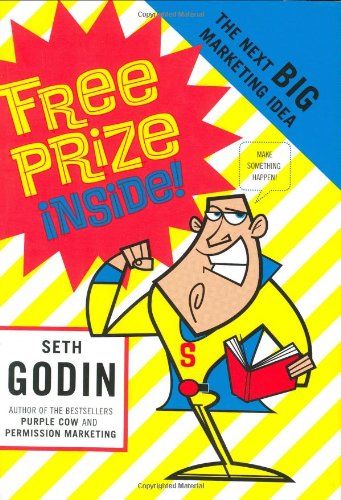
Godin uses the cereal-box toy as the central metaphor. A “free prize” is an extra feature, experience, convenience, or emotional benefit that makes an offering more attractive and talk-worthy—not necessarily something customers need or something that improves the product’s main performance. The book then shifts from idea generation to implementation: how to choose feasible innovations, build prototypes, recruit support, and overcome organizational fear. Godin presents the book as a practical sequel to Purple Cow, aimed at readers who accept the case for remarkability but need tactics for acting on it.
Core ideas
A free prize is a soft innovation
The differentiator may be small rather than technically superior: a delightful extra, a memorable service detail, an unusual package, a convenience, or an emotional cue. It should create enough perceived value or curiosity that customers notice and may tell others. Godin distinguishes this from merely fixing defects or adding more of the core function.
Remarkability beats undifferentiated advertising
In a crowded market, advertising must repeatedly buy attention, whereas a talk-worthy product can generate voluntary word of mouth. The claim is not that advertising becomes irrelevant, but that promotion cannot rescue an offering that gives people little reason to care or talk.
Use edgecraft instead of vague brainstorming
Rather than asking for random creative ideas, examine specific dimensions of the offering—such as speed, visibility, convenience, safety, audience, packaging, hours, or emotional tone—and push one dimension unusually far. The method is iterative: identify an edge, explore its consequences, and test whether the result is noticeable and feasible.
Choose an executable edge
The most spectacular idea is not automatically the best idea. Godin emphasizes matching the innovation to the organization’s actual resources, reach, authority, and ability to deliver consistently. A modest idea that can be implemented well is more valuable than an ambitious idea that remains a presentation.
Innovation requires internal selling
A promising idea competes with budgets, habits, status concerns, and fear of failure. The book therefore treats persuasion as part of marketing: find a champion, make the idea concrete with a prototype, start with a manageable test, and give colleagues a way to participate without feeling reckless. Godin specifically recommends team discussion and shared language.
Make the difference easy to explain
A free prize works best when customers can quickly understand why it is interesting and when employees can communicate it consistently. Novelty alone is insufficient: the feature must matter to a defined audience and fit the story people are likely to tell about the product.
Practical takeaways
- Audit an existing product or service for one inexpensive addition that customers would find fun, useful, reassuring, status-enhancing, or surprising.
- Map possible edges across the whole experience—not just the product: purchase, onboarding, delivery, packaging, support, pricing, timing, and follow-up.
- Select one audience that is likely to notice and care. Do not design a supposedly remarkable feature for everyone.
- Push one differentiating dimension far enough to be unmistakable; half-measures often consume resources without creating notice.
- Prototype the idea before seeking broad approval. A concrete demonstration lowers the organization’s perceived risk.
- Frame the proposal around customer behavior and word of mouth, not only internal efficiency or feature specifications.
- Run a small test with a clear signal: recognition, adoption, referral, repeat purchase, or unsolicited discussion.
- Treat implementation and internal advocacy as part of the marketing plan, not as administrative work after the idea is finished.
Caveats and counterpoints
- The book’s central concepts are useful heuristics, but critics argue that labels such as “free prize,” “Purple Cow,” and “edgecraft” can blur different activities—product improvement, promotion, service design, and organizational change.
- A talk-worthy extra does not guarantee profitable demand. Novelty can attract attention without improving retention, willingness to pay, trust, or long-term brand fit.
- The word-of-mouth model depends on audience motivation and social context; not every customer wants to share purchases, and some categories require reliability, compliance, or discretion more than surprise.
- The book is from 2004. Its critique of mass advertising remains conceptually relevant, but its examples and assumptions about media, distribution, and digital sharing should be translated rather than copied directly. The publisher lists the original publication as May 11, 2004.
- “Go to the edge” can become expensive or gimmicky if the chosen dimension is unrelated to customer value. The useful test is not extremeness by itself, but whether the change is meaningful, deliverable, and memorable.
Questions worth revisiting
- What part of our customer experience is ordinary because we designed it that way—and what part is ordinary because nobody has reconsidered it?
- Which audience would notice and value a small extra most strongly?
- What single dimension could we push far enough to become unmistakable?
- Can we explain the idea in one sentence without relying on Godin’s terminology?
- What prototype or low-risk experiment would reveal whether people actually care?
- Who inside the organization has enough credibility and persistence to champion the idea?
- Are we creating genuine customer value, or merely manufacturing a gimmick that earns attention once?
Return to this when…
Return to this book when a team is stuck trying to compete through incremental feature improvements, larger advertising budgets, or generic brainstorming. Revisit the “edgecraft” process when you need a distinctive concept, and the implementation sections when the main obstacle is organizational hesitation rather than lack of ideas.
References
- goodreads.com
- Free Prize Inside!: The Next Big Marketing Idea by Seth Godin
- Free Prize Inside – Seth’s Store
- blueskyonmars.com
- Free Prize Inside - Seth Godin - Flipbook by Business & Self Development | FlipHTML5
- Q&A: Where is the free prize inside? | Seth's Blog
- books.apple.com
- Free Prize Inside by Seth Godin: 9781591841678 | PenguinRandomHouse.com: Books
- goodreads.com
- books.google.com
- audiofilemagazine.com
- Seth Godin’s last book, Purple Cow, was the #1