
In one sentence
Look past stated motives and surface correlations: behavior is often shaped by incentives, constraints, information, and institutional design. The book’s method is to ask an unexpected question, find unusually revealing data, and test whether the apparent cause is really causing the outcome.
Overview
This is an eclectic set of case studies rather than a single sustained theory. Topics include teacher and student cheating, sumo wrestling, real-estate incentives, the economics of drug gangs, crime trends, parenting and school performance, distinctive names, and discrimination. The recurring perspective is applied microeconomics: use evidence to expose mechanisms hidden by conventional stories.
Core ideas
Incentives often explain more than intentions
People may describe their behavior in moral or professional terms, but the payoff structure can point elsewhere. Teachers with access to answer sheets, wrestlers facing uneven tournament incentives, real-estate agents paid on commission, and office workers using an honor system respond to what is rewarded, penalized, or easy to conceal.
Correlation is not causation
A central analytical task is separating cause from effect. More police may appear alongside more crime because crime leads to hiring; the book looks for outside events—such as election-driven police expansion—that help isolate causal effects. The authors present this work as creative empirical reasoning rather than automatic statistical certainty.
Information is unevenly distributed
When one party knows more than another, incentives change. The real-estate example suggests agents may devote less effort to maximizing a client’s price than to completing a sale, because their personal gain from a higher price is small relative to the additional work.
Markets can reward extreme inequality
The crack-gang case portrays street-level dealers as poorly paid workers competing for a chance at concentrated rewards near the top. A large headline income can coexist with low expected earnings for most participants—an important distinction when evaluating “lucrative” occupations.
Unexpected data can challenge comfortable explanations
The authors repeatedly replace broad cultural explanations with narrower, testable mechanisms—for example, relating achievement gaps to family resources and school environments, and treating names as signals of socioeconomic background rather than simple causes of later outcomes. These interpretations are arguments to investigate, not universal laws.
Narrative makes empirical reasoning memorable—and risky
Dubner’s journalistic storytelling turns technical research into vivid puzzles, which helps readers remember the method. It can also make a striking result feel more conclusive than the underlying evidence warrants; the persuasive story should not substitute for checking definitions, samples, assumptions, and alternative explanations.
Practical takeaways
- When evaluating a claim, ask: Who benefits, who bears the cost, and what behavior does the current system reward?
- Look for the relevant counterfactual: what would likely have happened without the policy, incentive, information, or event being credited with the outcome?
- Distinguish average outcomes from distribution: a profession or market can be highly profitable at the top while most participants earn little.
- Treat impressive correlations as leads, not conclusions. Search for reverse causation, omitted variables, selection effects, and competing mechanisms.
- For personal decisions, identify the incentive that is easiest to ignore—such as convenience, status, delayed rewards, or the cost imposed on someone else.
- Use provocative examples to generate questions, not to replace domain expertise or broader evidence.
Caveats and counterpoints
- The book’s most controversial argument links legalized abortion to the later decline in U.S. crime. It was presented as a causal explanation, but its sensitivity and methodological contestability mean it should not be remembered as settled fact.
- The chapters are selective case studies, often built around unusually interesting datasets. They demonstrate a way of thinking more reliably than they establish general rules about parenting, education, crime, race, or markets.
- Some arguments move quickly from statistical association to social interpretation. The scholarly review notes unresolved tensions—for example, around when school quality appears to matter—and criticizes the book’s occasional lack of reconciliation between claims.
- The book’s contrarian framing can overcorrect against conventional wisdom. A surprising explanation is not automatically better; it still needs replication, sound measurement, and comparison with institutional and historical evidence.
- The treatment of race, names, and discrimination can be read too narrowly if socioeconomic signals are treated as alternatives to racism rather than overlapping mechanisms. Use the analyses as hypotheses requiring careful context.
Questions worth revisiting
- Which claim in the book depends most heavily on a particular dataset or identification strategy?
- Where does the incentive explanation illuminate behavior, and where might norms, identity, power, or institutional history matter just as much?
- What evidence would distinguish a causal mechanism from a compelling post hoc story?
- When does making an incentive visible improve behavior, and when might it crowd out intrinsic motivation or trust?
- Which conclusions would you expect to change across countries, time periods, or different legal institutions?
- Can you apply the book’s method to one everyday system you use: identify its players, payoffs, information gaps, and unintended consequences?
Return to this when…
Return to this book when you need a reminder to question obvious explanations, inspect incentive structures, and separate correlation from causation. Revisit the caveats before using any headline claim—especially the crime, abortion, education, or discrimination arguments—as evidence in a present-day policy debate.
Highlights
But just because two things are correlated does not mean that one causes the other. A correlation simply means that a relationship exists between two factors—let’s call them X and Y—but it tells you nothing about the direction of that relationship. It’s possible that X causes Y; it’s also possible that Y causes X; and it may be that X and Y are both being caused by some other factor, Z.
Consider the folktale of the czar who learned that the most disease-ridden province in his empire was also the province with the most doctors. His solution? He promptly ordered all the doctors shot dead.
Here’s the surprise: the amount of money spent by the candidates hardly matters at all. A winning candidate can cut his spending in half and lose only 1 percent of the vote. Meanwhile, a losing candidate who doubles his spending can expect to shift the vote in his favor by only that same 1 percent. What really matters for a political candidate is not how much you spend; what matters is who you are.
Economics is, at root, the study of incentives: how people get what they want, or need, especially when other people want or need the same thing.
So a big part of a real-estate agent’s job, it would seem, is to persuade the homeowner to sell for less than he would like while at the same time letting potential buyers know that a house can be bought for less than its listing price.
So the conventional wisdom in Galbraith’s view must be simple, convenient, comfortable, and comforting—though not necessarily true. It would be silly to argue that the conventional wisdom is never true. But noticing where the conventional wisdom may be false—noticing, perhaps, the contrails of sloppy or self-interested thinking—is a nice place to start asking questions.
The delicate balance between these factors helps explain why, for instance, the typical prostitute earns more than the typical architect. It may not seem as though she should. The architect would appear to be more skilled (as the word is usually defined) and better educated (again, as usually defined). But little girls don’t grow up dreaming of becoming prostitutes, so the supply of potential prostitutes is relatively small. Their skills, while not necessarily “specialized,” are practiced in a very specialized context. The job is unpleasant and forbidding in at least two significant ways: the likelihood of violence and the lost opportunity of having a stable family life. As for demand? Let’s just say that an architect is more likely to hire a prostitute than vice versa.
The “Moratorium” argument rests on a fundamental confusion of correlation and causality. Consider a parallel argument. The mayor of a city sees that his citizens celebrate wildly when their team wins the World Series. He is intrigued by this correlation but, like the “Moratorium” author, fails to see the direction in which the correlation runs. So the following year, the mayor decrees that his citizens start celebrating the World Series before the first pitch is thrown—an act that, in his confused mind, will ensure a victory.
The broken window theory argues that minor nuisances, if left unchecked, turn into major nuisances: that is, if someone breaks a window and sees it isn’t fixed immediately, he gets the signal that it’s all right to break the rest of the windows and maybe set the building afire too.
Why? Because regulation of a legal market is bound to fail when a healthy black market exists for the same product. With guns so cheap and so easy to get, the standard criminal has no incentive to fill out a firearms application at his local gun shop and then wait a week.
So which should we actually fear more, flying or driving? It might first help to ask a more basic question: what, exactly, are we afraid of? Death, presumably. But the fear of death needs to be narrowed down. Of course we all know that we are bound to die, and we might worry about it casually. But if you are told that you have a 10 percent chance of dying within the next year, you might worry a lot more, perhaps even choosing to live your life differently. And if you are told that you have 10 percent chance of dying within the next minute, you’ll probably panic. So it’s the imminent possibility of death that drives the fear—which means that the most sensible way to calculate fear of death would be to think about it on a per-hour basis.
textbook author named Judith Rich Harris. The Nurture Assumption was in effect an attack on obsessive parenting, a book so provocative that it required two subtitles: Why Children Turn Out the Way They Do and Parents Matter Less than You Think and Peers Matter More. Harris
Correlation is nothing more than a statistical term that indicates whether two variables move together. It tends to be cold outside when it snows; those two factors are positively correlated. Sunshine and rain, meanwhile, are negatively correlated. Easy enough—as long as there are only a couple of variables. But with a couple of hundred variables, things get harder. Regression analysis is the tool that enables an economist to sort out these huge piles of data. It does so by artificially holding constant every variable except the two he wishes to focus on, and then showing how those two co-vary.
After all, there are several ways in which two variables can be correlated. X can cause Y; Y can cause X; or it may be that some other factor is causing both X and Y.
A regression alone can’t tell you whether it snows because it’s cold, whether it’s cold because it snows, or if the two just happen to go together.
But this is not to say that parents don’t matter. Plainly they matter a great deal. Here is the conundrum: by the time most people pick up a parenting book, it is far too late. Most of the things that matter were decided long ago—who you are, whom you married, what kind of life you lead. If you are smart, hardworking, well educated, well paid, and married to someone equally fortunate, then your children are more likely to succeed. (Nor does it hurt, in all likelihood, to be honest, thoughtful, loving, and curious about the world.) But it isn’t so much a matter of what you do as a parent; it’s who you are. In this regard, an overbearing parent is a lot like a political candidate who believes that money wins elections—whereas in truth, all the money in the world can’t get a candidate elected if the voters don’t like him to start with.
References
- kirkusreviews.com
- goodreads.com
- challies.com
- ischoolonline.berkeley.edu
- joycehopkins.com
- goodreads.com
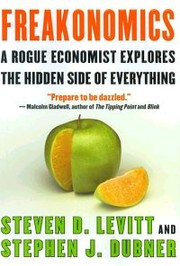
- FREAKONOMICS: A Rogue Economist Explores the Hidden Side of Everything by Steven D. Levitt, Stephen J. Dubner
- verysmalldreams.com
- unsolicitedfeedback.blog
- freakonomics.com
- ideaexchange.bibliocommons.com
- proquest.com
- princeton.edu