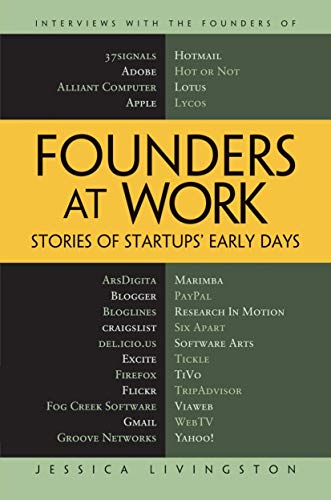

In one sentence
The book’s central lesson is that successful startups rarely begin as fully formed business plans. They emerge through technical curiosity, experimentation, persistence, opportunistic changes in direction, and unusually committed people. The interviews collectively suggest that founder judgment and adaptability matter more than following a standardized startup formula—but the evidence is retrospective and heavily shaped by success stories.
Overview
Livingston organizes the book as firsthand conversations rather than a conventional argument. The subjects describe how they found initial problems, built early versions, attracted users or customers, recruited collaborators, raised money, handled competition, and responded to setbacks. The roster spans consumer internet, enterprise software, hardware, media, and web infrastructure; it includes founders as well as Yahoo’s first non-founding employee.
Core ideas
Start with something technically or personally compelling
Many ventures began because the founders wanted to solve a problem, explore a technology, or build something they themselves found interesting—not because they had completed market research. Intrinsic interest helped sustain effort before the opportunity was obvious.
The initial idea is often only a starting point
The companies’ eventual products and markets frequently differed from their founders’ first concept. Early users, technical constraints, and unexpected applications helped reveal what the business could become. Treat the first plan as a hypothesis rather than a commitment.
Build and learn through real use
The interviews repeatedly emphasize working software, prototypes, demos, and early customers over elaborate planning. Direct contact with users exposes what is valuable, what is confusing, and which features or markets deserve continued investment.
Persistence is practical, not merely inspirational
Founders endured technical failures, weak initial demand, financing uncertainty, cofounder disagreements, and pressure from larger competitors. Persistence mattered because it created more opportunities to learn—but persistence was productive when paired with adaptation, not stubborn repetition.
Small teams can move with exceptional speed
Early-stage advantages often came from compact groups with strong technical ownership and short communication paths. Hiring too quickly, adding organizational layers, or separating decision-makers from the product could reduce the speed and clarity that made the startup viable.
Distribution and business model are discovered alongside the product
A technically impressive product still needs a way to reach users and generate value. Several stories show founders experimenting with pricing, partnerships, sales channels, viral mechanisms, or platform strategy rather than knowing the business model in advance.
Fundraising follows evidence, credibility, and timing
The conversations portray financing as dependent on relationships, reputation, market conditions, convincing demonstrations, and investor fit. Capital can accelerate a promising company, but it also introduces dilution, expectations, and pressure to grow before the product is ready.
Luck and historical timing are major causal factors
The outcomes depended on shifts in hardware, the internet, software platforms, regulation, competition, and access to influential networks. Founder skill is important, but the interviews do not support treating success as fully controllable or reproducible.
Practical takeaways
- Identify a problem or technical question you can stay engaged with before external validation arrives.
- Build the smallest usable version that can generate informative feedback.
- Watch what early users actually do; their behavior may reveal a better product or market than your stated plan.
- Keep the founding team small enough for rapid decisions, but make roles, ownership, and expectations explicit.
- Treat fundraising as a strategic tradeoff, not an automatic milestone.
- When changing direction, preserve the underlying insight or capability that gives the team an advantage.
- Separate principles from anecdotes: copy the reasoning behind a decision, not the visible outcome.
- Record assumptions, experiments, user evidence, and major decisions so later success does not rewrite the company’s history.
Caveats and counterpoints
- This is a collection of retrospective interviews, not a controlled study of startups. Successful founders are overrepresented, while comparable companies that failed or made similar choices without succeeding are largely absent.
- The interview format gives founders authority over their own narratives, but memory, hindsight, self-presentation, and selective emphasis can distort causality.
- The examples are concentrated in technology startups and largely reflect the personal-computing and internet environment of the 1980s–2000s. Their tactics may not transfer directly to regulated, capital-intensive, local, or nontechnical businesses.
- The book’s variety is valuable but also means there is no single validated playbook. Some subjects favor bootstrapping and patience; others benefit from venture capital, rapid expansion, or fortunate market timing.
- Success stories can encourage survivorship bias: unconventional behavior appears wise in retrospect because the companies survived. The same behavior may be reckless when resources, timing, or market conditions differ.
Questions worth revisiting
- Which decisions in these stories were genuinely repeatable practices, and which depended on unusually favorable timing?
- What would the same interviews look like if they included founders whose companies failed despite competent execution?
- What evidence would convince me to change the product, market, team, or financing strategy?
- Am I building because users urgently value the result, or because the technology is personally fascinating?
- Which constraints in my situation make the book’s technology-startup examples poor analogies?
Return to this when…
Return to these notes when starting a product, evaluating founder advice, or feeling pressure to imitate a famous startup’s path. Revisit especially the distinction between transferable habits—build, observe, adapt, communicate—and nontransferable outcomes such as timing, network access, market structure, and luck.
Highlights
They all were determined to build things that worked. In fact, I'd say determination is the single most important quality in a startup founder. If the founders I spoke with were superhuman in any way, it was in their perseverance. That came up over and over in the interviews.
Perseverance is important because, in a startup, nothing goes according to plan. Founders live day to day with a sense of uncertainty, isolation, and sometimes lack of progress. Plus, startups, by their nature, are doing new things—and when you do new things, people often reject you.
Levchin: No, because I think we didn't know what we were doing. I think the hallmark of a really good entrepreneur is that you're not really going to build one specific company. The goal—at least the way I think about entrepreneurship—is you realize one day that you can't really work for anyone else. You have to start your own thing. It almost doesn't matter what that thing is. We had six different business plan changes, and then the last one was PayPal.
Bhatia: While we were putting the business plan for JavaSoft together and were working at FirePower Systems, they installed a firewall around our corporate intranet that prevented us from dialing out to our personal email accounts. I had an account at Stanford and Jack had one at AOL, so we would dial out and email each other. But we couldn't do that anymore because the firewall prevented us from accessing our personal accounts. So we ended up exchanging information on floppy disks and on physical pieces of paper. That's when it occurred to us, "Wait a minute, we can access any website in the world through a web browser. If we made email available through the web browser, that would solve our problem." And then it occurred to us, "If that would solve our problem, it would solve the problems of many others." We didn't know how many others, but email was something that everyone used. To provide ubiquitous access to that email from any web browser from anywhere in the world was the killer idea.
Bhatia: The general piece of advice, which is fairly mundane and oft repeated, is: make sure you write a business plan because it will crystallize your thoughts to communicate your ideas with somebody else. Make sure that once you have written your business plan, you have somebody read and critique it and ask you questions. It doesn't have to be a cookie-cutter business plan with glossy pages and lots of information. Essentially it's a plan that says what the company is going to do, what problem it is going to solve, how big the market is, what the sources of revenue for the company are, what your exit strategy is for your investors, what amount of money is required, how you are going to market it, what kind of people you need, what the technology risks are, marketing risks, execution risks. Those are the fundamentals of what goes into a business plan, and many people have it in their heads but don't write it down. Second is, don't try to change user behavior dramatically. If you are expecting people to dramatically change the way they do things, it's not going to happen. Try to make it such that it's a small change, yet an important one. For example, the reason that Hotmail succeeded was because people were accustomed to going to different websites. All they had to do was put in their name and password and a little bit of information and they got an email account. So in that regard, it was the ease of use of getting online and having an identity. The other reason why Hotmail became kind of like its own phenomenal PR was every time somebody sent an email out, it was sent from @hotmail.com. That's of huge branding value, to have that moniker in people's email IDs. So when people would give a business card to somebody that said @hotmail.com, it perpetuated the brand.
Steve knew Ron at Atari and liked him. Ron was a super-conservative guy. I didn't know anything about politics of any sort; I avoided it. But he had read all these right-wing books like None Dare Call it Treason, and he could rattle the stuff off. I didn't realize it until later.
Kraus: No, it was never clear that we were on to something huge. You never know anything. The hardest part in a startup is that you wake up one morning, and you feel great about the day, and you think, "We're kicking ass." And then you wake up the next morning, and you think "We're dead." And literally nothing's changed. You haven't made some big deal, you haven't sold something new. Maybe you wrote a few lines of code over the course of that last day. Maybe you had some conversations with people, but nothing's really moved.
Even up to the time when Excite was several hundred people and we were the fourth largest website in the world, it didn't feel real. It doesn't feel like you're really doing something huge. On some level it feels like you're fooling people—like, are we really doing this?
Microsoft made a buyout offer for Excite in late '95, and even then I had Microsoft's CTO, Nathan Myhrvold, yelling at me, "Search is not a business. People are just going to search a few times and then bookmark what they want to go to."
Livingston: You felt there was the threat of the larger companies with deep pockets getting into the space? Kraus: Right, and they never did. When Microsoft made its buyout offer for Excite in late 1995, they offered about $70 million. We'd just launched in October '95 and they're offering $70 million. We said no, and we told them the number needed to be more like $100 million. And apparently what happened is—and I only learned this story recently—the negotiator we were working with went back to Gates and said, "I think the number's going to be $100 million if we want to do this." And Gates said, "How much would it cost us to do it ourselves?" So the guy went away and built a plan and said it would be about a year and $25 million and 25 people or something like this. And the interesting thing is that they didn't buy Excite for the $100 million, and they didn't invest and build it themselves. Instead they did nothing. Which is really interesting to me in terms of the longer-term history of Microsoft and the search wars. It's interesting that MCI and AT&T and these guys never got into the business.
That was what helped launch the company. It's so ironic. If you look at the way that a lot of huge companies get built ... Microsoft built itself off IBM, unwittingly. Excite built itself unwittingly off Netscape. Google built itself unwittingly off Yahoo. I don't think we would have gotten where we got without the Netscape deal and we certainly wouldn't have gotten the Netscape deal without a really valuable lesson in persistence. I see way too many people give up in the startup world. They just give up too easily. Recruiting is a classic example. I don't even hear the first "no" that somebody says. When they say, "No, I'm not interested," I think, "Now it's a real challenge. Now's when the tough part begins." It's hard to identify talent, but great people don't look for jobs, great people are sold on jobs. And if they're sold they're going to say no at first. You have to win them over.
I see way too many people give up in the startup world. They just give up too easily. Recruiting is a classic example. I don't even hear the first "no" that somebody says. When they say, "No, I'm not interested," I think, "Now it's a real challenge. Now's when the tough part begins." It's hard to identify talent, but great people don't look for jobs, great people are sold on jobs. And if they're sold they're going to say no at first. You have to win them over. For example, we had this VP of marketing that I worked to get for about 3 months. He was the former VP of marketing at QVC. He called me literally the day before he was supposed to move out to California and said, "I can't do it." I said, "Well, we're going to have dinner tonight, so I'm coming out to New York." I got on a plane and went to New York and sat down with him. And I got really lucky: we're at the restaurant and we were quiet for a second and you could hear people talking about the Net. They were talking about Hotmail and AOL and the Internet boom going on. So I said, "Look, these people aren't talking about home shopping, they're talking about the Internet. So your choice is, 'Do you want to be part of the past or do you want to be part of the future?'" I love this stuff; the persistence part is the part that I like. It's actually not fun when it's happening, but you know it makes a difference because 99.9 percent of the people give up. And Vinod gave me that lesson in spades. I think I would have given up with Netscape. I wouldn't have known what to do. I wouldn't have had the chutzpah to just say, "No, we haven't lost, we're still negotiating, aren't we?" And treating it as if I didn't hear their "no." It was very unfamiliar to me originally.
Venture capitalists, with the exception of people like Don Valentine, would tell you that they'd rather fund a great team than a great idea. The reason is that if they have a bad idea, great teams can figure out a better one. Mediocre people even with a great idea can screw it up in its execution. Or if they have a bad idea, then they aren't going to be in a position to think about how to change it. They're just going to pursue it blindly.
One is hiring slowly and more carefully. Another is be cheap, cheap, cheap. Also, get the legs of the business underneath it before you run terribly fast. We were always playing catch-up at Excite and I never liked that feeling. You always felt like the traffic, the momentum, the deals were all ahead of where the business naturally was. You want to be ahead of where it naturally is, but you don't want to be two times ahead of it. So, I think really taking the time to understand the dynamics of the business, so we can scale it, is important, along with being cheap and hiring well.
References
- Founders at Work: Stories of Startups' Early Days | Springer Nature Link
- link.springer.com
- en.wikipedia.org
- openlibrary.org
- books.google.com
- Contents at a Glance - Founders at Work: Stories of Startups' Early Days Book
- search.worldcat.org
- books.google.co.uk
- oreilly.com
- books.google.co.uk
- openlibrary.org
- openlibrary.org