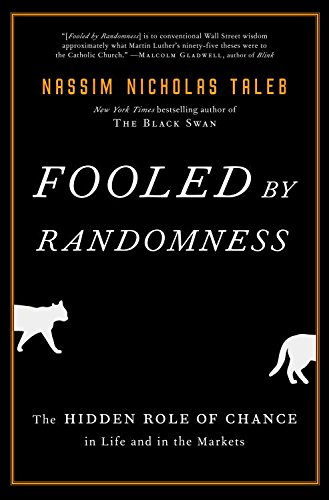

In one sentence
We systematically mistake random outcomes for meaningful patterns, especially when evaluating success. Because we see winners more readily than failures and explain events retrospectively, luck often masquerades as skill. Better judgment requires examining alternative histories, respecting uncertainty, and judging decisions by their process and risk—not by a single outcome.
Overview
Taleb combines probability, epistemology, psychology, and stories from trading to challenge confidence in expertise and prediction. The market is his clearest example: a trader may achieve an excellent record through favorable chance, while hidden risks remain. The same error appears in careers, business, biography, journalism, and everyday explanations of cause and effect.
Core ideas
Luck is easily mistaken for skill
A good result does not by itself demonstrate a good method. In a noisy environment, some people will accumulate impressive records merely because chance favored them. The visible success of survivors can create the illusion that their strategy was reliably effective.
Survivorship bias hides the losers
We study successful traders, companies, and careers because they remain visible; failed counterparts disappear from the sample. This makes success stories look more instructive and repeatable than they really are. Ask: who followed the same approach and vanished?
The narrative fallacy
After an event, people assemble a coherent story linking its causes. The story feels explanatory because it is orderly, not because it is true. Retrospective clarity should not be confused with genuine foresight.
Alternative histories matter
To evaluate a decision, imagine plausible paths that did not occur. A reckless decision can produce a profitable outcome; a careful decision can lose money. The relevant question is whether the choice was defensible given the information and risks available at the time.
Probability is not the same as certainty
Uncertainty does not disappear because someone supplies a precise forecast. Numerical confidence can conceal weak assumptions, limited data, or an inappropriate model. Taleb is particularly suspicious of financial models that understate rare, consequential events.
Randomness is psychologically uncomfortable
Humans prefer agency, causation, and patterns. We therefore overinterpret streaks, attribute outcomes to personality, and treat noise as information. Taleb’s broader philosophical point is that intellectual humility begins with recognizing how poorly intuitive reasoning handles chance.
Process should outrank outcome
A track record is evidence, but not decisive proof of ability—especially when observations are few, outcomes are highly variable, or risks are asymmetric. Evaluate incentives, exposure to ruin, hidden losses, and whether the method would survive unfavorable luck.
Practical takeaways
- When assessing a success story, look for the missing failures and the role of favorable timing.
- Separate the quality of a decision from the result it happened to produce.
- Use base rates and outside-view comparisons before accepting a compelling personal narrative.
- Treat short track records with suspicion, particularly in markets and other noisy domains.
- Ask what could produce a good outcome by luck alone; if the answer is “many things,” lower your confidence.
- Prefer strategies with limited downside and avoid situations where one rare event can erase years of gains.
- Record predictions and decisions before outcomes occur so later explanations cannot quietly rewrite your reasoning.
- Be cautious with experts whose authority rests mainly on past success rather than transparent process and appropriate risk-taking.
Caveats and counterpoints
- The book’s central warning is valuable, but Taleb’s rhetoric can be more sweeping than his demonstrations. Critics have noted that his combative, anecdotal style sometimes substitutes personal heuristics for systematic evidence; this is a criticism of presentation and generalization, not a refutation of the core problem of survivorship bias.
- Randomness does not mean that skill is absent. In some domains, repeated performance, mechanism-based explanations, and controlled evidence can distinguish expertise from luck; the practical challenge is determining how much signal exists and how much data is needed.
- The book is strongest as a corrective to overconfidence and retrospective storytelling, not as a complete theory of markets or a universal rule that every success is mostly luck.
- Taleb’s market examples may encourage excessive skepticism if applied indiscriminately. Avoiding all inference or prediction is not possible; the better response is calibrated confidence, explicit assumptions, and attention to downside risk.
Questions worth revisiting
- Where in my life am I judging people mainly by outcomes rather than by decision quality?
- Which visible successes am I studying without accounting for comparable failures?
- What would the alternative histories of my recent decisions look like?
- Which risks are small and frequent, and which are rare but potentially ruinous?
- How much evidence would change my mind about someone’s skill or a strategy’s effectiveness?
- Am I using a compelling explanation because it is supported—or because it is emotionally satisfying?
- What would I do differently if I assumed my current track record contains more luck than I think?
Return to this when…
Return to these notes when evaluating an impressive career, investment record, prediction, business success, or your own recent results—especially when the explanation feels obvious only after the outcome is known.