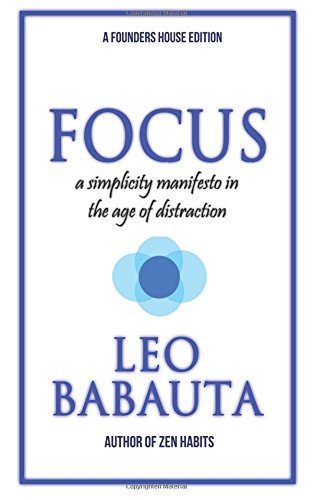

In one sentence
Focus is less a matter of forcing concentration than of removing competing claims on attention. By simplifying what you do, when you do it, and what you allow into your environment, you can protect time for creation, reflection, relationships, and the things that matter most.
Overview
Babauta presents Focus as a practical manifesto rather than a comprehensive productivity system. The book moves from diagnosing the “age of distraction,” through disconnection and distraction management, to simplification, single-tasking, focused reading, and applications for parents and managers. Its recurring prescription is to choose less, work more deliberately, and stop treating constant availability as obligatory.
Core ideas
Attention is lost through competing modes
Babauta distinguishes creating from consuming information and communicating with others. Switching among them may feel productive, but it fragments the creative process. His practical response is to give these activities separate blocks of time rather than mixing them continuously.
Disconnection is a productive choice
Regular periods without email, websites, devices, news, or other streams are not presented as rejection of technology. They restore quiet, solitude, reflection, and direct contact with the immediate world. Technology remains useful when it serves chosen purposes rather than demanding constant response.
Simplify before optimizing
The book’s “less” principle is selective reduction: eliminate unnecessary commitments, clutter, inputs, and goals before trying to manage them more efficiently. Smaller areas of focus make action easier and create more room for what is important.
Single-tasking is the basic operating rule
Choose one task, remove obvious distractions, and stay with it until a meaningful stopping point. Babauta extends this beyond office work to reading, walking, exercise, family time, and other activities that become richer when attention is not divided.
Focus needs rituals and environmental support
A reliable start—such as clearing the workspace, deciding the task beforehand, disconnecting, and working in a defined time window—reduces the need for moment-to-moment willpower. The environment should make the desired behavior easier than checking, browsing, or responding.
Priorities require repeated choosing
Prioritization is not merely making a long list. Babauta emphasizes selecting the few tasks that matter most, focusing on them early or in protected periods, and being willing to let lower-value goals or opportunities go.
The system is social, not purely individual
Parents, coworkers, and managers also shape one another’s attention. Focus therefore involves negotiating expectations, creating interruption-friendly boundaries where possible, and helping workplaces value concentrated work rather than constant responsiveness.
Practical takeaways
- Separate the day into creating, consuming, and communicating blocks; avoid treating all three as one activity.
- Turn off nonessential notifications and check email or messages at deliberate times rather than continuously.
- Begin with one clearly defined task and make the next physical action obvious.
- Keep the workspace and active browser tabs limited to what the current task requires.
- Schedule regular technology-free periods for walking, reading, reflection, exercise, or conversation.
- Use a short priority list instead of trying to advance every project at once.
- When a commitment no longer serves an important aim, practice dropping or postponing it rather than optimizing it.
- Explain your availability rules to others so that disconnection is a shared expectation, not a silent refusal.
Caveats and counterpoints
- The advice is intentionally minimalist and aphoristic; it offers limited empirical evidence and is not a research-based account of attention or multitasking.
- “Disconnecting” is easier for people with autonomy over their schedules. Caregiving, customer service, emergencies, collaborative work, and precarious employment may require genuine responsiveness.
- Separating creation from communication can improve sustained work, but some jobs depend on rapid iteration, coordination, or frequent feedback.
- The book’s examples and technology references come from the early 2010s, so the principle transfers better than the specific tools or social-media assumptions.
- Readers may find the argument repetitive or idealistic; its value is mainly as a reset of priorities and habits, not as a complete time-management framework. Reader summaries likewise note its simplicity and actionability alongside repetition and idealism.
Questions worth revisiting
- Which activity in my day is genuinely creative, and which activities merely prepare for or communicate about it?
- What interruptions are necessary, and which ones have become habitual expectations?
- What could I remove before attempting to organize it?
- What is the smallest meaningful task I can complete with full attention today?
- Where would a recurring disconnection ritual improve my work or relationships?
- Which goal, subscription, obligation, or information stream am I maintaining mainly because I have not chosen to let it go?
Return to this when…
Return when your attention feels scattered, your commitments have multiplied, or you are confusing responsiveness with meaningful progress. The most useful rereading is the sections on disconnection, simplifying, single-tasking, and the “smaller work focus.”
Highlights
“Most of what we say and do is not essential. If you can eliminate it, you’ll have more time, and more tranquillity. Ask yourself at every moment, ‘Is this necessary?” – Marcus Aurelius