
In one sentence
Human activity can be approached either as a finite contest with defined winners, rules, boundaries, and endpoints, or as infinite play whose purpose is to keep play going. Finite games can occur within infinite play, but treating life itself as a contest to be won produces distortion, rigidity, and unnecessary conflict.
Overview
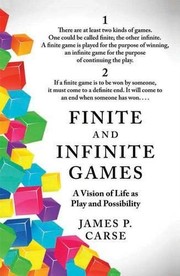
Published originally by Free Press in 1986, the book is a compact, aphoristic work by James P. Carse, a scholar of religion and professor emeritus at New York University. It develops its central distinction through short propositions rather than a conventional linear argument. Carse moves from games and competition into language, culture, nature, religion, sexuality, theatrical performance, evil, science, and mortality.
Core ideas
Finite games seek closure
Finite games have agreed boundaries, rules, participants, and conditions of victory. Their drama depends on seriousness, competition, and an eventual ending: someone wins, someone loses, or the game is otherwise concluded.
Infinite play seeks continuation
Infinite play is open-ended and improvisational. Its participants adapt rules, boundaries, roles, and objectives so that play can continue. The aim is not to defeat every opponent but to invite further participation and possibility.
Finite games are nested
Carse does not simply say that finite games are bad. A finite contest—such as a match, election, negotiation, or professional goal—can be played inside a larger, continuing relationship or culture. The danger is allowing the smaller contest to define the whole context.
Theatrical versus dramatic action
Finite play resembles theater: roles, scripts, costumes, and outcomes are established in advance. Infinite play is more dramatic: participants act without a fully settled script and remain capable of surprise. This distinction helps explain Carse’s contrast between playing a role and generating new possibilities.
Power and freedom
Finite power depends on control, possession, rank, and the ability to impose an outcome. Infinite freedom is less about mastering circumstances than about remaining capable of response, transformation, and renewed participation. Control can therefore become self-defeating when it suppresses the conditions of future play.
Culture and meaning are ongoing
For Carse, language, culture, religion, and inquiry are not objects that can be finally possessed or completed. Their vitality depends on reinterpretation, response, and the arrival of new participants. A definitive explanation may terminate the questioning that gave the activity life.
The infinite player changes the frame
An infinite player can enter finite contests without confusing victory with ultimate purpose. This reframing changes how one handles success, defeat, opponents, rules, and identity: outcomes matter locally, but they need not determine the meaning of the larger life.
Practical takeaways
- When pursuing a goal, ask whether you are trying to win a bounded contest or sustain a valuable activity over time.
- Separate the immediate score from the relationship, institution, craft, or community in which the contest occurs.
- Treat rules as arrangements serving continued play, not automatically as permanent features of reality.
- Notice when status, possessions, or credentials have become ends in themselves rather than temporary instruments.
- In disagreement, preserve the possibility of future conversation; defeating someone may end the exchange without resolving the underlying issue.
- Build practices that welcome revision, newcomers, surprise, and succession rather than depending entirely on your control.
- Use the framework diagnostically, not morally: finite games are useful and sometimes necessary, but they become destructive when mistaken for the whole of life.
Caveats and counterpoints
- The book is philosophical and aphoristic rather than empirical. Its claims are offered as a conceptual lens, not demonstrated through systematic evidence.
- Carse’s definitions are intentionally expansive: he classifies activities such as culture, religion, and language as forms of infinite play. Readers may find the categories illuminating but too loose for precise analysis.
- The finite/infinite contrast can oversimplify mixed situations. Institutions often need both continuity and closure, and some finite contests—law, elections, examinations, or sports—protect fair participation rather than merely expressing domination.
- The book’s style is compressed and sometimes oracular. Kirkus praised the breadth of its observations but criticized the work as ponderous and uneven, with some aphorisms more memorable than others.
- This is not the same project as Simon Sinek’s later business-oriented The Infinite Game. Sinek popularized and extended Carse’s distinction for leadership, while Carse’s original book is broader, more religiously inflected, and more metaphysical.
Questions worth revisiting
- Which of my current goals are genuine finite contests, and which are continuing activities I should not reduce to a score?
- What larger game contains the competition I am currently taking most seriously?
- Where am I defending a rule, identity, or boundary at the expense of continued participation?
- How could I make this relationship, institution, or project more hospitable to newcomers and future revision?
- What would count as success if continuation—not victory—were the governing standard?
Return to this when…
Return to this book when achievement, rivalry, control, or fear of losing has begun to dominate your judgment. Its most useful reminder is not to abandon finite goals, but to place them inside a longer horizon: win when winning is required, without forgetting what must continue after the contest ends.