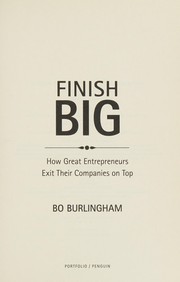

In one sentence
A successful exit is designed long before the owner leaves. The goal is not simply to maximize the sale price, but to create a resilient, valuable company; choose an outcome that fits the founder’s objectives; protect employees and other stakeholders where possible; and prepare for the founder’s own loss of identity, purpose, and structure after departure.
Overview
Burlingham investigates why some entrepreneurs look back on leaving their businesses with satisfaction while others regard the experience as a nightmare. He uses case narratives across industries to compare sales, succession arrangements, gifts, and other forms of exit. The book’s practical framework covers four broad stages—exploration, strategy, execution, and transition—while the publisher describes the lessons as eight key factors; another catalog summary describes them as nine lessons, so the exact count appears to vary by edition or summary.
Core ideas
Start with the end in mind
Exit planning is not an admission that the business will fail or that the founder is giving up. Starting early preserves options, exposes weaknesses, and encourages the owner to build a company that can operate without constant personal intervention. Burlingham’s central practical claim is that a business built to be transferable is often stronger and more valuable.
Define what “finishing big” means for you
Price is only one measure of a good outcome. Founders also care about autonomy during the process, treatment of employees, continuity of the company’s culture, relationships with buyers or successors, and what they will do afterward. A financially attractive deal can still be a bad exit if it violates the owner’s deeper priorities.
Build a transferable company
Reduce dependence on the founder by developing capable managers, documented systems, reliable financial information, diversified customers, and a business model that survives leadership change. This improves both operational resilience and the range of possible exit paths.
Separate exploration from commitment
Early conversations with potential buyers, advisers, family members, and successors can clarify alternatives without forcing an immediate sale. The exploration phase is for discovering goals, constraints, and realistic options; strategy follows once the founder understands what outcome is actually wanted.
Treat the transaction as a process, not a single event
Negotiation, valuation, due diligence, financing, tax considerations, and deal structure can materially change the result. Rushing because an offer feels flattering—or because the owner is emotionally exhausted—can destroy leverage and lead to an outcome that looked attractive only at the beginning.
Plan the human transition
Leaving a company can remove the founder’s daily identity, relationships, authority, and sense of purpose. Owners should plan a meaningful post-exit life before the deal closes, rather than assuming money or leisure will automatically supply direction. Several of the book’s favorable exits involve founders who had a next chapter ready.
Consider the successor’s and employees’ experience
A responsible exit asks what the company will become under new ownership and how the change will affect employees, customers, and partners. The best outcome is not necessarily the buyer offering the highest headline price; fit, credibility, and the ability to preserve or improve the business may matter more.
Use stories as pattern recognition, not formulas
The cases illustrate recurring patterns, but they do not provide a universal sale template. Industry, ownership structure, family circumstances, financing, timing, and the founder’s personal objectives all affect which exit path is appropriate.
Practical takeaways
- Write a personal exit brief: desired timing, minimum financial needs, preferred successor, non-negotiables, and what you want preserved.
- Audit founder dependence: list decisions, relationships, knowledge, and processes that would fail or slow down without you.
- Develop a second layer of leadership and give it genuine authority before an exit is imminent.
- Keep clean, credible financial records and track the business metrics a buyer or successor will need to understand.
- Explore more than one path: sale to a strategic buyer, sale to employees or management, family succession, recapitalization, continued ownership with a professional operator, or orderly wind-down.
- Do not let the first unsolicited offer define the value of the company or the only acceptable future.
- Plan the announcement and transition for employees, customers, suppliers, and the successor—not merely the closing paperwork.
- Design the post-exit calendar and sources of purpose before leaving: work, mentorship, investment, family, community, or a new venture.
Caveats and counterpoints
- The book is primarily a journalistic, story-driven guide rather than a technical manual on valuation, tax, securities law, or transaction structuring. Professional legal, tax, and financial advice remains necessary for an actual exit.
- Its cases are selected to illuminate patterns, not to establish statistically tested rules. An entrepreneur should treat the framework as a decision aid rather than evidence that early planning guarantees a favorable sale.
- “Success” is partly subjective. Burlingham emphasizes satisfaction, continuity, and purpose alongside compensation, but some owners may rationally prioritize maximum liquidity, speed, or a clean break.
- Early planning can improve options, but it cannot eliminate external shocks such as recessions, illness, buyer financing problems, regulatory changes, or family conflict.
- The advice is most directly aimed at owner-founded small and midsize businesses. Venture-backed startups, public-company founders, and highly regulated businesses may face substantially different exit dynamics.
Questions worth revisiting
- If I could not sell the company, what other exit would still count as a good life outcome?
- What does the business currently depend on me to do that another person could learn or own?
- Which matters more in my imagined exit: price, continuity, employee welfare, speed, independence, or legacy?
- Who could credibly lead the company after me, and what evidence do I have that they are ready?
- What would I do with an ordinary Tuesday six months after leaving?
- What would make me regret accepting an otherwise attractive offer?
- Which weaknesses would a buyer, successor, or employee owner discover during due diligence?
- Have I confused wanting to stop operating the business with wanting to stop working altogether?
Return to this when…
Return to these notes when the business is becoming founder-dependent, when an acquisition or succession conversation begins, when family or management succession becomes plausible, or when the founder is feeling ready to leave but has not yet defined the next chapter.
References
- boburlingham.com
- Finish Big: How Great Entrepreneurs Exit Their Companies on Top by Bo Burlingham
- penguin.co.uk
- search.worldcat.org
- openlibrary.org
- kobo.com
- Finish Big by Bo Burlingham: 9781591844976 | PenguinRandomHouse.com: Books
- goodreads.com
- goodreads.com
- greatgame.com
- lobab.com
- penguinrandomhousehighereducation.com