
In one sentence
Explosive growth is created by finding unusually powerful distribution, relentlessly testing product and marketing ideas, and moving faster than competitors—but growth without retention, sound economics, organizational discipline, and platform independence can destroy value as quickly as it creates attention.
Overview
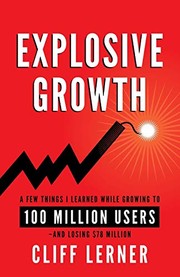
Cliff Lerner recounts the rise of SNAP Interactive, the company behind AreYouInterested?, an early Facebook dating application. The pivotal move was betting on Facebook’s app platform when the company was short on money; social-graph features and viral distribution helped the product scale dramatically. SNAP later became publicly traded, but the story is deliberately framed as a cautionary one: headline user numbers and company valuation did not prevent major losses.
Core ideas
Distribution can matter more than the original idea
SNAP’s breakthrough came less from inventing dating than from placing dating inside a rapidly expanding platform. Lerner’s implicit lesson is to look for a distribution shift—new platform, channel, audience, or behavior—that makes customer acquisition radically cheaper or faster. This advantage is usually temporary, so speed matters.
Treat growth as a sequence of experiments
The book presents growth through testing: change the product, message, onboarding, pricing, or acquisition channel; measure the result; keep or discard the change. The useful mental model is not a single ‘growth hack’ but a high-volume learning system connecting acquisition, activation, engagement, retention, and revenue.
Engineer virality into the product experience
Social features worked because users’ actions could expose the product to other users and make participation more valuable. Viral loops are strongest when sharing is a natural part of the product—not merely an advertising request—and when the recipient has an immediate reason to join.
User growth is not business health
The memoir’s central contrast is 100 million users versus a $78 million loss. Large install or registration numbers can conceal weak retention, low willingness to pay, expensive acquisition, fraud, poor unit economics, or dependence on a temporary platform opportunity. Track cohorts and contribution economics, not vanity totals.
Platform leverage creates platform risk
Facebook supplied extraordinary reach, but reliance on a third-party platform also exposed SNAP to policy, algorithm, technical, and competitive changes. A channel that can make a startup overnight can also remove its advantage overnight. Build owned channels, differentiated product value, and contingency plans while the platform is favorable.
Product positioning is sticky
Lerner discusses the difficulty of changing what an existing audience believes a product is. A feature or repositioning that seems strategically sensible may conflict with users’ established expectations. Test new positioning with fresh audiences instead of assuming current users will smoothly follow a new identity.
Scaling requires management systems, not just founder intensity
Rapid growth magnifies hiring mistakes, unclear responsibilities, weak communication, and poor prioritization. The founder’s energy can launch the company, but repeatable decision-making, capable leaders, metrics, and financial controls are needed to survive scale.
Timing and luck are part of the causal story
The Facebook opportunity was unusually favorable: a large emerging platform, relatively open distribution, and a product category suited to social sharing. The tactics are therefore better understood as principles to adapt than as a reproducible recipe. The same playbook may fail on a mature platform with high acquisition costs and stricter controls.
Practical takeaways
- Map your growth loop: acquisition source → first valuable action → repeat usage → invitation or sharing → new user. Identify the weakest step before adding more traffic.
- Separate installs, registered users, active users, retained users, paying users, revenue, and contribution margin. Never use one number as a substitute for the others.
- Run small, fast experiments with explicit hypotheses and success metrics. Keep a record of failed tests so the company does not relearn the same lesson.
- When a platform provides distribution, ask what you own if the platform changes its rules tomorrow.
- Test positioning with new users before forcing a major identity change onto an established customer base.
- Treat growth spending as an investment that must earn back its cost. Set stop-loss rules for channels and campaigns.
- Hire ahead of the bottleneck, but do not confuse adding people with solving unclear strategy or weak accountability.
- Build a cash model that includes downside scenarios: slower retention, higher acquisition costs, lower conversion, and platform disruption.
Caveats and counterpoints
- The book is a founder’s retrospective, not an independently audited case study; its numbers, causal explanations, and lessons should be read as Lerner’s account of SNAP’s experience.
- Many tactics depend on the unusually permissive and fast-growing Facebook app ecosystem of the late 2000s. They do not transfer directly to today’s mature, crowded platforms.
- The narrative and marketing emphasize exceptional scale, but success was also shaped by timing, category dynamics, competitive conditions, and platform access—not just execution.
- The book’s practical advice is broad and anecdotal rather than a controlled comparison of which interventions caused which outcomes. Use it to generate hypotheses, then validate them with your own data.
- The title’s loss figure is part of the book’s framing; it should not be interpreted without clarifying the relevant accounting period, financing structure, and distinction between operating losses, investment losses, and changes in valuation.
Questions worth revisiting
- Which parts of my current growth depend on a channel I do not control?
- Are my most impressive metrics leading indicators of durable value, or merely accumulated activity?
- What would users say my product is for—and how difficult would it be to change that answer?
- What experiment could disprove my current growth theory within two weeks?
- What level of retention and gross margin would make additional acquisition rational?
- If growth doubled next quarter, which people, processes, infrastructure, or cash constraints would fail first?
Return to this when…
Return to this book when evaluating a major acquisition channel, interpreting a sudden spike in users, considering a platform-dependent strategy, or preparing to scale a team. Its most valuable reminder is the tension between explosive distribution and durable economics: reaching 100 million users can be evidence of opportunity, but it is not proof that the company works.