
In one sentence
A successful exit is not merely the largest possible transaction; it is a deliberately prepared life transition. Founders should decide what they want from a sale, build the business and support team accordingly, protect the people and relationships affected, and plan for the psychological and practical reality after closing.
Overview
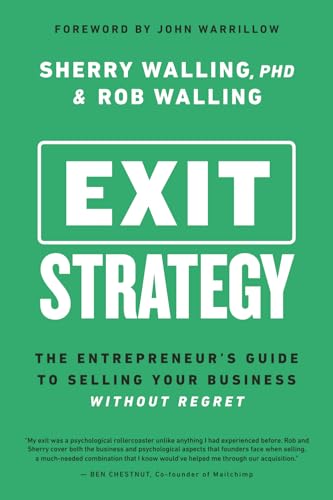
The book spans three phases: before the sale, during the transaction, and life afterward. Its distinctive contribution is pairing Rob Walling’s experience with multiple entrepreneurial exits and Sherry Walling’s clinical perspective on founder mental health. Public descriptions and previews emphasize timing, deal structure, advisers, employees, family, identity, recovery, and what comes next—not just valuation or negotiation.
Core ideas
Define a good exit before pursuing one
Clarify whether you actually want to sell, what outcome would make the sale worthwhile, and which terms matter beyond headline price. Timing should be evaluated against personal readiness, business condition, family circumstances, and the kind of post-sale life you want—not treated as a purely financial optimization problem.
Preparation creates leverage and reduces regret
Exit planning is presented as an ongoing process: make the business transferable, understand its financial and operational reality, assemble competent advisers, and anticipate the effects on employees and family. The practical implication is to prepare before a buyer appears, rather than letting a tempting offer dictate the process.
The transaction is a human system, not just a deal
A sale involves founders, buyers, advisers, employees, partners, and family members whose incentives and emotional responses may conflict. Protecting confidentiality, communicating carefully, and deciding in advance what responsibilities and relationships must be preserved can limit collateral damage.
Expect mixed emotions and identity disruption
Selling can bring relief, pride, grief, anxiety, and uncertainty at the same time. Because founders often understand themselves through the businesses they built, the end of ownership can feel like a loss of identity or purpose even when the financial result is excellent. Treating those reactions as part of the transition makes them easier to navigate.
Plan the post-exit recovery before choosing the next chapter
After closing—especially after an earn-out—founders may need genuine rest and physical, relational, and psychological recovery. The authors identify two tempting extremes: immediately trying to prove they can build another winner, or assuming they will permanently retire and never create again. A better path is to pause, take stock, and let the next direction emerge.
Practical takeaways
- Write a personal definition of a successful exit: money, freedom, legacy, treatment of employees, ongoing involvement, and acceptable risk.
- Start exit-readiness work early: clean up finances, document operations, reduce founder dependence, and understand what a buyer would need to trust.
- Build a support team with distinct expertise—such as legal, financial, tax, and deal guidance—rather than expecting one adviser to cover everything.
- Discuss the likely effects of a sale with family and key employees before the process becomes urgent.
- Separate the business’s value from your identity; selling the company does not require abandoning the parts of yourself that built it.
- Reserve a deliberate decompression period after closing or an earn-out. Avoid making major identity or investment decisions while exhausted and disoriented.
- Use the book alongside transaction-specific legal, tax, and financial advice; its frameworks help with judgment but do not replace professional diligence.
Caveats and counterpoints
- The public material presents the book as broadly relevant to entrepreneurs, but Rob Walling’s background is strongest in bootstrapped software and SaaS; some deal examples or assumptions may fit those businesses better than highly regulated, capital-intensive, or family-owned companies.
- The book’s emphasis on emotional preparation is a strength, but psychological readiness cannot compensate for weak financials, poor documentation, an unsuitable buyer, or unfavorable transaction terms.
- A sale is not always the best exit. Depending on goals and circumstances, continued ownership, delegation, recapitalization, or an employee/family succession may better preserve control or values.
- This refresher is based on publicly available author materials, previews, podcast discussions, and bibliographic information—not the user’s edition or an assumed reading of the complete text.
Questions worth revisiting
- What would I regret more: selling too early, selling too late, or selling on terms that violate my priorities?
- Which parts of the business currently depend too heavily on me?
- What does my family need to understand about the money, uncertainty, confidentiality, and time demands of a sale?
- If the sale closes tomorrow, what structure will keep me healthy and purposeful six months later?
- Am I drawn toward another venture because it is genuinely right—or because I am trying to prove the exit was not a fluke?
Return to this when…
Return to these notes when an offer arrives, when you begin preparing a business for sale, when negotiations become emotionally charged, or during the first year after closing. The most useful reminder is that “successful exit” includes the deal, the people affected by it, and the life you are able to build afterward.
Highlights
What external cues may be relevant for you? What decision criteria would tell you it’s time to sell the business? A dollar amount? What is the current state of your industry or marketplace, and how do you see that shifting? What are time-limited opportunities? External vulnerabilities? Are there business or personal factors that might diminish or limit your interest in running your business? What are your energy levels like? How would you rate your current level of restlessness? Of burnout? What energizes you most during the day? What drains your energy? What interests would you like to explore outside of your business? Are there legacy projects that might be important for you to spend time on?
DEFINING YOUR “CHAMPAGNE MOMENT” If we were to meet one year from now, what would you like us to be toasting? Clay Hebert, the founder of Take Back Perfect, advises entrepreneurs to define their exit goal—their “champagne moment”—and work backward from there to strategize every other aspect of the exit.
The reality is that when you sell your business, it will likely be the biggest, most impactful project on your plate. But that’s not necessarily true for anyone else who’s involved. This is just another day on the job for your lawyers. The acquirer might be working on five other deals this year. Your broker will get paid, but not as much as you do, and they have another deal closing next month.
Remember: The game is not over until the money is in your hand and the ink is dry. Until that happens, keep running your business like you’ll own it forever, and be willing to walk away if the buyer starts playing games. That will help you get the deal you want without blowing up your life or your company along the way.
In other words, if you represented that you pre-paid for all the software subscriptions to run the business for the coming year, but the buyer gets a $2,000 bill from your email service provider, they won't be able to take that out of the holdback amount. However, if they get twenty-five bills like that, they can access the holdback funds. Some buyers opt instead to get reps and warranty insurance to cover those incidentals, especially if they want to grease the wheels on the deal.
Another powerful tool is to imagine having a conversation with your future self. Imagine sitting down for coffee with yourself five or ten years from now and discussing this decision. Imagine your future self telling you that you did a good job. That you were mindful. That you did the best you could with what you knew. Frame hard decisions from that perspective. When you look back, what will you regret? Selling your business in the first place? Selling for a smaller amount than you’d hoped? Not selling at all because you dug in on a few terms? Taking a longer earnout instead of negotiating harder? Having these regular check-ins with your “future self” can be a healthy way to keep a walk-away mindset.
References
- Books — Sherry Walling, PhD
- Rob Walling’s Books
- Exit Strategy: The Entrepreneur's Guide to Selling Your Business Without Regret by Rob Walling | Goodreads
- podcasts.apple.com
- sherrywalling.squarespace.com
- backerkit.com
- robwalling.com
- kickstarter.com
- In episode 740 of Startups For the Rest of Us, Sherry Walling, PhD and I discuss our new book “Exit Strategy: The Entrepreneur's Guide to Selling Your Business Without Regret”. You can back the book… | Rob Walling
- fivebooks.com
- startupsfortherestofus.com
- goodreads.com