
In one sentence
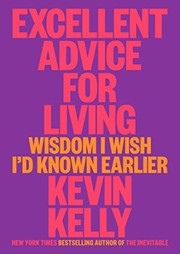
A good life is built less by discovering one master principle than by repeatedly practicing sound small principles: be kind, curious, useful, adaptable, accountable, and generous. Kelly presents wisdom as memorable prompts for action, not as a systematic theory of human behavior.
Overview
Kelly began writing advice for his young adult children on his sixty-eighth birthday and continued until he had assembled roughly 450 short pieces. The book ranges widely—from civility and forgiveness to careers, finances, travel, troubleshooting, creativity, and parenting. It is designed for dipping into and revisiting rather than reading as a sequential argument. The published Viking edition appeared May 2, 2023, at 224 pages.
Core ideas
Character is practical, not ornamental
Kelly repeatedly treats decency, gratitude, compassion, forgiveness, humility, and taking responsibility for mistakes as usable forms of intelligence. Trust and cooperation are built through ordinary conduct: listen, keep promises, apologize, and treat people better than strictly necessary.
Prefer compounding improvements to dramatic reinvention
Many pieces imply a compounding model of progress: learn continuously, make small improvements, cultivate useful habits, and preserve optionality. A modest action repeated for years can matter more than an intense burst of motivation.
Generosity is both moral and strategic
Give credit, introductions, attention, advice, and help without obsessively tracking immediate repayment. Kelly’s implied test is whether an action enlarges another person’s capacity or strengthens a relationship, not merely whether it produces a visible short-term return.
Curiosity and creativity require making and experimenting
Creativity is presented as a practice of noticing, trying, tinkering, and combining ideas. Useful work often emerges from repeated experiments and willingness to be a beginner, rather than from waiting for inspiration or certainty.
Work should create durable value
Career advice favors usefulness, reputation, learning, relationships, and long-term trust over status alone. Aim to become unusually good at something valuable, while staying adaptable as circumstances and technologies change.
Use simple rules for everyday decisions
The book’s aphoristic form turns broad wisdom into portable heuristics: pause before reacting, remove what no longer serves you, ask for advice when you want collaboration, and learn basic practical skills. Their value lies in recall under pressure.
Optimism is an operating stance
Kelly’s optimism is not a promise that things will work out. It is a choice to assume that improvement, cooperation, and unexpected opportunity remain possible—and therefore to keep acting constructively in uncertain conditions.
Practical takeaways
- Choose a few principles to practice rather than trying to remember all of the book’s advice.
- When asking for help, be specific about the decision, constraints, and kind of response you need.
- Build reputation through consistent small acts: reliability, generosity, follow-through, and useful work.
- Review possessions, commitments, and habits periodically; deliberately remove accumulated friction.
- Treat mistakes as information, but do not use learning from them as an excuse to avoid accountability.
- Invest in relationships before you need them; offer useful help without making every interaction transactional.
- Maintain a small portfolio of experiments in work, learning, and creativity so that new options can emerge.
- Learn practical skills that increase independence, resilience, and your ability to help others.
Caveats and counterpoints
- This is a collection of maxims, not a research-based framework or a tightly reasoned productivity system; readers must judge which advice fits their circumstances.
- Aphorisms gain memorability by compressing context. Advice that is sensible for ordinary situations may fail under poverty, illness, disability, abuse, discrimination, or serious power imbalances.
- The book’s optimism and emphasis on personal conduct can understate structural constraints and the extent to which outcomes depend on luck, institutions, and other people.
- Some advice is familiar or culturally specific; the collection’s strength is often its accessibility and portability rather than originality. Kirkus specifically notes that some examples will already be familiar.
- Because the advice covers many domains, it should not substitute for specialized financial, medical, legal, or relationship guidance.
Questions worth revisiting
- Which three principles would materially change my behavior if practiced for one year?
- Where am I confusing busyness with usefulness or ambition with value?
- What relationship would improve if I offered more attention, gratitude, forgiveness, or practical help?
- Which possessions, commitments, or habits create recurring friction without producing enough value?
- What small experiment could expand my future options?
- Where does this advice need qualification because my circumstances differ from Kelly’s intended audience?
Return to this when…
Return when you want a quick reset toward decency, curiosity, generosity, and practical action—or when you need a short prompt for a decision. Read a few entries at a time, then convert one into a concrete behavior; the book is better used as a recurring sourcebook than as a one-time program.
Highlights
Collecting things benefits you only if you display your collection prominently and share it in joy with others. The opposite of this is hoarding.
Whenever you can’t decide which path to take pick the one that produces change.
Don’t be the best. Be the only.
Everyone is shy. Other people are waiting for you to introduce yourself to them; they are waiting for you to send them an email; they are waiting for you to ask them on a date. Go ahead.
Trust me: There is no “them.”
If you are not falling down occasionally you are just coasting.
Keep showing up. 99% of success is just showing up. In fact, most success is just persistence.
To cultivate a habit switch your language from “I can or can’t do” to “I do or don’t do.” You shift the weight from a wavering choice to an unwavering identity.
Be prepared: When you have 90% of a large project completed finishing the final details will take another 90%. Houses and films are famous for having two 90%s.
You really don’t want to be famous. Read the biography of any famous person.
On vacation go to the most remote place on your itinerary first bypassing the cities and then return to the big city at the end. You’ll maximize the shock of otherness in the remote, and then later you’ll welcome the familiar conveniences of a busy city on the way back.
When you get invited to do something in the future ask yourself: Would I do this tomorrow? Not too many promises will pass that immediacy filter.
Don’t say anything about someone in email you would not be comfortable saying to them directly because eventually it will reach them.
Don’t reserve you kindest praise for a person until their eulogy. Tell them while they are alive when it makes a difference to them Write it in a letter they can keep.
Don’t aim to have others like you; aim to have them respect you.
Everyone’s time is finite and shrinking. The highest leverage you can get with your money is to buy someone else’s time. Hire and outsource when you can.
When you are young have friends who are older; when you are old have friends who are younger.
Ignore what others may be thinking of you because they aren’t thinking of you.
Writing down one thing you are grateful for each day is the cheapest possible therapy ever.
You’ll learn a lot more if you ask people “how are you sleeping?” instead of “how are you doing?”
Generally, say less than necessary.
The work on any worthy project is endless, infinite. You cannot limit the work so you must limit your hours. Your time, not the work is the only thing you can manage.
Children totally accept —and crave—family rules. “In our family we have a rule for X” is the only excuse a parent needs for setting a family policy. In fact, “I have a rule for X” is the only excuse you need for your own personal policies.
If your goal does not have a schedule, it is a dream.
People can’t remember more than three points from a speech.
If you are buying stock, the person selling it thinks it is worth less than you do. If you are selling, they think it is worth more than you do. Each time you are ready to buy or sell stock ask yourself “What do I know that they don’t?”
You don’t marry a person you marry a family.
Cultivate 12 people who love you because they are worth more than 12 million people who like you.
Don’t let your email inbox become your to-do list run by others.
Don’t ever work for someone you don’t want to become.
Most wonderful things quickly become unwonderful if they are repeated too often. Once-in-a-life is often the optimal interval.
The consistency of your endeavors (exercise, companionship, work) is more important than the quantity. Nothing beats small things done every day which is way more important than what you do occasionally.
Efficiency is highly overrated; goofing off is highly underrated. Regularly scheduled sabbaths, sabbaticals vacations, breaks, aimless walks and time off are essential for top performance of any kind. The best work ethic requires a good rest ethic.
When you feel like quitting just do five more: 5 more minutes, 5 more pages 5 more steps. Then repeat. Sometimes you can break through and keep going but even if you can’t, you ended five ahead. Tell yourself that you will quit tomorrow but not today.
Spend as much time crafting the subject line of an email as the message itself because the subject line is often the only thing people read.
Denying or deflecting a compliment is rude. Accept it with thanks even if you believe it is not deserved.
When you don’t know how much to pay someone for a particular task ask them, “What would be fair?” and their answer usually
The general strategy for real estate is to buy the worst property on the best street.
You cannot get smart people to work extremely hard just for money.
If you’re doing something that you are hiding from others it’s probably not good for you.
Make others feel they are important; it will make their day and it will make your day.
You can be whatever you want to be so be the person who ends meetings early.
The only productive way to answer “What should I do now?” is to first tackle the question of “Who should I become?”
Most articles and stories are improved significantly if you delete the first page of the manuscript. Start with the action.
Take note if you find yourself wondering “Where is my good knife?” or “Where is my good pen?” That means you have bad ones. Get rid of those.
For the best results with your children spend only half the money you think you should but double the time with them.
Be a pro. Back up your backup. Have at least one physical backup and one backup in the cloud. Have more than one of each. How much would you pay to retrieve all your data, photos, notes if you lost them? Backups are cheap compared to regrets.
Your time and space are limited. Remove, give away, throw out anything that no longer gives you joy in order to make room for those that do.
When negotiating don’t aim for a bigger piece of the pie; aim to create a bigger pie.
Copying others is a good way to start. Copying yourself is a disappointing way to end.
If you repeated what you did today 365 more times will you be where you want to be next year?
It doesn’t matter how many people don’t appreciate you or your work. The only thing that counts is how many do.
If your opinions on one subject can be predicted from your opinions on another you may be in the grip of an ideology. When you truly think for yourself your conclusions will not be predictable.
When you are presented with a task that could be completed in 2 minutes or less do it immediately.
When a customer of yours complains always apologize first and ask “What can we do to resolve this?” even if it is not your fault. Acting as if the customer is right is a small tax to pay to grow a business.
To get your message across follow this formula used by ad writers everywhere: simplify, simplify, simplify, then exaggerate.
Pay attention to who you are around when you feel your best. Be with them more often.
The very best thing you can do for your kids is to love your spouse.
Make one to throw away. The only way to write a great book is to first write an awful book. Ditto for a movie, song, piece of furniture or anything.
Worry is ineffective. It is certain that 99% of the stuff you are anxious about won’t happen.
First, always ask for what you want. Works in relationships, business, life.
Measure your wealth not by the things you can buy but by the things that no money can buy.
An honest friend is someone who wants nothing at all from you.
You will spend one third of your life in your bed sleeping, and almost another third in your chair sitting. It’s worth investing in a great bed and fantastic chair.
If you are stuck in life travel to a place you have never heard of.
To speed a meeting up require that any person who speaks must say something no one else in the room knows.
The rich have money. The wealthy have time. It is easier to become wealthy than rich.
The natural state of all possessions is to need repair and maintenance. What you own will eventually own you. Choose selectively.
Commit to doing no work no business no income one day a week. Call it a sabbath (or not). Use that day for resting, recharging, and cultivating the most important things in life. Counterintuitively, this sabbath will prove to be your most productive act all week.
Your goal is to be able to say on the day before you die that you have fully become yourself.