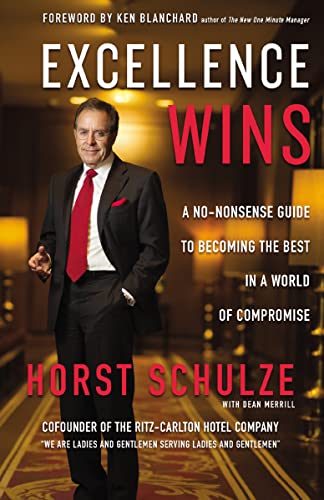

In one sentence
Organizations win by refusing routine compromise: understand what customers truly value, define excellence precisely, equip employees to deliver it, and build leadership systems that reinforce the standard every day. Profit is treated as the result of serving people exceptionally well, not as the primary operating purpose.
Overview
The book is organized into three movements: serving customers, engaging employees, and building true leadership. Schulze draws heavily on his career in hospitality and on the Ritz-Carlton model, but explicitly invites readers in other sectors to translate “customers” into clients, citizens, patients, students, donors, or other people being served. The approach combines service design, quality control, culture-building, and servant leadership.
Core ideas
Start with the customer’s real needs
Excellence begins with discovering what customers actually expect and value—not merely delivering the organization’s existing product or process. Customer knowledge is presented as the basis for differentiation and loyalty. The practical test is whether the organization understands the customer well enough to anticipate important needs.
Service is everyone’s job
Customer experience is created across the whole process, including by employees who never meet the customer. Schulze’s example of recurring room-service delays shows why visible defects often originate several steps earlier; finding the root cause can improve service while lowering long-term cost.
Four operating objectives
The preview’s contents identify a chapter devoted to four “supreme objectives.” The book’s framework, as reflected in available descriptions and summaries, is to retain existing customers, gain new ones, encourage appropriate additional business, and increase efficiency. The objectives reinforce one another: growth is worthless if service drives customers away, and efficiency should remove waste rather than degrade value.
Employees are contributors, not labor inputs
People should be selected, placed, trained, and treated as participants in a meaningful purpose—not merely as pairs of hands. Schulze links employee dignity and responsibility to customer outcomes. Empowerment is credible only when employees understand the standard, have the necessary tools, and receive recognition for sound judgment.
Standards need repetition
Clear service standards must be taught, practiced, revisited, and reinforced. Repetition is not bureaucratic excess when it keeps priorities visible and makes desired behavior dependable under pressure. The Ritz-Carlton example includes regular staff meetings that review direction, concerns, and service standards.
Leaders provide vision and systems
Managers can push for compliance; leaders create commitment by explaining why the work matters and connecting individual roles to a larger purpose. Vision statements matter when they guide decisions and behavior, not when they remain promotional language. Leadership is treated as an acquired skill rather than an instinct reserved for exceptional personalities.
Empowerment requires trust and accountability
Schulze advocates giving frontline employees meaningful discretion to resolve customer problems. The often-cited Ritz-Carlton policy allowing employees to spend up to $2,000 to satisfy a guest illustrates the principle: trust people close to the problem, then reinforce responsible decisions.
Excellence is both relational and operational
The book rejects the choice between caring for people and achieving results. Employee relationships, customer loyalty, standards, process discipline, and profitability are treated as connected rather than competing priorities. In the foreword, Ken Blanchard summarizes this as a “both/and” orientation toward results and relationships.
Practical takeaways
- Define, in observable terms, what an excellent customer experience looks like at important moments.
- Map customer complaints backward through the process instead of blaming the employee who receives the complaint.
- Give frontline employees authority to fix problems, paired with training, boundaries, and feedback.
- Translate broad values into a small number of repeated behaviors and operating standards.
- Use regular team meetings to restate the mission, surface obstacles, and review one standard or failure mode.
- Recruit and assign people for fit, capability, and motivation—not only for immediate task coverage.
- Treat defects as opportunities to improve the system; ask what condition allowed the failure to occur.
- Measure retention, new-customer acquisition, appropriate customer value, and efficiency together rather than optimizing one metric in isolation.
Caveats and counterpoints
- The book is strongly shaped by luxury hospitality, where service interactions and brand standards are unusually visible. Manufacturing, software, public services, and low-touch businesses will need to translate its ideas rather than copy its rituals.
- Schulze relies substantially on career stories and prescriptions. The available material does not establish that every Ritz-Carlton practice caused the reported outcomes, so the anecdotes are best used as illustrations, not universal proof.
- “No compromise” can become unrealistic if interpreted as perfection in every dimension. Organizations still face trade-offs involving cost, speed, accessibility, safety, and equity; the useful question is which standards are strategically nonnegotiable.
- Broad employee empowerment can fail when processes, staffing, incentives, or leadership behavior contradict the stated culture. Authority without competence or operational support merely transfers risk to the frontline.
- The book’s language includes a clear servant-leadership and purpose orientation, with some explicitly Christian framing in the surrounding presentation; readers seeking an evidence-heavy, secular management text may find it more inspirational and experiential than analytical.
Questions worth revisiting
- What do our customers value most, and how do we know rather than assume?
- Which recurring complaint is actually a system defect several steps upstream?
- What decisions should the frontline be able to make without managerial approval?
- Are our stated values translated into training, staffing, measurement, and recognition?
- Where are we optimizing budget or convenience at the expense of retention and trust?
- Which standards deserve repetition because inconsistency is currently costly?
- Does our leadership behavior toward employees match the experience we expect employees to create for customers?
Return to this when…
Return to the customer-service, root-cause, and employee-empowerment sections when designing service standards, diagnosing recurring complaints, or reviewing whether culture is supported by systems. Return to the leadership chapters when a team has values and slogans but lacks shared direction, disciplined reinforcement, or ownership.
Highlights
People both inside and outside the Ritz-Carlton Hotel Company couldn’t believe it when, many years ago, Horst instituted the policy empowering every employee to spend up to $2,000 to make sure a guest is happy. He trusted his people’s judgment—and he loved to collect stories that proved he was right. I particularly like the one about a housekeeper named Mary who flew from Atlanta to Hawaii because a guest had forgotten his laptop computer in his room. He needed it for a big speech he was giving at an international conference in Honolulu the following afternoon. Mary didn’t trust that the overnight courier would get the laptop to the gentleman in time for his speech, so she delivered it herself.