
In one sentence
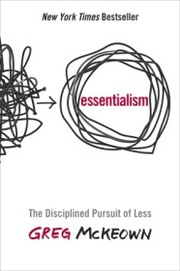
McKeown’s central argument is that most options are not equally valuable, yet people often surrender their choices to social pressure, habit, and the belief that they must do everything. Essentialism means reclaiming the power to choose, determining where one’s highest contribution lies, and concentrating time and energy there. It is a way of operating—not merely a list of productivity techniques.
Overview
The book moves through four linked stages: Essence establishes the mindset; Explore develops discernment through reflection, play, sleep, and selective evaluation; Eliminate addresses refusal, boundaries, editing, and abandoning sunk costs; Execute makes essential actions easier through buffers, obstacle removal, small wins, routines, and attention to what matters now.
Core ideas
Choice is a capability, not an obligation
The Essentialist treats choice as something to exercise deliberately. Saying yes automatically allows other people’s priorities to determine one’s schedule; pausing before commitment restores agency.
The vital few require active discernment
Essentialism is not simplistic minimalism. McKeown recommends exploring options carefully, creating space to think, observing what matters, and using demanding criteria before committing. The aim is not fewer options at the outset, but better selection.
Every commitment has a trade-off
The book rejects the fantasy of having everything without cost. Choosing one project, role, or opportunity necessarily means declining another. Explicitly acknowledging that cost is clearer than pretending all priorities can coexist.
Elimination is the difficult middle step
Knowing what matters is insufficient if nonessential work remains. McKeown emphasizes graceful refusal, renegotiating commitments, cutting losses, editing activities, and setting boundaries. A decision is incomplete until the unwanted obligation is actually removed.
Execution should reduce friction
Once priorities are chosen, build conditions that support them: leave buffers for surprises, remove obstacles, protect sleep and thinking time, use routines, and pursue incremental progress. The system should make the important behavior easier rather than relying on constant willpower.
Focus is situational
“What is important now?” is more useful than treating every important goal as simultaneously urgent. Essentialism therefore requires recurring review: priorities can change, and the essential task is the one that best serves the current purpose and moment.
Practical takeaways
- Write down the one outcome that would make the current period successful; use it to filter requests.
- Treat a vague or lukewarm opportunity as a likely no rather than allowing politeness to create another obligation.
- Before accepting work, ask what existing commitment, resource, or quality standard it will displace.
- Use a clear threshold for commitments: choose only opportunities that are unusually aligned, valuable, or meaningful.
- Create protected blocks for reflection and essential work; constant availability prevents discernment.
- Say no to the request, not the person: be direct, appreciative, and brief rather than inventing elaborate excuses.
- Schedule buffer time so unexpected work does not automatically consume the time reserved for priorities.
- Review commitments periodically and remove activities that no longer serve the current objective.
Caveats and counterpoints
- The book’s advice is strongest where people possess meaningful discretion over their schedules. Employees with rigid jobs, caregivers, people in crisis, and those facing financial insecurity may have limited ability to decline demands.
- McKeown offers a compelling framework but not a rigorous decision procedure for identifying what is “essential”; values, power, obligations, and cultural context still determine the answer.
- “Do less” can be misapplied as self-protection, avoidance, or a justification for neglecting shared responsibilities. Essentialism requires distinguishing trivial demands from necessary but unglamorous care and maintenance.
- The book relies heavily on anecdotes and exhortation, so its productivity claims should be treated as practical guidance rather than a systematically tested theory. Its repeated examples can also make the framework feel more universal than it is.
Questions worth revisiting
- What am I doing mainly because I fear disappointing someone?
- Which current commitment would I refuse if I were deciding today?
- What is the highest-contribution outcome for this season of my life or work?
- What will this new yes force me to neglect?
- Which obstacle can I remove instead of trying to become more disciplined?
- Where do I need a boundary, buffer, or recurring review?
- Am I eliminating noise—or merely avoiding a difficult essential responsibility?
Return to this when…
Return to this book when your calendar is full but progress feels thin, when other people’s priorities are dominating your attention, or when you are considering another commitment. Revisit the Essence–Explore–Eliminate–Execute sequence during a quarterly review or at a major change in role, project, or life circumstance.
Highlights
Dieter’s design criteria can be summarized by a characteristically succinct principle, captured in just three German words: Weniger aber besser. The English translation is: Less but better. A more fitting definition of Essentialism would be hard to come by.
If you don’t prioritize your life, someone else will.
“You cannot overestimate the unimportance of practically everything.”9
STOP WORDSMITHING AND START DECIDING When developing statements of purpose—for your company, your team, or even yourself—there is a tendency to start obsessing about trivial stylistic details, like “Should we use this word or that word?” But this makes it all too easy to slip into meaningless clichés and buzzwords that lead to vague, meaningless statements like the ones I cited at the beginning of the chapter. An essential intent doesn’t have to be elegantly crafted; it’s the substance, not the style that counts. Instead, ask the more essential question that will inform every future decision you will ever make: “If we could be truly excellent at only one thing, what would it be?”
TO FIGHT THIS FEAR, RUN A REVERSE PILOT One of the ideas that has grown popular in business circles in recent years is “prototyping.” Building a prototype, or large-scale model, allows companies to test-run an idea or product without making a huge investment up front. Exactly the same idea can be used in reverse to eliminate nonessentials in a relatively low-risk way, by running what Daniel Shapero, a director at LinkedIn, calls a “reverse pilot.”
Boundaries are a little like the walls of a sandcastle. The second we let one fall over, the rest of them come crashing down.
DON’T ROB PEOPLE OF THEIR PROBLEMS I am not saying we should never help people. We should serve, and love, and make a difference in the lives of others, of course. But when people make their problem our problem, we aren’t helping them; we’re enabling them. Once we take their problem for them, all we’re doing is taking away their ability to solve it.
The question is this: What is the “slowest hiker” in your job or your life? What is the obstacle that is keeping you back from achieving what really matters to you?
Instead of just jumping into the project, take a few minutes to think. Ask yourself, “What are all the obstacles standing between me and getting this done?” and “What is keeping me from completing this?” Make a list of these obstacles. They might include: not having the information you need, your energy level, your desire for perfection. Prioritize the list using the question, “What is the obstacle that, if removed, would make the majority of other obstacles disappear?”
When identifying your “slowest hiker,” one important thing to keep in mind is that even activities that are “productive”—like doing research, or e-mailing people for information, or rewriting the report in order to get it perfect the first time around—can be obstacles.
Anything slowing down the execution of that goal should be questioned.
decade the Positive Tickets system had reduced recidivism
“Of all the things that can boost emotions, motivation, and perceptions during a workday, the single most important is making progress in meaningful work,”
It’s true that doing the same things at the same time, day after day, can get boring. To avoid this kind of routine fatigue, there’s no reason why you can’t have different routines for different days of the week. Jack Dorsey, the cofounder of Twitter and founder of Square, has an interesting approach to his weekly routine. He has divided up his week into themes. Monday is for management meetings and “running the company” work. Tuesday is for product development. Wednesday is for marketing, communications, and growth. Thursday is for developers and partnerships. Friday is for the company and its culture.9 This routine helps to provide calmness amid the chaos of a high-growth start-up. It enables him to focus his energy on a single theme each day instead of feeling pulled into everything.
BEWARE THE BARRENNESS OF A BUSY LIFE. —Socrates
The iconoclastic entrepreneur and venture capitalist Peter Thiel took “less but better” to an unorthodox level when he insisted that PayPal employees select one single priority in their role—and focus on that exclusively. As PayPal executive Keith Rabois recalls: “Peter required that everyone be tasked with exactly one priority. He would refuse to discuss virtually anything else with you except what was currently assigned as your #1 initiative. Even our annual review forms in 2001 required each employee to identify their single most valuable contribution to the company.”2 The result was the employees were empowered to do anything within the confines of that clearly defined role that they felt would make a high level of contribution to the shared mission of the company.