
In one sentence
Human beings are driven primarily by an irrational will to live, so desire repeatedly produces frustration, conflict, boredom, and suffering. Clear thinking cannot abolish this condition, but it can loosen its grip: understanding human motives, limiting desire, cultivating compassion, encountering art, and learning to live with fewer illusions may reduce suffering.
Overview
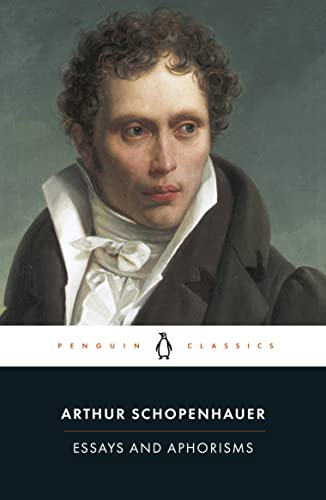
This is not a systematic introduction to Schopenhauer’s philosophy but a deliberately accessible selection from the second volume of Parerga and Paralipomena, his 1851 collection of essays, aphorisms, dialogues, and observations. Hollingdale’s Penguin volume was first published in English in 1970 and later reissued; the selection emphasizes Schopenhauer’s mature cultural criticism and practical reflections rather than reproducing the whole source work.
Core ideas
The will precedes deliberation
Reason is often an instrument serving deeper impulses rather than an independent ruler of conduct. People commonly construct explanations after acting, then mistake those explanations for the true causes of their behavior.
Suffering is structurally built into desire
Wanting places us in lack; satisfying a want is temporary, after which another want appears—or boredom replaces frustration. Happiness is therefore less a permanent positive condition than a brief interruption of pressure.
Pessimism is diagnostic, not merely emotional
Schopenhauer asks readers to judge life by its ordinary structure rather than by exceptional pleasures. His argument depends on the asymmetry between pain and pleasure: suffering demands attention, while pleasure often amounts to relief from prior deprivation.
Compassion grounds morality
Moral action begins when the boundary between self and others becomes less absolute. Compassion interrupts egoism by making another person’s suffering matter directly, though Schopenhauer’s metaphysical explanation of this experience is more controversial than the ethical insight itself.
Art provides temporary release
In aesthetic contemplation, attention can shift away from personal striving and practical interests. Art does not permanently solve existence; it offers a temporary suspension of willing, with music receiving a particularly privileged role in Schopenhauer’s broader system.
Practical wisdom means managing circumstances
The essays distinguish what a person is, what a person has, and how a person appears. Character and temperament matter more than status or possessions, while independence, moderation, solitude, and realistic expectations protect against avoidable disappointment.
Reading can weaken one’s own judgment
Books are valuable when they stimulate independent thought, but excessive reading can substitute other people’s ideas for firsthand reflection. Schopenhauer prefers thinking for oneself, selective reading, and writing that communicates a genuinely formed thought rather than ornamental learning.
Religion is interpreted psychologically and philosophically
Schopenhauer treats religions as symbolic or popular forms of metaphysical insight, while criticizing dogmatism and institutional authority. He is especially sympathetic to elements of Buddhism, Hindu thought, and Christianity that emphasize renunciation, compassion, and the overcoming of egoism.
Practical takeaways
- Separate genuine needs from recurring cravings; satisfaction may only reset the cycle of wanting.
- Treat solitude as a resource for independent judgment, not automatically as a social failure.
- Before pursuing status, ask whether it changes your inner condition or merely your public appearance.
- Read less indiscriminately: choose works that deepen thought, then pause to think without them.
- Expect people—including yourself—to rationalize motives after the fact; interpret conduct more carefully than explanations.
- Use art and contemplative attention as temporary relief from self-interested striving, without pretending they permanently remove suffering.
- Reduce avoidable misery through moderation, lowered expectations, and careful management of time and social exposure.
- When evaluating Schopenhauer’s advice, distinguish his useful psychological observations from his sweeping claims about women, society, religion, and human nature.
Caveats and counterpoints
- The catalogue description is misleading in saying that each individual is “absolutely free.” Schopenhauer generally argues that actions follow character and motives necessarily; his famous distinction is closer to being able to do what one wills than to freely choosing what one wills.
- The description also overstates “self-awareness” as salvation. Schopenhauer’s more characteristic remedies are aesthetic contemplation, compassion, resignation, and ultimately denial of the will to live—not confidence in ordinary self-knowledge.
- This Penguin book is a selection, not the complete Parerga and Paralipomena. Its arrangement foregrounds memorable essays and aphorisms, so readers should not treat it as a neutral map of Schopenhauer’s entire philosophy.
- Schopenhauer’s attacks on women, academics, popular culture, and religious institutions are often rhetorically vivid but historically situated, sweeping, and sometimes prejudicial. They should be read as arguments to assess, not as reliable social description.
- His pessimism can illuminate frustration, boredom, status-seeking, and self-deception, but it can also flatten differences between kinds of suffering and understate the value of cooperation, political reform, attachment, and ordinary achievement.
- The practical advice sometimes pulls in two directions: it recommends prudent worldly self-management while the underlying metaphysics points toward renunciation of willing itself. The book is strongest when these levels are kept distinct.
Questions worth revisiting
- Which claims about desire seem empirically persuasive, and which depend on Schopenhauer’s metaphysics of the will?
- Does compassion require his claim that individuality is ultimately appearance, or can it be defended on ordinary ethical grounds?
- When does solitude support independent thought, and when does it become avoidance or self-enclosure?
- Are pleasure and happiness merely relief from suffering, or does Schopenhauer discount positive forms of flourishing?
- How much of the book’s practical wisdom survives if one rejects the conclusion that life is fundamentally suffering?
- Which passages on women, religion, and society reveal nineteenth-century prejudice rather than general psychological insight?
- Does aesthetic contemplation genuinely suspend self-interest, or does it simply replace one form of attention with another?
Return to this when…
Return to the sections on suffering, thinking for oneself, reading and books, and practical wisdom when reassessing ambition, information overload, social comparison, or recurring dissatisfaction. Use the essays on religion, women, and suicide especially as historical-philosophical arguments requiring critical distance, not as ready-made conclusions.