
In one sentence
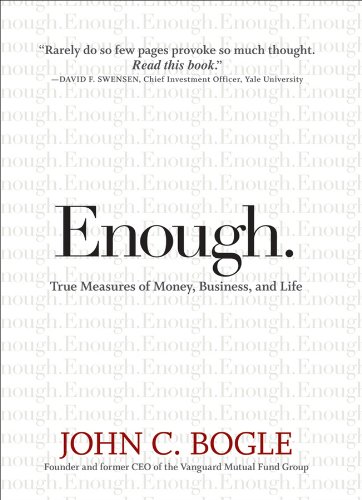
A good life and a healthy financial system require replacing the pursuit of “more” with a clearer standard of “enough.” In money, that means emphasizing long-term ownership, diversification, simplicity, and low costs; in business, stewardship and professional ethics; in life, character, relationships, service, and purpose over status or accumulation.
Overview
Bogle organizes the book around three overlapping arenas: money, business, and life. His financial argument is familiar from his investing work: market returns belong to investors collectively, but the financial industry subtracts substantial costs through intermediation, speculation, sales incentives, and excessive complexity. The sensible response is to capture the market’s return cheaply and patiently rather than try to outguess it. His business argument is that corporations and financial firms have drifted from serving owners and clients toward serving executives, traders, and intermediaries. His broader moral argument is that numerical measures—income, assets, rankings, growth, and performance—cannot adequately measure trust, judgment, loyalty, or human fulfillment.
Core ideas
“Enough” is a standard, not a number
Bogle treats enough as a judgment about sufficiency and priorities rather than a universal wealth threshold. The central danger is allowing comparison, status competition, and endless scorekeeping to define success. Material security matters, but beyond that point additional accumulation may displace time, integrity, relationships, and service.
Investors collectively earn the market return—less costs
Because investors as a group own the market, they must collectively receive the market’s gross return before expenses. The industry, however, deducts management fees, trading costs, sales charges, taxes, and other forms of financial friction. Therefore, cost control is not a minor detail: it is one of the few reliable ways investors can improve their share of the return.
Simplicity and patience beat financial entertainment
Bogle favors broad diversification, long holding periods, disciplined saving, and resistance to market noise. Complexity can create the appearance of sophistication while increasing costs and opportunities for error. His approach is less about forecasting and more about accepting what markets offer while minimizing what the investor gives up.
Business should be a profession, not merely a trade
A professional places clients, owners, or the institution’s long-term interests ahead of personal extraction. Bogle criticizes a culture in which financial actors emphasize transactions, quarterly numbers, executive rewards, and legal permission while neglecting fiduciary duty, trust, and stewardship. The relevant distinction is not simply legal compliance versus illegality, but adequate conduct versus honorable conduct.
What matters most is often difficult to measure
Quantification is useful for selected tasks but dangerous when mistaken for a complete account of value. Bogle argues that character, wisdom, loyalty, trust, and social contribution resist reduction to a metric. Organizations that manage only what is easily counted may optimize the wrong things.
Vanguard’s lesson: build institutions around durable principles
Bogle presents Vanguard’s success as depending not only on the index-fund idea but also on structure, frugality, long-term orientation, and an unusual emphasis on serving fund shareholders. He credits colleagues and institutional design rather than portraying achievement as a solitary triumph—a leadership lesson about creating systems that make the right behavior easier.
Money is a means to human ends
The book ultimately places investing inside a larger moral framework. Financial security can support independence and generosity, but money cannot by itself supply meaning. Bogle’s preferred measures of a successful life include integrity, family and friendship, constructive work, citizenship, and leaving something worthwhile to others.
Practical takeaways
- Define what “enough” means for your household before adopting goals based on comparison or market performance.
- Favor diversified, low-cost investments and avoid strategies whose main benefits accrue to intermediaries.
- Treat fees, turnover, taxes, complexity, and behavioral mistakes as investment returns surrendered.
- Separate genuine financial security from status spending and the desire to keep score.
- When evaluating a business or leader, ask who benefits, who bears the costs, and whether the arrangement deserves trust—not merely whether it is technically legal.
- Use quantitative targets for planning, but supplement them with qualitative questions: Is this useful? Is it sustainable? Does it serve people well?
- Review whether your work and investments are reinforcing the life you want, rather than becoming substitutes for it.
Caveats and counterpoints
- This is not primarily a step-by-step personal-finance manual; its investing guidance is principle-driven and assumes the reader will translate it into an appropriate portfolio and savings plan.
- Bogle’s critique is deliberately moral and polemical. It is strongest as a framework for judging incentives and trade-offs, but it can understate legitimate reasons investors or institutions may choose active management, specialization, or complexity.
- His praise of Vanguard’s model is informative but necessarily shaped by his role as its founder and former leader; readers should distinguish the general principles from the company-specific example.
- The book was published in 2008–2009, during the financial crisis. Its institutional criticisms remain relevant as arguments, but particular market conditions, products, regulations, and industry practices have changed since publication.
Questions worth revisiting
- What expenses, risks, or incentives are being hidden by a headline return or performance figure?
- Where am I pursuing “more” without a clear purpose or stopping rule?
- Which important outcomes in my work or life are not captured by the metrics I currently use?
- Would I still endorse this financial or business decision if I had to explain its beneficiaries and costs publicly?
- What does enough look like in money, time, recognition, and professional ambition?
- Am I building a life that money supports, or a life organized around producing and measuring money?
Return to this when…
Return to this book when investing starts to feel like a competition, when career success is being measured only by compensation or prestige, or when financial complexity is obscuring the basic question: what is this effort meant to accomplish? Its most useful refresher is the connection between low-cost investing, institutional stewardship, and a deliberately bounded definition of success.
Highlights
Pulling off this trick was not easy, and in fact I might not have tried doing so if I hadn’t had the two characteristics that someone once attributed to me: “the stubbornness of an idealist and the soul of a street fighter.”
Many of the numbers that we cannot count on, paradoxically, are produced by our federal government. As Kevin Phillips pointed out in his essay “Numbers Racket,” published in the May 2008 issue of Harper’s magazine, we’re being grossly misled by government data, including the vital numbers that have become central to our national dialogue, such as our national output or gross domestic product (GDP), our unemployment rate, and our inflation rate.
Not everything that counts can be counted, and not everything that can be counted counts.
Our strategy arose from a conviction that the best corporate growth comes from putting the horse of doing things for clients ahead of the cart of earnings targets. Growth must be organic, rather than forced. No company, of course—and certainly not one as huge as Vanguard is today—can ignore numbers altogether, but I’ve often noted the extremes in management style between companies that trust and companies that count, and I fervently hope that anyone who has ever worked for Vanguard includes our company among the former.
For my part, I’ve tried to reinforce the point over the decades with an aphorism that I’ve seen posted at countless desks throughout our now seemingly countless buildings: For God’s sake, let’s always keep Vanguard a place where judgment has at least a fighting chance to triumph over process.
Hear exemplary business leader Bill George, former chief of medical technology pioneer Medtronic: “Trust is everything, because success depends upon customers’ trust in the products they buy, employees’ trust in their leaders, investors’ trust in those who invest for them and the public’s trust in capitalism. . . . If you do not have integrity, no one will trust you, nor should they.”
Daedalus then added these wonderful words: “The primary feature of any profession [is] to serve responsibly, selflessly, and wisely . . . and to establish [an] inherently ethical relationship between the professional and the general society.”
To paraphrase Upton Sinclair: “It’s amazing how difficult it is for a man to understand something if he’s paid a small fortune not to understand it.”
There is a profound difference between management and leadership, and both are important. To manage means to bring about, to accomplish, to have charge of or responsibility for, to conduct. Leading is influencing, guiding in a direction, course, action, opinion.The distinction is crucial.
Rather, I proposed a single overarching but simple rule: “Do what’s right. If you’re not sure, ask your boss.” Why so? Because as I’ve said a thousand times: “Good ethics is good business.” A new thought? Hardly. In the Odyssey, Homer reminds us, Take it to the heart, and pass the word along: Fair dealing brings more profit in the end.
But leading a business is also thrilling, challenging, and rewarding. The key to the difference, I believe, lies in doing everything possible to focus on long-term opportunities, doing your best to ignore the inevitable short-term difficulties. Scores of times I’ve reminded our crew: “Once you decide whether you expect to be in business for a short time or a long time, most of the right decisions are easy.”
Nothing in the world can take the place of persistence. Talent will not;nothing is more common than unsuccessful men with talent. Genius will not; unrewarded genius is almost a proverb. Education will not; the world is full of educated derelicts. Persistence and determination alone are omnipotent. The slogan “Press on” has solved, and always will solve, the problems of the human race.
Are you in earnest? Seize this very minute; What you can do, or dream you can do, begin it; Boldness has genius, power and magic in it.
Where is the Life we have lost in living? Where is the wisdom we have lost in knowledge? Where is the knowledge we have lost in information? The cycles of Heaven in twenty centuries Bring us farther from God and nearer to the Dust. To paraphrase Neil Postman’s essential message, soon we shall know everything that doesn’t count, and nothing that does.
“an enterprising man willing to run some risks, yet not willing to risk in hazardous enterprises the property of others entrusted to his keeping, careful to indulge no extravagance and to be simple in his manner and unostentatious in his habits, not merely a merchant, but a man, with a mind to improve, a heart to cultivate, and a character to form.”
As René Descartes reminded us four full centuries ago, “A man is incapable of comprehending any argument that interferes with his revenue.”
According to an authoritative article in American Psychologist magazine, it’s not money that determines our happiness, but the presence of some combination of these three attributes: (1) autonomy, the extent to which we have the ability to control our own lives, “to do our own thing”; (2) maintaining connectiveness with other human beings, in the form of love of our families, our pleasure in friends and colleagues, and an openness with those we meet in all walks of life; and (3) exercising competence, using our God-given and self-motivated talents, inspired and striving to learn.
References
- goodreads.com
- Enough. True Measures of Money, Business, and Life (a review)
- finnotes.org
- johncbogle.com
- Enough: True Measures of Money, Business, and Life - John C. Bogle - Google Books
- goodreads.com
- books.google.com
- search.worldcat.org
- books.google.com
- 5. Too Much Business Conduct, Not Enough Professional Conduct - Enough.: True Measures of Money, Business, and Life Book
- goodreads.com
- everand.com