
In one sentence
The novel asks whether victory can justify the psychological destruction of the person engineered to achieve it—and whether understanding an enemy is possible when institutions define that enemy as less than fully human.
Overview
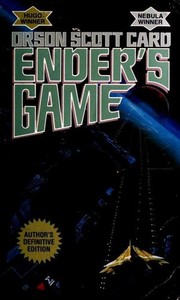
Ender is selected for military training because he combines unusual intelligence, empathy, and tactical instinct. At Battle School, children’s games function as both education and social warfare: Ender must learn leadership, improvise under pressure, and survive rivalry while adults deliberately control what he knows. Parallel chapters follow his siblings Peter and Valentine as they influence events on Earth through political writing and persuasion. The plot’s central tension is not simply whether Ender can win, but what the adults’ methods are doing to him. The novel originated as a 1977 short story and was expanded into the 1985 novel, which won both the Nebula and Hugo Awards.
Core ideas
Games that conceal reality
Battle exercises are presented as play, but their consequences and institutional purpose are serious. The blurred boundary between simulation and reality makes the reader question who is allowed to know the truth, and whether ignorance can count as consent.
Empathy as a military advantage—and moral danger
Ender’s ability to understand opponents helps him defeat them. The same empathy that makes him effective also threatens his innocence, because understanding another being can become entangled with discovering how to destroy it.
Children shaped by adult systems
The adults claim that extraordinary danger requires extraordinary measures. The book is skeptical of this justification: training, surveillance, competition, and engineered isolation produce results, but they also transfer responsibility for violence from institutions onto a child.
Leadership without simple heroism
Ender succeeds by combining strategic imagination with attention to individual people. Yet his leadership is inseparable from loneliness, exhaustion, and manipulation. The novel resists treating command as glamorous; authority is shown as a burden that can damage both leader and followers.
Family as both refuge and pressure
Peter and Valentine are not merely background characters. Their different relationships with Ender illuminate competing possibilities for power: domination, compassion, persuasion, and political influence. Ender’s fear of resembling Peter gives his moral struggle a deeply personal form.
The enemy as an ethical category
The Formics initially exist through human labels and military narratives. The novel’s lasting question is whether a society can recognize another intelligence as morally significant before, rather than after, violence has become its organizing response.
Practical takeaways
- When an institution calls something a game, exercise, test, or simulation, ask what real behavior it is rehearsing and who bears the consequences.
- Competence and goodness are not the same achievement. A person can become highly effective while being pushed toward morally troubling actions.
- Empathy is not automatically harmless: understanding another person can support care, persuasion, control, or violence depending on the surrounding system.
- Leadership built through isolation may produce decisive results but can deprive the leader of informed consent, friendship, and meaningful alternatives.
- Pay attention to the information asymmetry in conflicts. Who knows the stakes, who does not, and who benefits from keeping the distinction hidden?
Caveats and counterpoints
- The novel’s critique of militarization is complicated by its admiration for strategic brilliance and decisive command; it can read as both antiwar and fascinated by military power.
- Its treatment of genius, gifted children, and psychological pressure is deliberately extreme rather than a realistic account of child development or military training.
- Some readers find the adult political subplot less developed than Ender’s school narrative, while others value it as a warning about rhetoric, media influence, and political manipulation.
- The book is widely influential and award-winning, but its reputation is not identical to universal critical approval; contemporary commentary has questioned its originality and literary style even while acknowledging its force as a speculative thought experiment.
- This refresher intentionally avoids the ending and does not assume any particular edition; pagination and some textual details vary among editions. The bibliographic records consulted include revised and reprinted versions.
Questions worth revisiting
- At what point does Ender’s ability to understand others become a form of exploitation?
- Can a person be morally responsible for actions whose meaning was deliberately concealed from them?
- Does the novel ultimately condemn the adults’ methods, or suggest that they were tragically necessary?
- How do Peter and Valentine complicate the idea that Ender is the uniquely important Wiggin child?
- What would genuine communication with an unfamiliar intelligence require that military institutions cannot easily provide?
Return to this when…
Return to these notes when thinking about military ethics, leadership under coercion, the morality of simulations, child exceptionalism, or stories in which empathy and violence become uncomfortably connected.
Highlights
“What else should you be? Human beings didn’t evolve brains in order to lie around on lakes. Killing’s the first thing we learned. And a good thing we did, or we’d be dead, and the tigers would own the earth.”