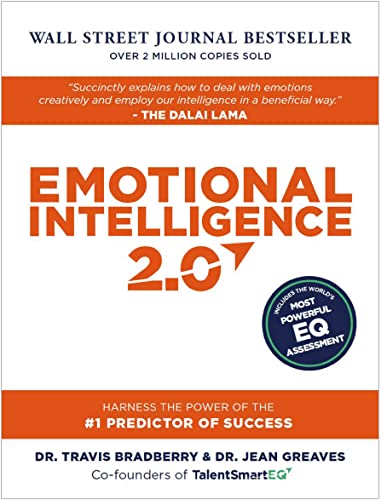

In one sentence
Emotional intelligence is presented as a set of learnable behaviors that influence performance and relationships. The authors’ central method is diagnostic and incremental: identify a weak skill, choose a few concrete strategies, practice them repeatedly, obtain feedback, and reassess.
Overview
The book organizes EQ into two broad competencies—personal competence and social competence—crossed with awareness and management. Self-awareness means recognizing emotions, triggers, patterns, and their effects. Self-management means using that awareness to choose responses rather than acting automatically. Social awareness means accurately attending to other people’s emotions and perspectives. Relationship management applies both kinds of awareness to communication, trust, conflict, and collaboration. The contents move from the framework to strategy lists for each skill, followed by an action plan and a brief review of EQ research.
Core ideas
Emotions shape behavior before deliberate reasoning catches up
The book treats emotional reactions as fast, influential signals. The practical implication is not to suppress emotion, but to notice the signal early enough to insert a pause and select a better response.
Awareness is the prerequisite for control
You cannot reliably change a reaction you do not recognize. The authors emphasize tracking recurring triggers, bodily stress signals, self-talk, habits, and the consequences of one’s behavior.
Self-management is choice under pressure
Useful tactics include pausing, reframing interpretations, managing stress, adjusting self-talk, clarifying intentions, and preparing for predictable difficult situations. The goal is behavioral flexibility, not emotional numbness.
Social awareness requires attention, not mind-reading
The recommended stance is to listen closely, observe tone and nonverbal cues, ask questions, and consider another person’s perspective before responding. This reduces the tendency to treat one’s interpretation as fact.
Relationships are built through consistent signals
Trust and cooperation depend on whether words, tone, body language, and follow-through align. Relationship-management strategies include clear communication, constructive feedback, handling conflict directly, and adapting to others’ needs without abandoning one’s own.
Improvement follows a practice loop
The book’s distinctive contribution is operational: use the Emotional Intelligence Appraisal to identify a target, select several strategies, involve a mentor or feedback source, practice patiently, monitor progress, and then choose the next target.
Practical takeaways
- When emotionally activated, name the feeling and trigger before deciding what the other person intended.
- Keep a short log of recurring situations: what happened, what you felt, what you assumed, how you acted, and what result followed.
- Choose one EQ skill at a time rather than trying to overhaul your personality.
- Before a difficult conversation, define the outcome you want and the emotional reaction you are most likely to bring.
- In conversation, listen for both content and emotional meaning; test interpretations with a question instead of making a confident assumption.
- After important interactions, ask a trusted person for specific behavioral feedback—not a general judgment of whether you are “good with people.”
- Treat improvement as repeated rehearsal. A single insight is unlikely to survive stress without advance practice.
Caveats and counterpoints
- The four-skill model is a useful coaching framework, but it is not the only model of emotional intelligence. Research distinguishes self-report or trait measures from ability-based tests, and different instruments can measure substantially different constructs.
- The book’s commercial appraisal is best treated as a reflection and development aid, not an objective IQ-like score. Self-report measures can reflect self-perception, confidence, mood, and social desirability as well as actual skill.
- The book’s broad claims about EQ and success should be read cautiously. Outcomes such as leadership, performance, and relationship quality are also shaped by cognitive ability, personality, context, incentives, power, culture, and structural conditions.
- Some advice risks making emotional skill sound universally desirable in the same form. Directness, expressiveness, eye contact, and conflict styles vary across cultures, personalities, neurotypes, and situations.
- The strategy lists are practical but can feel repetitive and somewhat workplace-centered. They are most useful when paired with real feedback, deliberate practice, and—where problems involve trauma, severe anxiety, depression, or unsafe relationships—appropriate professional support.
Questions worth revisiting
- Which of the four skills is the bottleneck in my recurring conflicts: noticing myself, regulating myself, reading others, or repairing the relationship?
- What physical signs appear before I become defensive, withdrawn, impatient, or controlling?
- Which assumptions about another person do I routinely mistake for facts?
- Where might “better emotional management” become avoidance of a legitimate boundary, anger, or disagreement?
- What specific behavior would another person observe if I improved one EQ skill by 10 percent?
- Whose feedback would challenge my self-assessment without simply reflecting their preferences?
- Am I using emotional intelligence to build mutual understanding, or mainly to appear agreeable and gain compliance?
Return to this when…
Return to the four-skill map when a recurring interpersonal problem feels vague. Use it to classify the breakdown, select one observable behavior to practice, and review the caveats before treating an EQ score or workplace outcome as a precise measure of personal ability.
Highlights
Emotional intelligence taps into a fundamental element of human behavior that is distinct from your intellect. There is no known connection between IQ and EQ; you simply can’t predict EQ based on how smart someone is. Cognitive intelligence, or IQ, is not flexible. Your IQ, short of a traumatic event such as a brain injury, is fixed from birth. You don’t get smarter by learning new facts or information. Intelligence is your ability to learn, and it’s the same at age 15 as it is at age 50. EQ, on the other hand, is a flexible skill that can be learned. While it is true that some people are naturally more emotionally intelligent than others, a high EQ can be developed even if you aren’t born with it.
The next time you are in a stressful or emotional situation, focus on taking slow deep breaths, inhaling through your nose until you can feel your stomach swell outward and grow tight, and then exhaling gently and completely through your mouth. As you exhale, go ahead and push that breath out until you have completely emptied your lungs.
You confuse and frustrate others when you say one thing and your body or tone say another. Over time, this confusion will cause communication issues that will affect your relationships. To resolve the mixed signal issue, use your self-awareness skills to identify your emotions, and use your self-management skills to decide which feelings to express and how to express them.
This last piece, choosing a complementary response, doesn’t require you to match or mirror emotions; it wouldn’t make sense for the customer service rep to use the same impatient approach you did—that would infuriate you as the customer. Mirroring emotions would also make coworkers and friends recoil. The complementary response always says you recognize what the other person feels and you think it’s important.
Making business personal is nothing new in China. Executives ordinarily schedule dinner meetings with their staff to talk about business trends, career aspirations, and family. People expect their leaders to set an eminent example in how they make decisions, connect with others, and improve. There is genuine shame in not fulfilling these duties because people really care.