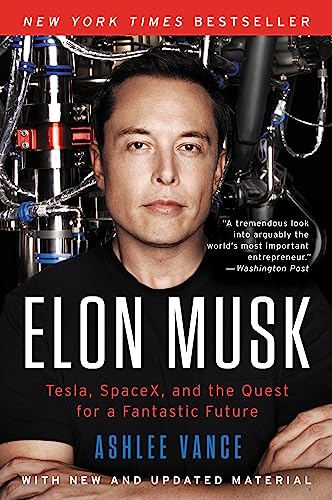

In one sentence
Vance’s central portrait is of an entrepreneur driven less by wealth than by an urgent mission: preserve humanity’s future by accelerating sustainable energy and making life multiplanetary. Musk’s effectiveness comes from combining extreme ambition, personal investment, technical immersion, recruiting power, and willingness to risk failure—but the same traits produce fear, overpromising, and destructive behavior.
Overview
The book moves chronologically from Musk’s childhood and emigration to his early internet ventures, the PayPal story, and the creation of SpaceX and Tesla. Its narrative energy comes from repeated crises: launches fail, cash runs out, production falls behind, and Musk repeatedly commits more money and credibility than conventional managers would. Vance reports through interviews with Musk, colleagues, friends, family, and former associates. The book was published May 19, 2015, and is an authorized portrait written with Musk’s cooperation, but not his final approval.
Core ideas
Mission-first entrepreneurship
Musk frames businesses as instruments for large goals: online payments, electric vehicles, solar energy, and space exploration. This mission helps attract exceptional people and tolerate losses, but it can also make ordinary constraints—profitability, schedules, employee welfare—appear secondary.
Cross-domain transfer
The biography links Musk’s ventures through a recurring pattern: use software-era speed and first-principles reasoning in industries dominated by expensive hardware, regulation, legacy suppliers, and slow institutional habits. The approach is powerful when redesigning systems, less reliable when complexity cannot be compressed into a few fundamentals.
Capital as strategic fuel
The PayPal exit supplies the money that lets Musk pursue SpaceX and Tesla simultaneously. Vance emphasizes how repeatedly staking personal wealth changes the entrepreneur’s credibility: employees and investors see commitment, but the companies also become exposed to one person’s appetite for risk.
Crisis as an operating method
SpaceX and Tesla are shaped by near-failure: rocket crashes, production problems, funding scares, and the 2008 financial crisis. Musk’s response is relentless intervention and deadline pressure. This can force breakthroughs, yet it encourages unrealistic forecasts and makes recovery depend heavily on heroic effort.
Charisma plus intimidation
Musk recruits through a compelling future-oriented narrative and a reputation for extraordinary intensity. Vance also depicts fear-based management, abrupt demands, and harsh treatment of subordinates and partners. The book’s subject is therefore not simply inspirational: the personal force that mobilizes teams can also damage them.
The ‘great entrepreneur’ problem
Vance presents Musk as a modern inventor-industrialist while giving substantial attention to collaborators, engineers, investors, and predecessors. Critics nevertheless argue that the narrative sometimes excuses or romanticizes Musk’s authoritarian conduct, so readers should distinguish the book’s explanatory portrait from an endorsement.
Practical takeaways
- A credible mission can attract talent and sustain effort through long periods when conventional business metrics look terrible.
- In capital-intensive innovation, survival may depend on sequencing ambition with financing: a technically brilliant plan is irrelevant if the organization runs out of cash first.
- Personal commitment can inspire teams, but making the founder’s identity inseparable from the company increases fragility and discourages dissent.
- Aggressive deadlines are useful as forcing functions only when paired with honest risk estimates, engineering feedback, and permission to revise the plan.
- Study the whole system, not just the celebrated founder: the biography’s crises were resolved by teams, suppliers, executives, investors, and public institutions—not by vision alone.
- Treat charismatic leadership as an amplifier rather than a virtue. It magnifies both productive urgency and abusive or reckless behavior.
Caveats and counterpoints
- This is a 2015 biography, not a complete account of Musk’s later companies, controversies, or public conduct.
- It is authorized and based on extensive access, which improves detail but may also contribute to a sympathetic framing. Kirkus specifically criticized Vance for rationalizing some of Musk’s tyrannical behavior.
- The book’s dramatic structure emphasizes exceptional breakthroughs and near-catastrophes; it may underrepresent routine execution, institutional support, and less visible contributors.
- The biography is strongest as a narrative of entrepreneurial ambition and organizational crisis, not as a neutral technical, financial, or ethical audit of Tesla, SpaceX, or SolarCity.
- Do not confuse the adult book with the separate young-readers adaptation, which was published in 2017 and extends its account into early 2016.
Questions worth revisiting
- Which parts of Musk’s success came from distinctive judgment, and which came from timing, access to capital, talented collaborators, government contracts, or favorable markets?
- When does a mission justify extraordinary risk, and who should bear the costs when the founder’s forecasts fail?
- Can a company preserve the speed and commitment of founder-led execution without reproducing fear-based management?
- Does Vance adequately separate Musk’s personal vision from the contributions of the engineers and executives who made the projects work?
- What evidence would show that ‘first principles’ reasoning is genuinely producing better decisions rather than serving as a leadership mythology?
Return to this when…
Return to these notes when evaluating founder mythology, mission-driven companies, high-risk innovation, or the tradeoff between visionary urgency and humane, reality-based management. For current information about Musk or his companies, use sources published after this 2015 book.
Highlights
“The best minds of my generation are thinking about how to make people click ads,” Jeff Hammerbacher, an early Facebook engineer, told me. “That sucks.” Silicon
“We wanted flying cars, instead we got 140 characters”
“I think the time allocated to the businesses and the kids is going fine,” Musk said. “I would like to allocate more time to dating, though. I need to find a girlfriend. That’s why I need to carve out just a little more time. I think maybe even another five to ten—how much time does a woman want a week? Maybe ten hours? That’s kind of the minimum? I don’t know.”