
In one sentence
Earthlings treats “normal society” as a coercive system rather than a neutral standard. Natsuki’s alien mythology begins as imaginative self-protection, but the novel asks whether rejecting dehumanizing rules can create freedom—or merely reproduce violence in another form.
Overview
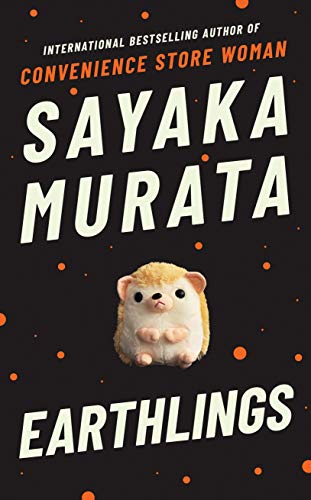
Natsuki feels unwanted at home and detached from the ordinary world. Her stuffed hedgehog, Piyyut, gives shape to an alien identity; her cousin Yuu becomes the human counterpart who shares her sense of exile. Their childhood bond and promises return with disturbing force in adulthood, when marriage, reproduction, work, and family duty are presented as mechanisms of “the Factory.” Murata’s deliberately flat, childlike perspective makes extreme events feel both dreamlike and horribly concrete. The novel moves from alienation and fantasy into psychological horror without fully settling what is literal, imagined, or symbolically true.
Core ideas
Normality as the “Factory”
Natsuki interprets society as a production system that turns people into interchangeable components, especially through expectations around work, marriage, sex, and childbirth. This metaphor makes ordinary social pressure appear industrial and predatory rather than merely annoying.
Fantasy as survival—and danger
The Popinpobopian/alien framework gives Natsuki and Yuu language for experiences they cannot safely describe. It protects them from an intolerable reality, but the novel also shows how a survival narrative can become rigid, isolating, and self-destructive when it replaces every other way of understanding the world.
Childhood trauma carried forward
The book links adult extremity to earlier abuse, neglect, sexual violation, family favoritism, and emotional abandonment. It does not present childhood innocence as untouched purity: children absorb the categories and cruelties imposed by adults, then may repeat or radically invert them.
The outsider bond
Natsuki, Yuu, and later Tomoya form an unstable community of people who cannot or will not perform conventional adulthood. Their connection offers recognition unavailable from family or society, but it also raises a difficult question: is solidarity still liberating when it depends on shared delusion, secrecy, or escalating transgression?
Deadpan style and moral distance
Murata’s restrained, matter-of-fact prose refuses to signal how readers should feel. That tonal flatness can make the narration seem childlike, dissociated, comic, or horrifying; reviewers disagree about whether the later grotesquerie deepens the critique or overwhelms it.
A deliberately unstable reality
The alien story works simultaneously as literal fantasy, dissociative defense, and metaphor for social alienation. The novel’s power depends less on deciding which interpretation is correct than on noticing how each possibility changes our judgment of Natsuki’s choices and of the society she rejects.
Practical takeaways
- When a character calls society “the Factory,” notice how the metaphor exposes the hidden assumptions behind supposedly natural roles.
- Distinguish nonconformity from healing: escaping a harmful norm does not automatically produce a humane alternative.
- Pay attention to whose language is available to describe harm. Natsuki’s alien vocabulary is both a refuge and a limit.
- The book is useful to revisit alongside Convenience Store Woman: both question conformity, but Earthlings pushes that question into much darker territory.
- Remember that the novel’s shock is part of its method, not simply its subject. Its extreme material tests whether readers can criticize social violence without romanticizing every form of revolt.
Caveats and counterpoints
- This is an exceptionally disturbing book, including child abuse, sexual abuse, incestuous material, coercive family dynamics, murder, starvation, severe dissociation, and cannibalism.
- The catalogue description is broadly accurate but understates the novel’s horror, explicitness, and escalating violence.
- Critical responses divide sharply: some find the grotesque ending a powerful literalization of dehumanization; others argue that its luridness weakens the earlier social critique.
- Natsuki’s perspective is not a reliable guide to either events or ethics. Treat her explanations as psychologically meaningful without assuming they are objectively true.
- The novel criticizes coercive norms, but it should not be read as endorsing abuse, violence, or the destruction of ordinary ethical distinctions.
Questions worth revisiting
- What does the alien metaphor allow Natsuki to understand that ordinary social language conceals?
- Where does resistance remain a form of agency, and where does it become another kind of imprisonment?
- How does the childlike narrative voice alter your response to adult responsibility and violence?
- Does the novel distinguish between chosen nonconformity and trauma-driven detachment?
- Are Natsuki and Yuu escaping society, or reproducing its logic in inverted form?
- How much does the final movement clarify the novel’s argument—and how much does it deliberately resist clarification?
Return to this when…
Return to these notes when comparing Murata’s treatment of conformity, gender, reproduction, and alienation across Earthlings and Convenience Store Woman; when discussing unreliable or dissociative narrators; or when examining how literary fiction uses horror to make social violence feel physically real.
References
- Book Marks reviews of Earthlings by Sayaka Murata, tr. Ginny Tapley Takemori Book Marks
- Earthlings Themes | SuperSummary
- BOOK REVIEW: EARTHLINGS BY SAYAKA MURATA
- Earthlings by undefined
- Sayaka Murata's 'Earthlings': Alienated misfits fight against the ties that bind - The Japan Times
- books.apple.com
- en.wikipedia.org
- theguardian.com
- kirkusreviews.com
- groveatlantic.com
- lspopovich.com
- fivebooks.com