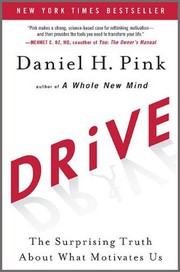

In one sentence
People are not motivated only by external rewards or threats. Once basic needs and fair compensation are reasonably addressed, sustained motivation—especially for non-routine work—depends more on having control over one’s activity, improving at something meaningful, and serving a worthwhile aim.
Overview
Pink describes an evolution from biological drives (“Motivation 1.0”) to carrot-and-stick incentives (“Motivation 2.0”), and argues for an updated “Motivation 3.0” suited to modern work. He uses research on intrinsic motivation, incentives, creativity, and flow to challenge command-and-control management. The book’s second half applies the model through recommendations for organizations, educators, parents, and individuals.
Core ideas
External incentives have limits
Rewards can be useful for routine, clearly specified tasks, but they can undermine interest, creativity, ethical judgment, or persistence when applied to complex work. Pink’s point is not that money never matters; rather, incentives are a poor substitute for good work design and can distort behavior when treated as the main motivational system.
Autonomy
People are more engaged when they have meaningful discretion over aspects of their work—such as what they do, how they do it, when they do it, or whom they work with. Autonomy does not mean the absence of goals or accountability; it means replacing unnecessary control with self-direction.
Mastery
Mastery is the ongoing desire to become better at something that matters. It is inherently incomplete: progress is motivating, but total mastery is never finally reached. Useful conditions include appropriately difficult challenges, feedback, deliberate practice, and enough freedom to experiment.
Purpose
Motivation strengthens when people can connect their work to a larger contribution rather than seeing it as mere task completion. Purpose can operate at the level of an organization’s mission, a profession’s social value, or an individual’s chosen commitments.
The practical formula
Pink’s memorable framework is autonomy + mastery + purpose: freedom to direct effort, a path of meaningful improvement, and a reason the effort matters. The three elements are best treated as mutually reinforcing rather than as a ranked list.
Practical takeaways
- When trying to motivate someone, first check for unfair pay, unclear expectations, impossible workloads, or lack of competence; intrinsic motivation cannot reliably compensate for those problems.
- Offer bounded choice: define the outcome and constraints, but allow discretion over methods, sequencing, or presentation.
- Replace vague exhortations to “do better” with a visible learning loop: a challenging task, timely feedback, reflection, and another attempt.
- Explain who benefits from the work and how it connects to a larger goal; purpose is more credible when demonstrated through decisions, not slogans.
- Use rewards carefully: make compensation fair and transparent, avoid turning every desirable behavior into a contest, and do not use bonuses to compensate for poor job design.
- For personal goals, ask three questions: What choice do I genuinely have? What skill am I trying to develop? Why is this worth doing?
Caveats and counterpoints
- Pink’s contrast between carrots-and-sticks and intrinsic motivation is rhetorically sharp and useful, but reviewers note that the book can be one-sided. External rewards remain relevant for routine work, immediate behavior shaping, and situations where people lack interest or meaningful choice.
- Autonomy is not simply “letting people do whatever they want.” Without competence, resources, coordination, and clear boundaries, increased discretion can create confusion or overload.
- Purpose can become managerial manipulation if leaders invoke a noble mission while withholding fair pay, security, voice, or humane working conditions.
- The book popularizes a three-part framework related to established motivation research; its accessibility is a strength, but it should not be treated as a complete theory of motivation or as a universal management recipe.
Questions worth revisiting
- Where in my work am I being controlled unnecessarily, and where would more autonomy create real value?
- What kind of progress would count as mastery for the next three months?
- Can I state the purpose of this task in concrete human terms, without using corporate abstractions?
- Am I using a reward because it supports the work—or because I have not improved the work itself?
- Which tasks genuinely require intrinsic motivation, and which are sufficiently routine for straightforward incentives?
Return to this when…
Return to this book when designing roles, incentives, learning routines, or personal goals—especially when people are complying but not engaged. The key diagnostic is whether the environment supports meaningful choice, improvement, and contribution, rather than merely adding another reward.
Highlights
If that seems far-fetched, consider some of our other bizarre behaviors. We leave lucrative jobs to take low-paying ones that provide a clearer sense of purpose. We work to master the clarinet on weekends although we have little hope of making a dime (Motivation 2.0) or acquiring a mate (Motivation 1.0) from doing so. We play with puzzles even when we don’t get a few raisins or dollars for solving them.
As organizations flatten, companies need people who are self-motivated. That forces many organizations to become more like, er, Wikipedia. Nobody “manages” the Wikipedians. Nobody sits around trying to figure out how to “motivate” them. That’s why Wikipedia works. Routine, not-so-interesting jobs require direction; nonroutine, more interesting work depends on self-direction. One business leader, who didn’t want to be identified, said it plainly. When he conducts job interviews, he tells prospective employees: “If you need me to motivate you, I probably don’t want to hire you.”
Soon more boys arrive, all of whom tumble into Tom’s trap and end up whitewashing the fence—several times over—on his behalf. From this episode, Twain extracts a key motivational principle, namely “that Work consists of whatever a body is OBLIGED to do, and that Play consists of whatever a body is not obliged to do.”
There are wealthy gentlemen in England who drive four-horse passenger-coaches twenty or thirty miles on a daily line, in the summer, because the privilege costs them considerable money; but if they were offered wages for the service, that would turn it into work and then they would resign.
Reporting the results for the Federal Reserve Bank of Boston, the researchers wrote, “In eight of the nine tasks we examined across the three experiments, higher incentives led to worse performance.”
The candle problem solved. The key is to overcome what’s called “functional fixedness.” You look at the box and see only one function—as a container for the tacks. But by thinking afresh, you eventually see that the box can have another function—as a platform for the candle.
Not always, but a lot of the time, when you are doing a piece for someone else it becomes more “work” than joy. When I work for myself there is the pure joy of creating and I can work through the night and not even know it. On a commissioned piece you have to check yourself—be careful to do what the client wants.
Up pops another bug in Motivation 2.0. One reason most parents showed up on time is that they had a relationship with the teachers—who, after all, were caring for their precious sons and daughters—and wanted to treat them fairly. Parents had an intrinsic desire to be scrupulous about punctuality. But the threat of a fine—like the promise of the kronor in the blood experiment—edged aside that third drive. The fine shifted the parents’ decision from a partly moral obligation (be fair to my kids’ teachers) to a pure transaction (I can buy extra time). There wasn’t room for both. The punishment didn’t promote good behavior; it crowded it out.
As Suvorov explains, “Rewards are addictive in that once offered, a contingent reward makes an agent expect it whenever a similar task is faced, which in turn compels the principal to use rewards over and over again.” And before long, the existing reward may no longer suffice. It will quickly feel less like a bonus and more like the status quo—which then forces the principal to offer larger rewards to achieve the same effect.
Get people fired up with the prospect of rewards, and instead of making better decisions, as Motivation 2.0 hopes, they can actually make worse ones. As Knutson writes, “This may explain why casinos surround their guests with reward cues (e.g., inexpensive food, free liquor, surprise gifts, potential jackpot prizes)—anticipation of rewards activates the [nucleus accumbens], which may lead to an increase in the likelihood of individuals switching from risk-averse to risk-seeking behavior.”22 In short, while that dangled carrot isn’t all bad in all circumstances, in some instances it operates similar to a rock of crack cocaine and can induce behavior similar to that found around the craps table or roulette wheel—not exactly what we hope to achieve when we “motivate” our teammates and coworkers.
CARROTS AND STICKS: The Seven Deadly Flaws 1. They can extinguish intrinsic motivation. 2. They can diminish performance. 3. They can crush creativity. 4. They can crowd out good behavior. 5. They can encourage cheating, shortcuts, and unethical behavior. 6. They can become addictive. 7. They can foster short-term thinking.
In other words, where “if-then” rewards are a mistake, shift to “now that” rewards—as in “Now that you’ve finished the poster and it turned out so well, I’d like to celebrate by taking you out to lunch.” As Deci and his colleagues explain, “If tangible rewards are given unexpectedly to people after they have finished a task, the rewards are less likely to be experienced as the reason for doing the task and are thus less likely to be detrimental to intrinsic motivation.”
Type I behavior promotes greater physical and mental well-being. According to a raft of studies from SDT researchers, people oriented toward autonomy and intrinsic motivation have higher self-esteem, better interpersonal relationships, and greater general well-being than those who are extrinsically motivated. By contrast, people whose core aspirations are Type X validations such as money, fame, or beauty tend to have poorer psychological health. There’s even a connection between Type X and Type A. Deci found that those oriented toward control and extrinsic rewards showed greater public self-consciousness, acted more defensively, and were more likely to exhibit the Type A behavior pattern.5 Ultimately, Type I behavior depends on three nutrients: autonomy, mastery, and purpose. Type I behavior is self-directed. It is devoted to becoming better and better at something that matters. And it connects that quest for excellence to a larger purpose.
For instance, while many enterprises are offshoring work to low-cost providers overseas, some companies are reversing the trend by beginning what’s known as “homeshoring.” Instead of requiring customer service reps to report to a single large call center, they’re routing the calls to the employees’ homes. This cuts commuting time for staff, removes them from physical monitoring, and provides far greater autonomy over how they do their jobs.
In the midst of play, many people enjoyed what Csikszentmihalyi called “autotelic experiences”—from the Greek auto (self ) and telos (goal or purpose). In an autotelic experience, the goal is self-fulfilling; the activity is its own reward. Painters he observed during his Ph.D. research, Csikszentmihalyi said, were so enthralled in what they were doing that they seemed to be in a trance. For them, time passed quickly and self-consciousness dissolved. He sought out other people who gravitated to these sorts of pursuits—rock climbers, soccer players, swimmers, spelunkers—and interviewed them to discover what made an activity autotelic. It was frustrating. “When people try to recall how it felt to climb a mountain or play a great musical piece,” Csikszentmihalyi later wrote, “their stories are usually quite stereotyped and uninsightful.”3 He needed a way to probe people’s experiences in the moment. And in the mid-1970s, a bold new technology—one that any twelve-year-old now would find laughingly retrograde—came to the rescue: the electronic pager.
From these results, Csikszentmihalyi began to peel back the layers of those autotelic experiences. Perhaps equally significant, he replaced that wonky Greek-derived adjective with a word he found people using to describe these optimal moments: flow. The highest, most satisfying experiences in people’s lives were when they were in flow.
Green Cargo, thatgamecompany, and the companies employing the patent-cranking scientists typically use two tactics that their less savvy competitors do not. First, they provide employees with what I call “Goldilocks tasks”—challenges that are not too hot and not too cold, neither overly difficult nor overly simple. One source of frustration in the workplace is the frequent mismatch between what people must do and what people can do. When what they must do exceeds their capabilities, the result is anxiety. When what they must do falls short of their capabilities, the result is boredom.
Another doctor, one who lacks a Ph.D. but has a plaque in the Basketball Hall of Fame in Springfield, Massachusetts, put it similarly. “Being a professional,” Julius Erving once said, “is doing the things you love to do, on the days you don’t feel like doing them.”
“One cannot lead a life that is truly excellent without feeling that one belongs to something greater and more permanent than oneself.”
In 1962, Clare Boothe Luce, one of the first women to serve in the U.S. Congress, offered some advice to President John F. Kennedy. “A great man,” she told him, “is one sentence.” Abraham Lincoln’s sentence was: “He preserved the union and freed the slaves.” Franklin Roosevelt’s was: “He lifted us out of a great depression and helped us win a world war.” Luce feared that Kennedy’s attention was so splintered among different priorities that his sentence risked becoming a muddled paragraph.
Finite and Infinite Games: A Vision of Life as Play and Possibility BY JAMES P. CARSE
Talent Is Overrated: What Really Separates World-Class Performers from Everybody Else BY GEOFF COLVIN
Flow: The Psychology of Optimal Experience BY MIHALY CSIKSZENTMIHALYI
Why We Do What We Do: Understanding Self-Motivation BY EDWARD L. DECI WITH RICHARD FLASTE
Mindset: The New Psychology of Success BY CAROL DWECK
Then We Came to the End BY JOSHUA FERRIS
Good Work: When Excellence and Ethics Meet BY HOWARD GARDNER, MIHALY CSIKSZENTMIHALYI, AND WILLIAM DAMON
Outliers: The Story of Success BY MALCOLM GLADWELL
Team of Rivals: The Political Genius of Abraham Lincoln BY DORIS KEARNS GOODWIN
Maverick: The Success Story Behind the World’s Most Unusual Workplace BY RICARDO SEMLER
The Fifth Discipline: The Art and Practice of the Learning Organization BY PETER M. SENGE
Why Work Sucks and How to Fix It,
TWITTER SUMMARYg Carrots & sticks are so last century. Drive says for 21st century work, we need to upgrade to autonomy, mastery & purpose.
COCKTAIL PARTY SUMMARYh When it comes to motivation, there’s a gap between what science knows and what business does. Our current business operating system—which is built around external, carrot-and-stick motivators—doesn’t work and often does harm. We need an upgrade. And the science shows the way. This new approach has three essential elements: (1) Autonomy—the desire to direct our own lives; (2) Mastery—the urge to get better and better at something that matters; and (3) Purpose—the yearning to do what we do in the service of something larger than ourselves.
Our “default setting” is to be autonomous and self-directed. Unfortunately, circumstances—including outdated notions of “management”—often conspire to change that default setting and turn us from Type I to Type X. To encourage Type I behavior, and the high performance it enables, the first requirement is autonomy. People need autonomy over task (what they do), time (when they do it), team (who they do it with), and technique (how they do it). Companies that offer autonomy, sometimes in radical doses, are outperforming their competitors.
References
- ERIC - EJ934720 - Finding Our Drive: Autonomy, Mastery, and Purpose, Independent School, 2011
- assumptionjournal.au.edu
- building-performance.org
- DRIVE | Kirkus Reviews
- en.wikipedia.org
- Book Review—Drive - Iowa State University Digital Repository
- Drive by Dan Pink: Scholarly Book Review – Madeleine Brookes
- coaching-focus.com
- HR Magazine - Review of Drive: The surprising Truth of What Motivates Us, by Dan Pink
- entrepreneur.com
- envisionexperience.com
- latimes.com