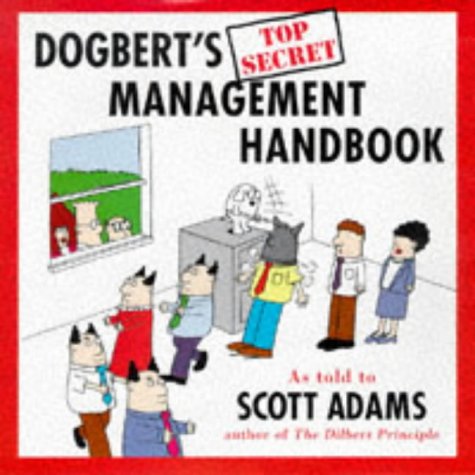

In one sentence
The book’s central joke is that many conventional management practices become absurd when their incentives are made explicit: managers can appear effective through jargon, rituals, symbolic rewards, and strategic avoidance rather than through good decisions or improved results. Its satire works by presenting cynical behavior as a formal management method.
Overview
Published in the mid-1990s as a HarperBusiness/HarperCollins title, the book is organized around practical-sounding management topics: acting like a manager, motivating employees, communicating, success strategies, compensation, dismissing employees, and managerial happiness, followed by appendices. It combines brief prose with Dilbert cartoons rather than offering a conventional evidence-based management system.
Core ideas
Managerial appearance can substitute for managerial competence
Dogbert’s imagined advice treats leadership as performance: use the posture, vocabulary, and rituals of authority while avoiding difficult decisions or accountability. The target is the gap between looking managerial and actually improving work.
Incentives reveal what organizations really value
The jokes repeatedly invert the normal promise of motivation. Token prizes, meaningless recognition, or carefully controlled compensation can be used to signal appreciation without surrendering money, power, or flexibility. The satirical lesson is to inspect rewards for their real cost and behavioral effect.
Communication can obscure rather than clarify
Corporate language is portrayed as a tool for avoiding direct statements. Jargon, meetings, slogans, and vague goals allow leaders to sound coordinated while preserving ambiguity and plausible deniability.
Bureaucracy protects itself
Processes that supposedly support efficiency may instead preserve hierarchy, diffuse responsibility, and make poor decisions difficult to challenge. The comic framing highlights how organizational systems can reward compliance with procedure over useful outcomes.
Employees bear the cost of managerial self-interest
The handbook’s recurring perspective is that workplace policies often protect managers and institutions first. Employees absorb the consequences through stagnant pay, arbitrary evaluation, unnecessary work, and decisions made far from the work itself.
Cynicism is a diagnostic lens, not a complete philosophy
Dogbert’s voice helps readers notice contradictions in management rhetoric, but the book’s deliberately malicious advice is best read as a stress test: ask what a policy would look like if its hidden incentives were openly acknowledged.
Practical takeaways
- When evaluating a management initiative, ask what behavior it rewards, who bears its costs, and how success will be measured.
- Distinguish genuine recognition from low-cost symbolic gestures that substitute for fair compensation, staffing, or autonomy.
- Translate corporate jargon into concrete claims: who will do what, by when, with which authority and resources?
- Watch for systems that make responsibility diffuse while making compliance highly visible.
- Treat cartoons and cynical hypotheticals as prompts for organizational diagnosis, not as literal leadership advice.
- If a policy sounds impressive but does not improve decisions, coordination, output, or employee conditions, its main function may be impression management.
Caveats and counterpoints
- This is satire, not a research-based management manual; its exaggerations are designed to expose patterns rather than establish universal laws.
- Its workplace targets are strongly rooted in 1990s corporate culture, including office bureaucracy and conventional hierarchy. Some examples may feel dated even when the underlying incentive problems remain recognizable.
- The book emphasizes managerial dysfunction and employee powerlessness, so it offers less guidance on constructive leadership, ethical change, or situations where management genuinely improves coordination.
- Because Dogbert is intentionally manipulative, readers should separate the author’s comic framing from endorsements of exploitation or deception.
Questions worth revisiting
- Which current workplace rituals create the appearance of progress without changing decisions or results?
- Where do our stated values conflict with compensation, promotion, staffing, or evaluation practices?
- Which forms of communication in my organization clarify responsibility, and which mainly protect people from accountability?
- What would employees identify as the real purpose of a policy—not its official justification?
- Where might my own cynicism be useful as diagnosis, and where might it prevent constructive action?
Return to this when…
Return to this book when a management initiative feels polished but strangely empty, when incentives seem misaligned, or when workplace language is obscuring rather than solving a problem. Its value is as a compact satire of organizational self-deception—not as a contemporary management playbook.
References
- Dogbert's top secret management handbook by Scott Adams | Open Library
- openlibrary.org
- Dogbert's Top Secret Management Handbook - Scott Adams - Google Books
- books.google.com
- openlibrary.org
- books.google.com
- search.worldcat.org
- preview.wellcomecollection.org
- goodreads.com
- wellsvillelibrary.org
- lib.umi.ac.ug
- goodreads.com