
In one sentence
Observed disparities are real, but their causes are plural and must be demonstrated rather than inferred. Sowell’s central warning is against treating unequal outcomes as proof of injustice—and then using that assumption to justify policies whose effects may worsen the problems they aim to solve.
Overview
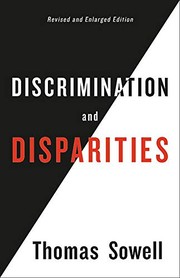
The book develops an empirical and comparative framework for analyzing disparities among people, groups, and nations. It distinguishes discrimination from other forms of selection and unequal treatment, discusses how statistical patterns can mislead, and argues that historical circumstances, social practices, incentives, and accumulated advantages often interact. The revised and enlarged edition adds discussion of consequences in education, crime, and public policy.
Core ideas
Disparity is an outcome, not an explanation
A gap between groups establishes a difference in results, not its cause. The same disparity may arise from discrimination, different skills or preferences, geography, timing, migration patterns, institutional rules, family structure, or historical starting points.
Separate kinds of discrimination
Sowell distinguishes discrimination involving prejudice or unequal treatment from selection based on relevant differences, imperfect information, or risk. His analytical point is that unequal treatment is not automatically evidence of bigotry; the mechanism and decision rule must be investigated.
The fallacy of one-factor explanations
The book rejects explanations that treat discrimination, exploitation, genetics, or culture as a universal cause. Complex outcomes generally reflect multiple interacting conditions, and a plausible factor is not necessarily the dominant factor in a particular case.
Selection and sorting shape group averages
People and groups are not randomly distributed across places, occupations, schools, or historical periods. Migration, self-selection, age composition, family structure, and occupational sorting can produce large average differences without a single coercive force producing them.
Numbers require a counterfactual
To claim that discrimination caused a disparity, one needs some comparison showing what would likely have happened absent the alleged discrimination. Simple before-and-after comparisons or comparisons of group averages can conceal changing conditions and omitted variables.
Policy has trade-offs and feedback effects
Policies designed to equalize outcomes can alter incentives, standards, behavior, and institutional selection. Sowell’s preferred test is not whether a policy expresses compassion or fairness, but whether it produces better results after its indirect effects are counted.
Social visions matter
The final part contrasts a constrained vision—accepting limits on knowledge and trade-offs—with a more unconstrained vision that assumes social problems can be redesigned through informed intervention. This difference helps explain disagreements about remedies, not merely about evidence.
Practical takeaways
- When presented with a disparity, ask four questions: What exactly is being measured? Compared with what? Through which mechanism? What alternative explanations have been tested?
- Do not confuse equal representation with equal opportunity, equal treatment, or equal outcomes; these are distinct goals with different policy implications.
- Look for selection effects before interpreting group averages—for example, who migrates, who remains, who enters an occupation, and who is excluded from the comparison.
- Treat historical explanations as causal claims requiring evidence, not as automatic interpretations of present-day gaps.
- Evaluate interventions by their opportunity costs, behavioral responses, and unintended consequences—not only by their stated purpose.
- Use the book as a framework for skepticism and causal analysis, not as a reason to dismiss documented discrimination in particular institutions or markets.
Caveats and counterpoints
- The book is an argument-driven synthesis rather than a systematic review of the full contemporary literature. Jennifer Doleac’s review in the Journal of Economic Literature finds its discussion of economic concepts useful but argues that Sowell is too pessimistic about government’s ability to improve outcomes; she favors experimentation and rigorous evaluation.
- Sowell’s emphasis on non-discriminatory explanations can be overextended if readers treat the existence of alternative causes as evidence that discrimination is unimportant. Showing that a disparity could arise without discrimination does not establish that discrimination did not contribute to it.
- The book often moves from comparative examples and broad historical patterns to policy conclusions. Those examples can illuminate mechanisms, but they do not always identify the relative causal importance of competing explanations in a specific modern case.
- Its critique is strongest against simplistic claims that disparities automatically prove oppression. It is less decisive when evaluating carefully specified evidence of institutional discrimination, persistent unequal treatment, or policies supported by credible causal studies.
Questions worth revisiting
- Which disparities does Sowell explain through selection, geography, or history, and which does he leave as genuinely unresolved?
- What evidence would distinguish prejudice-based discrimination from rational selection under imperfect information?
- When does a disparity become sufficiently persistent, large, or institutionally patterned to warrant policy intervention?
- How should the book’s constrained-vision framework handle cases where markets reproduce historical disadvantage?
- Which policy claims in the book have since been tested by stronger empirical research?
- Does rejecting equal outcomes as a goal risk underestimating the political or social value some people attach to equality?
Return to this when…
Return to the book when evaluating claims that a group gap proves a single cause, especially in debates about race, education, crime, employment, immigration, or affirmative action. Its most useful refresher is the discipline of separating observed outcomes from causal explanations and judging policies by effects rather than intentions.
References
- A Review of Thomas Sowell's Discrimination and Disparities - American Economic Association
- Discrimination and Disparities - Thomas Sowell - Google Books
- Discrimination and Disparities by Thomas Sowell | Sowell.org
- books.apple.com
- search.worldcat.org
- ideas.repec.org
- hachettebookgroup.com
- hachette.co.uk
- catalog.camdencountylibrary.org
- tallons.law.utexas.edu
- docslib.org
- goodreads.com