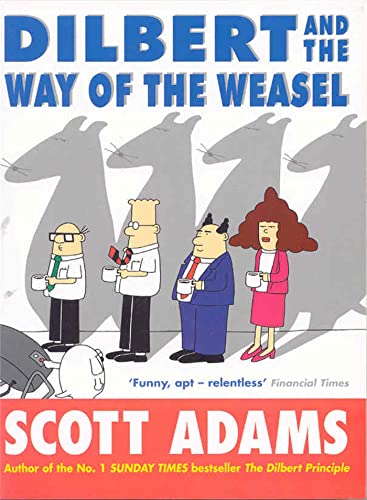

In one sentence
Adams’s central comic premise is that people routinely pursue self-interest while disguising it as competence, fairness, cooperation, or principle. Understanding these “weasel” tactics can help readers recognize office politics, avoid being exploited, and sometimes maneuver within bureaucracies—but the book presents this mainly as satire, not tested organizational science.
Overview
The book’s 27-chapter structure moves from avoiding work and entertaining oneself at work to getting one’s way, dealing with managers, negotiating, finance, marketing, sales, CEOs, social behavior, debate, whining, products, justice, and the “weasel mind.” The recurring device is to describe questionable behavior as a recognizable survival strategy, then exaggerate it until its logic becomes visible.
Core ideas
“Weasel” as a behavioral category
A weasel is not simply an incompetent or immoral person. In Adams’s framing, the type succeeds by exploiting ambiguity: making promises that are difficult to measure, shifting responsibility, controlling appearances, or benefiting from rules without openly violating them.
Office politics rewards visibility and narrative
The book treats organizations as systems where perceived contribution can matter more than actual contribution. Managing impressions, documenting activity, assigning blame, and appearing aligned with leadership may determine outcomes as much as doing useful work.
Evasion is often more efficient than confrontation
Many examples revolve around indirect tactics: delay, vague commitments, procedural objections, selective communication, and turning a problem into someone else’s responsibility. The comic insight is that bureaucracy supplies ready-made cover for these moves.
Language can conceal rather than clarify
Corporate, managerial, sales, and political language is portrayed as a tool for avoiding precise commitments. A practical reading is to translate abstractions into questions such as: Who owns this? What exactly will be delivered? By when? How will success be measured?
The advice is double-edged
Adams sometimes explains how to outmaneuver weasels, but the satire also exposes the cost: distrust, unfairness, wasted effort, and organizations that reward appearance over results. The implied ethical distinction is between recognizing manipulation and adopting it as a way of life.
Humor is the analytical method
The Dilbert cartoons and deliberately exaggerated categories make patterns memorable, but they also flatten differences among ordinary self-protection, incompetence, strategic politics, and genuine bad faith. The book works best as observational satire rather than a diagnostic framework.
Practical takeaways
- Look for mismatches between stated goals and actual incentives; behavior usually follows the latter.
- Turn vague promises into explicit owners, deliverables, deadlines, and decision rights.
- Keep a factual record of decisions and dependencies when blame-shifting is likely.
- Do not confuse busyness, confident language, or managerial visibility with useful work.
- When someone uses procedure to avoid substance, return the discussion to the concrete outcome required.
- Use the book’s categories as prompts for noticing behavior, not as proof that everyone is acting cynically.
- Treat “outweaseling” as a defensive tactic of last resort: repeated use damages trust and can reproduce the culture being mocked.
Caveats and counterpoints
- The book is intentionally cynical and anecdotal; the available bibliographic and review material presents it as humor and office satire, not evidence-based management research.
- Its broad claim that people are fundamentally “weasels” can become self-sealing: any cooperation may be reinterpreted as concealed manipulation.
- Advice that is funny in a comic strip—especially evasion, blame deflection, or strategic nonperformance—can be unethical, damaging to colleagues, and risky in accountable workplaces.
- The workplace examples reflect an early-2000s corporate world: cubicles, conventional hierarchies, and office politics. Remote work, flatter teams, and modern compliance systems may change the form of the tactics without eliminating the underlying incentive problems.
- Because the book mixes commentary, cartoons, and many short topical chapters, readers seeking a coherent theory of management or organizational behavior may find it repetitive and unsystematic.
Questions worth revisiting
- Which “weasel” behaviors are actually rational responses to bad incentives rather than personal dishonesty?
- Where is the line between prudent self-protection and manipulation?
- What measurements or feedback systems would make the described tactics less effective?
- Which parts remain recognizable in remote or highly collaborative workplaces?
- Does treating organizations as cynical systems help one resist exploitation, or does it encourage the same distrust and opportunism?
- What would a constructive, non-satirical companion guide recommend doing instead?
Return to this when…
Return to this book when diagnosing office-politics patterns, reviewing incentives, or needing a humorous reminder to translate corporate language into observable commitments. It is most useful as a memorable catalog of failure modes—not as a literal handbook for ethical conduct or a reliable theory of human nature.