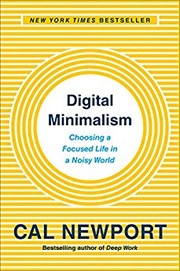

In one sentence
A good digital life requires intentional selection, not default participation. Newport’s central test is whether a tool strongly supports something important—and whether it is the best way to do so. The goal is not technological purity, but greater control over attention, time, and meaningful activity.
Overview
The book has two movements: first, an argument for digital minimalism and against casually accumulating apps, feeds, and notifications; second, a practical program for adopting it. Newport presents the 30-day Digital Declutter, followed by selective reintroduction, and recommends rebuilding offline sources of satisfaction rather than merely enduring an empty screen-free period. His examples include participants in his declutter experiment and communities that protect face-to-face life and deliberate leisure.
Core ideas
Clutter is costly
Small digital benefits can conceal larger costs: fragmented attention, compulsive checking, anxiety, and displacement of more valuable activities. A tool does not earn a permanent place merely because it provides some benefit. Newport’s framework treats time and attention as scarce resources that require active protection.
Values before tools
Begin with a clear account of what makes life worthwhile—such as family, craftsmanship, civic engagement, health, or friendship—then choose technology in service of those values. This reverses the usual pattern of adopting a tool first and inventing reasons to keep it.
Optimization matters
Even a useful service should be used deliberately. Ask what exact value it provides, what costs accompany it, and whether another method provides more value with less distraction. “Useful” is only the first filter; the stronger question is whether the tool is the best available method.
The Digital Declutter
For thirty days, remove optional technologies—not only social-media apps, but any nonessential digital behavior whose absence will not cause serious harm. During the break, observe what you miss, what improves, and what activities fill the recovered time. Reintroduce tools one at a time with explicit operating rules, rather than automatically restoring the old setup.
Solitude is a human need
Newport treats solitude as time free from input, reaction, and other people’s thoughts—not simply physical isolation. Constant messaging, feeds, audio, and notifications can prevent reflective thought. Deliberate periods without digital input help restore the ability to think independently and tolerate one’s own company.
High-quality leisure beats passive consumption
Removing digital noise is insufficient if the reclaimed time becomes television, aimless browsing, or other passive consumption. Newport favors demanding, concrete, often analog activities: making things, learning skills, exercising, reading, engaging in community, and sustaining face-to-face relationships.
Conversation over connection
Lightweight digital contact can create the feeling of social connection without the depth of actual conversation. Newport recommends favoring richer forms—especially in-person meetings and voice calls—and using texting or social platforms as tools for arranging meaningful contact, not as substitutes for it.
Practical takeaways
- Write down the values and life activities your technology should support before evaluating particular apps.
- List every optional digital tool or behavior, then conduct a thirty-day declutter. Define exceptions narrowly for work, safety, logistics, or essential relationships.
- For each tool you restore, specify its purpose, when you will use it, where you will use it, and what limits prevent default or compulsive use.
- Remove social-media apps from your phone, disable nonessential notifications, and batch-check messages instead of responding continuously.
- Replace deleted habits with scheduled alternatives: exercise, reading, hands-on projects, clubs, volunteering, classes, or recurring social plans.
- Create regular solitude: walks without audio, device-free meals, or periods of thinking and writing without incoming information.
- Judge success by whether your days contain more valued activity and attention—not merely by a lower screen-time number.
Caveats and counterpoints
- The book is a philosophical and practical argument, not a clinical treatment for addiction or a comprehensive empirical review of digital-media effects. Its anecdotes and experiment are useful illustrations but should not be treated as definitive causal evidence.
- A thirty-day abstinence period may be difficult or impractical for people whose work, caregiving, education, disability support, or relationships depend heavily on digital services. The method needs adaptation rather than rigid imitation.
- Newport’s emphasis on individual choice can understate structural problems: persuasive design, workplace expectations, social isolation, unequal access to offline activities, and platforms’ business incentives. Critics argue that personal productivity solutions may leave these broader cultural issues untouched.
- The book can sound more confident about the superiority of offline leisure than the evidence warrants. Online communities, games, creative tools, and digital communication can be central sources of belonging and meaning for some people; the relevant question is their role and cost in a particular life.
- The advice works best when decluttering is paired with positive replacement activities. Removing apps without rebuilding social, recreational, or reflective routines can leave boredom and loneliness intact.
Questions worth revisiting
- Which of my current digital tools strongly supports a value I genuinely prioritize?
- What do I use because it is valuable, and what do I use because it is merely available, habitual, or socially expected?
- What is the best non-digital or lower-distraction method for staying informed, maintaining relationships, or organizing my life?
- What offline activities would make the first week of a declutter rewarding rather than merely restrictive?
- Which tool would I miss for a real reason—and which absence would mainly feel uncomfortable?
- What operating rules would let me keep a useful tool without allowing it to dominate my attention?
Return to this when…
Return to this book when phone use feels automatic, when attention is fragmented, or when a new app or platform is becoming socially compulsory. Revisit especially the distinction between “some benefit” and “best method,” and repeat a shorter declutter when your digital environment has accumulated more tools than your values can justify.