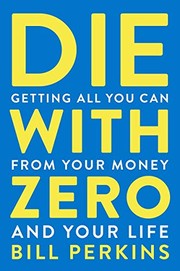

In one sentence
Money is a means of converting limited working years into a fulfilling life. Perkins’s target is not literally zero dollars at death so much as avoiding the predictable mistake of accumulating wealth that arrives too late to be enjoyed. He calls for optimizing “net fulfillment”—the value of experiences, relationships, and impact over a lifetime—rather than net worth.
Overview
The book challenges the default sequence of work hard, save maximally, retire, and enjoy life later. Its central observation is that health, free time, and money rarely peak together: youth often has health and time but little money; midlife has more money but less time; later life may have money but reduced health. Perkins therefore recommends matching spending to the periods when particular experiences are most valuable. The nine-chapter structure moves from life optimization and experiences to spending, inheritance, time-bucketing, peak years, and calculated risk.
Core ideas
Optimize fulfillment, not the account balance
Treat wealth as stored effort and life energy, then ask what it is for. A larger portfolio is not automatically a better outcome if it represents experiences postponed until they are less enjoyable or impossible.
Experiences generate “memory dividends”
A good experience can pay repeatedly through anticipation, the event itself, later recollection, storytelling, and shared meaning. This is Perkins’s case for prioritizing experiences over some material consumption.
Timing matters as much as affordability
An experience has an age-sensitive window. A physically demanding trip, an adventure with children, or time with aging parents may lose much of its value if delayed. Spending should therefore be evaluated by both price and the life stage at which it occurs.
Use time buckets
Divide the rest of life into periods and assign desired experiences to them. The exercise exposes “someday” plans, forces scheduling, and makes it harder to spend every year on work while assuming future health and availability.
Know your peak and spend earlier when appropriate
Perkins encourages identifying when different activities will be most enjoyable and shifting money toward those years. The goal is not uniformly high spending, but deliberate spending that tracks changing health, interests, obligations, and opportunity.
Give inheritances while they can help
If leaving money to children is a goal, Perkins favors giving earlier—when recipients may be buying homes, raising children, or building careers—rather than transferring wealth only after the parents’ death.
Take calculated risks, not foolish ones
The book distinguishes meaningful risks that buy time or memorable experiences from risks that endanger basic security. Boldness is justified only after accounting for downside, responsibilities, and the possibility that future health will not cooperate.
Practical takeaways
- Write a list of experiences you would regret missing, then assign each to a realistic age range rather than an undefined future.
- Review the next 5–10 years by time bucket: family milestones, travel, health-dependent activities, learning, friendships, and contribution.
- For a major expense, ask: What experience or capability does this buy? Why is this the right age? What is the cost of delaying it?
- Separate a secure financial floor from discretionary wealth. Spend more freely only after housing, healthcare, dependents, insurance, and longevity risks are addressed.
- If inheritance matters, discuss whether staged gifts, education funding, or help at key life transitions would be more useful than a distant bequest.
- Schedule experiences in the calendar and budget for them; an intention without a date is still postponement.
Caveats and counterpoints
- The advice is most persuasive for people with substantial financial slack. Readers with unstable income, debt, inadequate retirement savings, dependents, or uncertain healthcare costs should not imitate the spending conclusion without first securing essentials.
- “Die with zero” is an aspiration, not a reliably calculable endpoint. Longevity, inflation, investment returns, long-term care, disability, and a surviving partner make exact depletion difficult and potentially dangerous.
- The book’s framing can understate the value of security, autonomy, charitable giving, and helping descendants later in life. Money held in reserve is not necessarily wasted if it buys resilience or supports other people’s needs.
- Its experience-centered account of fulfillment is a normative position, not a universal law. Some people derive durable satisfaction from building, saving, craft, stability, or leaving a legacy; experiences also vary greatly in quality and accessibility.
- The memorable models—time buckets, peak periods, and memory dividends—are useful planning lenses, but they are not precise financial formulas. Use them alongside conventional retirement and risk planning.
Questions worth revisiting
- Which experiences are genuinely age-sensitive, and which can safely wait?
- What financial floor would let me spend without turning future uncertainty into anxiety?
- Am I saving for a stated purpose, or because accumulation has become the default goal?
- Who would benefit more from money now than from an inheritance later?
- What future health or caregiving assumptions am I quietly treating as guaranteed?
- If I had to use my money over the next decade, what would I choose—and what would I stop postponing?
Return to this when…
Return when you are over-saving for a vague future, approaching a major career or retirement decision, planning experiences with children or aging parents, or reconsidering when to give money to family. Pair it with a detailed retirement, insurance, tax, and long-term-care plan before making irreversible financial changes.
References
- Die with Zero: Getting All You Can from Your Money and Your Life - Bill Perkins, William O. Perkins - Google Books
- bookreviewsonline.org
- diewithzerobook.com
- Die With Zero | JNBA Financial Advisors Book Club
- books.google.com
- leapaheadapp.com
- webbyfox.com
- bookbase.app
- dollarsandsense.sg
- nomadnumbers.com
- noahkagan.com
- medium.com