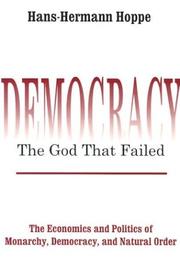

In one sentence
Hoppe’s central claim is that democracy is not a more limited or peaceful form of government than monarchy. Because rulers in a democracy possess temporary control rather than heritable ownership, they have stronger incentives to extract resources quickly, expand public debt, redistribute property, and transfer power to larger political units. His preferred alternative is not constitutional monarchy but a stateless “natural order” based on private property, voluntary association, and privately—競
Overview
The book is a collection of thirteen connected essays rather than a single linear historical narrative. Hoppe begins with an economic comparison of monarchy and democracy, develops a theory of time preference and “decivilization,” then applies it to public debt, welfare, mass democracy, immigration, centralization, secession, and the production of defense. The final sections argue that classical liberal hopes for a reliably limited state are mistaken and that libertarianism and conservatism may cooperate against egalitarian mass politics.
Core ideas
The state as an expropriating monopolist
Hoppe treats the state as an institution claiming a territorial monopoly on ultimate decision-making and taxation. The key question is therefore not whether government is democratic or monarchical, but which political arrangement gives rulers the weakest incentives to consume or damage the capital value of the territory they control.
Monarchy versus democracy
A hereditary monarch, in Hoppe’s model, owns or expects to pass on the state and therefore has an incentive to preserve its long-term value. An elected government has only temporary control, so officeholders are portrayed as more likely to maximize short-run revenue, borrowing, patronage, and redistribution. Hoppe calls monarchy the lesser evil, not a legitimate ideal.
Time preference and civilization
The book’s major economic model is time preference: people with lower time preference save, invest, plan, and maintain social institutions over longer horizons. Hoppe argues that secure property rights and long-term ownership encourage civilization, while democratic redistribution and political uncertainty raise present-oriented behavior and contribute to “decivilization.”
Democracy as mass redistribution
Universal suffrage turns political competition into a struggle over who receives transfers and who pays for them. Hoppe connects this mechanism to welfare expansion, public debt, bureaucratic growth, and the erosion of private-property norms. His argument is institutional: even well-intentioned voters and politicians face incentives that aggregate into damaging outcomes.
Centralization and secession
Democratic states tend toward larger jurisdictions because centralized political authority can redistribute across wider populations and standardize rules. Hoppe presents secession, decentralization, and smaller political communities as ways to limit the scale of extraction and make exit more credible.
Immigration, integration, and property rights
Hoppe distinguishes voluntary movement across privately owned property from state-sponsored or publicly subsidized immigration. He argues that “free immigration” is not genuinely free when public property and welfare systems are involved, and he favors a property-based approach in which owners and local associations decide whom to admit.
Natural order and private defense
The proposed alternative is a private-property order without a territorial state. Defense, insurance, arbitration, and law would be supplied by competing private firms and associations. Hoppe argues that competition and liability could restrain providers better than a compulsory monopoly, though the book gives more attention to the institutional argument than to detailed transition design.
The failure of limited government
Hoppe rejects the classical-liberal expectation that constitutional restraints can permanently contain the state. Democratic majorities, parties, courts, bureaucracies, and interest groups can reinterpret or bypass limits. The implication is that liberty requires reducing or eliminating the state’s monopoly, not merely improving its personnel or constitutional rules.
Practical takeaways
- Read the book primarily as an incentive-based critique of political institutions, not as a neutral history of democracy.
- When assessing a government, ask: Who controls resources? For how long? What costs can be shifted to future taxpayers? Can owners, minorities, or local communities exit?
- Separate Hoppe’s useful distinction between temporary political control and long-term ownership from his larger conclusion that monarchy is generally superior; the latter depends heavily on his stylized assumptions about rulers and political order.
- The time-preference framework is a portable analytical tool: policies that reward immediate consumption or socialize losses may weaken saving, maintenance, and long-term planning.
- Hoppe’s immigration argument turns on ownership and consent. It is strongest as a critique of treating public space as ownerless, but it does not by itself settle broader questions about equal citizenship, humanitarian duties, or democratic legitimacy.
- The proposed private defense order should be tested against problems of coordination, unequal bargaining power, external threats, capture by powerful firms, and disputes between competing legal systems.
Caveats and counterpoints
- The book’s method is strongly axiomatic and deductive. Hoppe uses theoretical premises to interpret historical developments; critics therefore dispute whether his conclusions are sufficiently supported by comparative history or empirical political science.
- “Monarchy” and “democracy” are treated as broad ideal types. Actual constitutional monarchies, representative democracies, dictatorships, and mixed regimes vary substantially, so the comparison can obscure important institutional differences.
- Hoppe’s account tends to treat democracy mainly as majoritarian redistribution and gives less weight to liberal-democratic protections such as competitive opposition, constitutional rights, transparency, peaceful succession, and constraints created by independent institutions.
- The book’s language about natural elites, exclusion, immigration, and cultural decline has been influential in far-right and ethnonationalist discourse. That reception is not identical to every argument in the book, but it is relevant to understanding its political afterlife.
- The private-law alternative is an institutional proposal, not a demonstrated operating system. Questions about public goods, war, monopoly formation, enforcement, and protection for people without substantial property remain underdeveloped or contested.
Questions worth revisiting
- Does long-term ownership really make monarchs more restrained, or can rulers offset short horizons through conquest, taxation, and dynastic ambition?
- Which empirical cases distinguish democracy’s alleged time-preference effects from industrialization, war, monetary policy, or technological change?
- Can private defense providers remain competitive without becoming de facto territorial states?
- If all land is privately owned, what protects people who lack meaningful property or bargaining power?
- Is secession a practical mechanism for liberty, or can small states reproduce the same coercive and redistributive incentives at a smaller scale?
- Which parts of Hoppe’s critique target democracy specifically, and which target the modern welfare-state form shared by democratic and nondemocratic regimes?
Return to this when…
Return to the chapters on time preference, monarchy versus democracy, centralization and secession, immigration, and private defense when evaluating arguments about state incentives, decentralization, property rights, or libertarian alternatives to constitutional government.
Highlights
Studies, for their continual support, financially and personally, in developing and elaborating the ideas
World War I marks one of the great watersheds of modern history. With its end the transformation of the entire Western world from monarchical rule and sovereign kings to democratic-republican rule and sovereign people that began with the French Revolution was completed. Until 1914, only three republics had existed in Europe—France, Switzerland, and after 1911, Portugal; and of all major European monarchies only the United Kingdom could be classified as a parliamentary system, i.e., one in which supreme power was vested in an elected parliament. Only four years later, after the United States had entered the European war and decisively determined its outcome, monarchies all but disappeared, and Europe along with the entire world entered the age of democratic republicanism.
The imposition of a government tax on property or income violates a property or income producer's rights as much as theft does. In both cases the appropriator-producer's supply of goods is diminished against his will and without his consent.
Because of their legitimacy, then, government violations of property rights affect individual time preferences systematically differently and much more profoundly than does crime. Like crime, government interference with private-property rights reduces someone's supply of present goods and thus raises his effective time-preference rate.
Crime, because it is illegitimate, occurs only intermittently—the robber disappears from the scene with his loot and leaves his victim alone. Thus, crime can be dealt with by increasing one's demand for protection goods and services (relative to that for nonprotection goods) so as to restore or even increase one's future rate of investment return and make it less likely that the same or a different robber will succeed a second time with the same or a different victim. In contrast, because they are legitimate, governmental property-rights violations are continual. The offender does not disappear into hiding but stays around, and the victim does not "arm" himself but must (at least he is generally expected to) remain defenseless.14 Consequently future property-rights violations, rather than becoming less frequent, become institutionalized. The rate, regularity, and duration of future victimization increases.
As will be explained in the course of the following section, if government property-rights violations take their course and grow extensive enough, the natural tendency of humanity to build an expanding stock of capital and durable consumer goods and to become increasingly more farsighted and provide for ever-more distant goals may not only come to a standstill, but may be reversed by a tendency toward decivilization: formerly provident providers will be turned into drunks or daydreamers, adults into children, civilized men into barbarians, and producers into criminals.
Nothing appears more surprising to those who consider human affairs with a philosophical eye, than the easiness with which the many are governed by the few, and the implicit submission, with which men resign their own sentiments and passions to those of their rulers. When we inquire by what means this wonder is effected we shall find, that as Force is always on the side of the governed, the governors have nothing to support them but opinion. It is, therefore, on opinion only that government is founded, and this maxim extends to the most despotic and most military governments, as well as to the most free and popular. The sultan of Egypt, or the emperor of Rome, might drive his harmless subjects, like brute beasts, against their sentiment and inclination. But he must, at least, have led his mamalukes or praetorian bands, like men, by their opinions. (Essays, p. 19) See also Mises, Human Action, pp. 863-64. 16On the lengthy historical process of the acquisition of government power, and the primacy of monarchical rule, see Bertrand de Jouvenel, Sovereignty: An Inquiry into the Political Good (Chicago: University of Chicago Press, 1957), esp. chap. 10; idem, On Power: The Natural History of its Growth (New York: Viking, 1949); idem, "The Principate" in idem, The Nature of Politics (New York: Schocken Books, 1987); Riistow, Freedom and Domination, esp. pp. 101-05. 17On the ubiquity of natural authority see de Jouvenel, Sovereignty, chap. 2. All that was needed [for the formation of associations] was that some one man should feel within him a natural ascendancy and should then inspire others with trust in himself. . . . when we can see every day associations forming all around us, why should we imagine them forming in the distant past in some different way? What makes leaders, now as always, is natural ascendancy-—authority as such. We see them arising under our very eyes whenever there is a rescue to organize or a fire to put out. (pp. 31-32) These two forms of government—private or public ownership of government (monarchy or democracy)—have systematically different effects on social time preference and the attendant process of civilization, and with the transition from personal (monarchical) to democratic (public) rule in particular, contrary to conventional wisdom, the decivilizing forces inherent in any form of government are systematically strengthened.18 The defining characteristic of private government ownership and the reason for a personal ruler's relatively lower degree of time preference (as compared to criminals and democratic governments) is that the expropriated resources and the monopoly privilege of future expropriation are individually owned. The expropriated resources are added to the ruler's private estate and treated as if they were a part of it, and the monopoly privilege of future expropriation is attached as a title to this estate and leads to an instant increase in its present value ("capitalization" of monopoly profit). Most importantly, as the private owner of the government estate, the ruler is entitled to pass his possessions on to his personal heir. He may sell, rent, or give away part or all of his privileged estate (and privately pocket the receipts from the sale or rental), and he may personally appoint or dismiss every administrator and employee of his estate.19 And on the transition from authority to power, de Jouvenel goes on to
A democratic ruler can use the government apparatus to his personal advantage, but he does not own it. He cannot sell government resources and privately pocket the receipts from such sales, nor can he pass government possessions on to his personal heir. He owns the current use of government resources, but not their capital value. In distinct contrast to a king, a president will want to maximize not total government wealth (capital values and current income) but current income (regardless and at the expense of capital values). Indeed, even if he wished to act differently, he could not, for as public property, government resources are unsaleable, and without market prices economic calculation is impossible. Accordingly, it must be regarded as unavoidable that public-government ownership results in continual capital consumption. Instead of maintaining or even enhancing the value of the government estate, as a king would do, a president (the government's temporary caretaker or trustee) will use up as much of the government resources as quickly as possible, for what he does not consume now, he may never be able to consume. In particular, a president (as distinct from a king) has no interest in not ruining his country. For why would he not want to increase his confiscations if the advantage of a policy of moderation—the resulting higher capital value of the government estate—cannot be reaped privately, while the advantage of the opposite policy of higher taxes—a higher current income—can be so reaped? For a president, unlike for a king, moderation offers only disadvantages.25 25On the nature of public ownership and its inherent irrationality see also Rothbard, Power and Market, pp. 172-84; Hoppe, A Theory of Socialism and Capitalism, chap. 9. The fundamental difference between private ownership of government (and low time preference) and public ownership of government (and high time preference) may be further illustrated by considering the institution of slavery, and contrasting the case of private slave ownership, as it existed for instance in antebellum America, with that of public slave ownership, as it existed for instance in the former Soviet Union and its Eastern European empire. Just as privately owned slaves were threatened with punishment if they tried to escape, in all of the former Soviet empire emigration was outlawed and punished as a criminal offense, if necessary, by shooting those who tried to run away. Moreover, anti-loafing laws existed everywhere, and governments could assign any task and all rewards and punishments to any citizen. Hence the classification of the Soviet system as slavery. Unlike a private slave owner, however, Eastern-European slave owners—from Lenin to Gorbachev—could not sell or rent their subjects in a labor market and privately appropriate the
Consequently, taxes will increase, be it directly in the form of higher tax rates or indirectly in that of increased governmental money "creation" (inflation). Likewise, government employment and the ratio of government employees ("public servants") to private employees tends to rise, attracting and promoting individuals with high degrees of time preference and low and limited farsightedness.26
In fact, during the entire monarchical age until the second half of the nineteenth century, which represents the turning point in the historical process of demonarchization and democratization beginning with the French Revolution and ending with World War I, the tax burden rarely exceeded 5 percent of national product (see also footnote 20 above). Since then it has increased constantly. In Western Europe it stood at 15 to 20 percent of national product after World War I, and in the meantime it has risen to around 50 percent. Likewise, during the entire monarchical age, until the latter half of the nineteenth century, government employment rarely exceeded
While a king is by no means opposed to debt, he is constrained in this "natural" inclination by the fact that as the government's private owner, he and his heirs are considered personally liable for the payment of all government debts (he can literally go bankrupt, or be forced by creditors to liquidate government assets). In distinct contrast, a presidential government caretaker is not held liable for debts incurred during his tenure of office. Rather, his debts are considered "public," to be repaid by future (equally nonliable) governments. If one is not held personally liable for one's debts, however, the debt load will rise, and present government consumption will be expanded at the expense of future government consumption. In order to repay a rising public debt, the level of future taxes (or monetary inflation) imposed on a future public will have to increase.
A commodity money standard makes it difficult for a government to inflate the money supply. By monopolizing the mint and engaging in systematic "coin clipping" (currency depreciation), kings did their best to enrich themselves at the expense of the public. But as much as they tried, they did not succeed in establishing monopolies of pure fiat currencies: of irredeemable national paper monies that can be created virtually out of thin air, at practically no cost. No particular individual, not even a king, could be trusted with an extraordinary monopoly such as this! It was only under conditions of democratic republicanism in the aftermath of World War I that the gold standard was abolished and at long last replaced with a worldwide system of irredeemable national paper monies in 1971.
The wars were the king's wars. The role of the good citizen was to pay his taxes, and sound political economy dictated that he should be left alone to make the money out of which to pay those taxes. He was required to participate neither in the decision out of which wars arose nor to take part in them once they broke out, unless prompted by a spirit of youthful adventure.
References
- DemocracyThe God That Failed: The Economics and Politics of Monarchy ... - Hans-Hermann Hoppe - Google Books
- (PDF) Democracy: The God that Failed: A Review
- papers.ssrn.com
- search.worldcat.org
- Democracy: The God That Failed
- mises.org
- opac.kila.ac.in
- books.google.com
- kansalliskirjasto.finna.fi
- passeidireto.com
- mlpol.net
- en.wikipedia.org