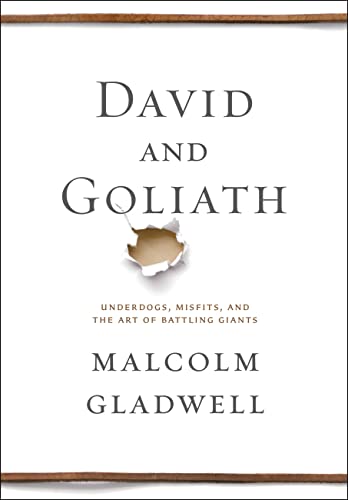

In one sentence
Underdogs do not win merely through courage or persistence. They may prevail when they recognize that the supposed giant’s strengths create vulnerabilities, then choose a different game, strategy, or standard of comparison. Conversely, adversity can produce useful adaptations—but only under particular conditions, and not every hardship becomes an advantage.
Overview
Gladwell begins by reframing the biblical David and Goliath encounter: David’s sling gives him a form of ranged power, while Goliath’s size and conventional armor may make him slow and vulnerable. He then develops the idea through cases including a girls’ basketball team using a full-court press, class size, elite-college competition, dyslexia, cancer research, civil-rights tactics, Northern Ireland, criminal justice, grief, and the French resistance. The recurring question is not simply “Who is stronger?” but “What kind of contest is this, and who benefits from its rules?”
Core ideas
Perceived disadvantage can conceal strategic advantage
David’s apparent weakness matters less than his ability to fight at a distance. The broader lesson is to avoid accepting an opponent’s preferred arena: change the rules, range, pace, or definition of success.
Advantages have diminishing returns and hidden costs
More size, money, prestige, or authority is not automatically better. Gladwell uses elite universities and the “big fish–little pond” effect to argue that a prestigious setting can damage confidence and persistence when comparison with stronger peers overwhelms the benefits of status.
Adaptation can turn difficulty into capability
Stories about dyslexic lawyer David Boies and cancer researcher Jay Freireich present disability or outsider status as pressures that encouraged alternative methods—listening closely, memorizing, improvising, or challenging professional consensus. The useful point is adaptation, not that dyslexia or deprivation is inherently desirable.
More resources can produce worse decisions
The book contrasts responses to violence and loss. Mike Reynolds’s campaign for California’s three-strikes law illustrates how a desire for maximal punishment can create an inflexible, counterproductive system; Wilma Derksen’s response to her daughter’s murder represents a less punitive route. Gladwell’s position is that power can become blunt when emotionally driven.
Legitimacy and moral courage depend on perceived limits
The accounts of the Birmingham civil-rights campaign and Le Chambon-sur-Lignon emphasize unconventional tactics, local networks, and the psychological effects of acting when conventional power is unavailable. Small groups may gain freedom to improvise that large institutions lack.
Trauma is not a reliable success formula
The book explores bereavement and adversity as possible sources of resilience, but its examples are exceptional cases. A hardship may produce strength, impairment, or both; the outcome depends on support, timing, personality, and opportunity.
Practical takeaways
- Before competing, identify the real game: are you being pushed toward a close contest when your strengths favor distance, speed, specialization, or surprise?
- Audit prestigious options by fit, not reputation alone. Ask where you are likely to learn, persist, and receive useful feedback—not merely where the credential is strongest.
- When an advantage produces confidence, also check for rigidity. Large organizations and well-resourced leaders may be slower to notice weak signals or revise a failing approach.
- Treat personal limitations as design constraints rather than identity verdicts: build compensating systems and methods, but do not romanticize the limitation itself.
- Use stories as hypotheses, not proof. After finding an apparent underdog advantage, look for base rates, counterexamples, and evidence that the mechanism generalizes.
Caveats and counterpoints
- The book’s strongest asset is narrative reframing, not experimental proof. Critics argue that Gladwell often selects unusual cases and attaches broad lessons to them, making the conclusions more compelling than demonstrably general.
- Some examples risk implying that disability, poverty, grief, or trauma can be beneficial in themselves. The more defensible interpretation is conditional: people sometimes develop valuable adaptations in response to difficulty, usually with substantial costs and support.
- The David-and-Goliath reinterpretation is provocative but depends on historical and medical speculation about ancient combat, Goliath’s condition, and the effectiveness of slings. It works best as a thought experiment rather than settled history.
- Gladwell’s cases do not imply that every underdog can win by trying harder or being unconventional. Structural inequality, missing resources, discrimination, and sheer probability remain real constraints.
Questions worth revisiting
- Which “giant” in my situation benefits from the rules being treated as natural or inevitable?
- Am I choosing an institution for genuine fit, or because its prestige seems like an unquestioned advantage?
- What adaptation has a past difficulty forced me to develop—and what did that adaptation cost me?
- Where might my current resources, status, or expertise be making me less flexible?
- Which claims in the book should be tested with data before I apply them to a consequential decision?
Return to this when…
Return to this book when you are intimidated by a powerful opponent, deciding between prestige and fit, or tempted to treat a setback as either purely destructive or automatically character-building. Revisit the caveats when a memorable personal story starts to feel like a universal psychological law.
Highlights
But the Lord said to Samuel, “Do not look on his appearance or on the height of his stature, because I have rejected him; for the Lord does not see as mortals see; they look on the outward appearance, but the Lord looks on the heart.” 1 Samuel 16:7
References
- David and Goliath: Underdogs, Misfits and the Art of Battling Giants by Malcolm Gladwell – review | Malcolm Gladwell | The Guardian
- theguardian.com
- kirkusreviews.com
- lapl.org
- washingtonindependentreviewofbooks.com
- freakonomics.com
- startribune.com
- sfchronicle.com
- allaboutwork.org
- quillandquire.com
- en.wikipedia.org
- allbookstores.com
- hachettebookgroup.com
- sparknotes.com