
In one sentence
Technology products often stall between visionary early adopters and the pragmatic early majority because the two groups buy for different reasons. Crossing this “chasm” requires abandoning broad, vision-led marketing in favor of focused market selection, credible proof, complete solutions, and disciplined expansion.
Overview
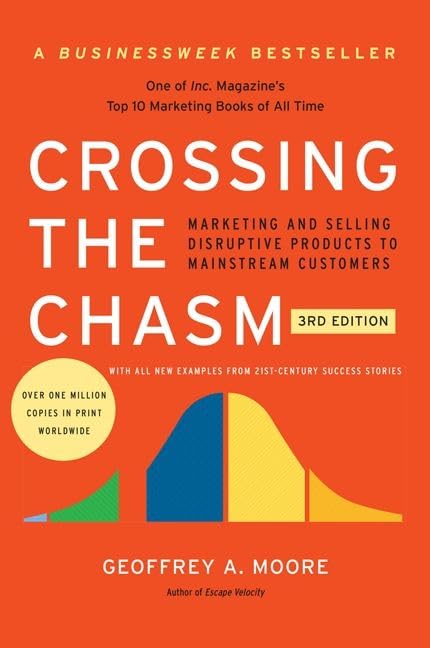
Moore adapts the technology-adoption lifecycle—innovators, visionaries, pragmatists, conservatives, and skeptics—by emphasizing the discontinuity between visionaries and pragmatists. Visionaries tolerate risk to pursue strategic change; pragmatists want dependable solutions, peer references, and reduced implementation risk. The book’s operational response is a D-Day-style campaign: select one defensible niche, concentrate resources there, win decisively, then use that credibility to enter adjacent markets.
Core ideas
The chasm is a change in buying logic
Early adopters may buy an incomplete product because they believe in its future. Mainstream buyers generally need evidence that the product works in a recognizable use case, for organizations like theirs, with manageable risk. Early traction therefore does not automatically predict scalable adoption.
Choose a beachhead, not a vague market
Identify one narrowly defined customer segment with an urgent problem and a compelling reason to act. The strategic goal is not to appeal to everyone but to become the clear leader in a niche where concentrated effort can create visible success and references.
Sell the whole product
Customers buy an outcome, not merely the core technology. The whole product includes the integrations, services, support, training, partners, and operational pieces required to make the promised result achievable. Gaps in this surrounding system can block adoption even when the core product is strong.
Position against the customer’s alternative
Positioning should clarify the target customer, the problem being solved, the product’s distinctive advantage, and the practical alternative it displaces. For mainstream buyers, differentiation must be connected to a credible business outcome rather than technological novelty alone.
References reduce perceived risk
Pragmatists look for evidence from comparable customers and established relationships. A successful beachhead supplies proof, partners, and word-of-mouth that make the next segment easier to win; expansion should proceed through adjacent segments rather than through an undifferentiated mass-market push.
The go-to-market system must align
Crossing requires coordination among product completeness, messaging, sales, distribution, partners, pricing, and customer support. A company can fail not because demand is absent but because its sales channel or delivery model cannot provide the confidence and implementation support mainstream buyers require.
Practical takeaways
- Diagnose the adoption stage before choosing tactics: a visionary sale and a pragmatic sale are not interchangeable.
- Define the beachhead by customer type, use case, and urgent problem—not by a huge category or total addressable market.
- Write down the customer’s “compelling reason to buy” in operational and economic terms.
- Map every dependency required for the promised outcome; treat missing integrations, services, support, or partners as product gaps.
- Prioritize a small number of referenceable customers whose organizations resemble the next targets.
- Measure whether you are creating repeatable adoption, not merely accumulating enthusiastic pilots or one-off custom deals.
- Expand only after the initial segment produces credible references, a repeatable implementation pattern, and a defensible position.
Caveats and counterpoints
- The framework is most directly suited to discontinuous or category-defining technology products, especially complex B2B offerings; it is less universal for ordinary consumer products or low-risk incremental improvements.
- The original examples and some assumptions reflect the high-tech markets of the 1990s. Platform, marketplace, open-source, and network-effect businesses may need simultaneous multi-sided adoption rather than a single sequential beachhead.
- The adoption categories are useful managerial heuristics, not a law that every product follows. Treat the chasm as a diagnostic question—whether buyer expectations have changed—not as proof that a particular percentage or curve must apply.
- A narrow niche can create focus, but it may also trap a company if the segment is too small, lacks adjacent markets, or requires economics that do not transfer.
Questions worth revisiting
- Which customer segment has the strongest combination of urgent pain, budget, authority, and similarity to future customers?
- What does the customer need beyond the core product to achieve the promised outcome?
- What evidence would make a pragmatic buyer believe the risk is acceptable?
- Which incumbent, workaround, or status quo are we actually displacing?
- Have we earned the right to expand, or are we mistaking scattered interest for repeatable adoption?
Return to this when…
Return to this book when a technology product has enthusiastic early users but struggles to convert that enthusiasm into repeatable mainstream sales. Its most useful reminder is that scaling is not simply “more marketing”: it may require a different customer, product package, proof system, sales motion, and channel.
References
- Crossing the Chasm - Geoffrey Moore
- shortform.com
- nextbooklist.com
- inigomedina.co
- After 30 years, 'Crossing the Chasm' is due for a refresh | TechCrunch
- peaka.com
- Crossing the Chasm: Marketing and Selling Disruptive Products to Mainstream ... - Geoffrey A. Moore - Google Books
- Crossing the Chasm Review | UtoRead.Com
- guptadeepak.com
- crossingthechasmbymoore.com
- shortform.com
- philippesilberzahneng.com