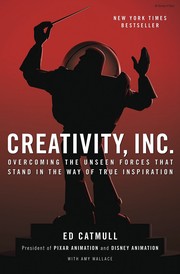

In one sentence
Creative excellence is less about discovering brilliant ideas than about building an organization where imperfect ideas can be exposed, tested, criticized, revised, and improved without fear. Management’s central responsibility is to identify and dismantle the unseen forces that suppress talent.
Overview
Catmull combines autobiography—from his computer-graphics work and Pixar’s founding with Steve Jobs and John Lasseter—with an account of Pixar’s creative-management practices. The book focuses more on collaboration, organizational design, feedback, and leadership than on individual techniques for generating stories or artistic ideas.
Core ideas
The messy middle is normal
Creative projects often look broken for much of their development. Leaders should not confuse an unfinished product’s visible problems with final failure; the process depends on iteration, diagnosis, and revision.
Trust people, not bureaucracy
Processes can support creativity, but they cannot replace judgment. When a system creates obstacles, the default response should be to investigate the system rather than assume employees lack discipline or ability.
Candor requires structure
Pixar’s Braintrust is presented as a peer-feedback mechanism: knowledgeable colleagues discuss what is and is not working, while the director retains responsibility for deciding what to change. Criticism is useful only when it is specific, informed, and separated from coercive authority.
Protect ideas while they are fragile
Early work is often rough and difficult to explain. Excessive evaluation, status competition, or premature exposure can cause people to defend safe choices instead of exploring promising but uncertain possibilities.
Failure is information, not identity
Experiments and failed projects reveal weaknesses in assumptions, process, or execution. The goal is not to celebrate failure indiscriminately, but to make it safe enough to learn from failures before they become expensive.
Hidden incentives shape behavior
People respond to what the organization rewards, fears, measures, and makes difficult. Even well-intentioned policies can produce secrecy, risk avoidance, or political behavior if they punish bad news or concentrate decision-making too narrowly.
Success creates new dangers
Past success can harden into formula, entitlement, or resistance to change. A creative organization must keep examining its habits even when its products and financial results appear strong.
Leadership is an ongoing debugging task
Catmull treats management somewhat like engineering: observe the system, find bottlenecks, test interventions, and revise. Leaders should assume their understanding is incomplete and actively seek information that contradicts their preferred interpretation.
Practical takeaways
- Create regular peer-review sessions where feedback is direct, concrete, and focused on the work—not the person.
- Separate the right to offer criticism from the authority to impose a solution.
- Reward early disclosure of problems; bad news becomes more dangerous when people hide it.
- Treat prototypes, drafts, and rough cuts as diagnostic tools rather than verdicts on talent.
- After a failure, ask which assumptions and systems produced it before assigning blame.
- Audit meetings, approval chains, metrics, and incentives for unintended effects on risk-taking.
- Preserve room for creative leaders to make final decisions while ensuring they receive strong opposing views.
- When adapting Pixar-style practices, copy the underlying principles—trust, candor, iteration, and accountability—not merely the vocabulary or meeting format.
Caveats and counterpoints
- This is primarily a case study and leadership memoir, not a controlled demonstration that Pixar’s methods generalize to every organization. Its advice is especially shaped by Pixar’s unusually high talent density, long production cycles, and distinctive creative-industry context.
- The book’s success narrative may understate how much its practices depended on particular individuals, resources, and market conditions; a Braintrust-style meeting cannot compensate for weak expertise or poor incentives.
- Catmull’s emphasis is organizational rather than artistic. Readers seeking instruction in plotting, prose style, or solitary creative practice may find the book indirect.
- There are multiple versions: the original U.S. edition was published in 2014, while an expanded edition was published in 2023. These notes summarize the book’s central argument and may not reflect every addition in a particular edition.
Questions worth revisiting
- Where in my current workflow do people learn about problems too late?
- Do my feedback sessions improve the work, or mainly signal status and approval?
- What decisions should remain with the creative owner, and what information must others be able to challenge?
- Which metric or incentive might be encouraging safe, political, or short-term behavior?
- Am I treating an unfinished draft as evidence of failure rather than as evidence about what needs revision?
Return to this when…
Return when a creative team is becoming cautious, political, or overconfident—or when a promising project is stuck and the instinct is to add controls rather than investigate the system producing the problem.
Highlights
Despite being novice filmmakers at a fledgling studio in dire financial straits, we had put our faith in a simple idea: If we made something that we wanted to see, others would want to see it, too.
What interested me was not that companies rose and fell or that the landscape continually shifted as technology changed but that the leaders of these companies seemed so focused on the competition that they never developed any deep introspection about other destructive forces that were at work.
We start from the presumption that our people are talented and want to contribute. We accept that, without meaning to, our company is stifling that talent in myriad unseen ways. Finally, we try to identify those impediments and fix them.
Like my classmates, the work I’d championed had taken hold largely because of the protective, eclectic, intensely challenging environment I’d been in. The leaders of my department understood that to create a fertile laboratory, they had to assemble different kinds of thinkers and then encourage their autonomy. They had to offer feedback when needed but also had to be willing to stand back and give us room. I felt instinctively that this kind of environment was rare and worth reaching for.
We met in a conference room with a white board and a large table surrounded by chairs—not that Steve stayed seated for very long. Within minutes, he was standing at the white board, drawing us a chart of Apple’s revenues. I remember his assertiveness. There was no small talk. Instead, there were questions. Lots of questions. What do you want? Steve asked. Where are you heading? What are your long-term goals? He used the phrase “insanely great products” to explain what he believed in. Clearly, he was the sort of person who didn’t let presentations happen to him, and it wasn’t long before he was talking about making a deal.
He said, “When I don’t see eye to eye with somebody, I just take the time to explain it better, so they understand the way it should be.”
The responsibility for finding and fixing problems should be assigned to every employee, from the most senior manager to the lowliest person on the production line. If anyone at any level spotted a problem in the manufacturing process, Deming believed, they should be encouraged (and expected) to stop the assembly line. Japanese companies that implemented Deming’s ideas made it easy for workers to do so: They installed a cord that anyone could pull in order to bring production to a halt. Before long, Japanese companies were enjoying unheard-of levels of quality, productivity, and market share.
While Toyota was a hierarchical organization, to be sure, it was guided by a democratic central tenet: You don’t have to ask permission to take responsibility.
Soon, I found myself criss-crossing the country with Steve, in what we called our “dog and pony show,” trying to drum up interest in our initial public offering. As we traveled from one investment house to another, Steve (in a costume he rarely wore: suit and tie) pushed to secure early commitments, while I added a professorial presence by donning, at Steve’s insistence, a tweed jacket with elbow patches. I was supposed to embody the image of what a “technical genius” looks like—though, frankly, I don’t know anyone in computer science who dresses that way. Steve, as pitch man, was on fire. Pixar was a movie studio the likes of which no one had ever seen, he said, built on a foundation of cutting-edge technology and original storytelling. We would go public one week after Toy Story opened, when no one would question that Pixar was for real.
If there was one thing we prided ourselves on at Pixar, it was making sure that Pixar’s artists and technical people treated each other as equals, and I had assumed that that same mutual respect would be afforded to those who managed the productions. I had assumed wrong. Sure enough, when I checked with the artists and technical staff, they did believe that production managers were second-class and that they impeded—not facilitated—good filmmaking by overcontrolling the process, by micromanaging. Production managers, the folks I consulted told me, were just sand in the gears.
The other principle we depended on was “Trust the Process.” We liked this one because it was so reassuring: While there are inevitably difficulties and missteps in any complex creative endeavor, you can trust that “the process” will carry you through. In some ways, this was no different than any optimistic aphorism (“Hang in there, baby!”), except that because our process was so different from other movie studios, we felt that it had real power. Pixar was a place that gave artists running room, that gave directors control, that trusted its people to solve problems. I have always been wary of maxims or rules because, all too often, they turn out to be empty platitudes that impede thoughtfulness, but these two principles actually seemed to help our people.
In another, smaller meeting with just the Toy Story 2 crew, Steve Jobs added his endorsement. “Disney doesn’t think we can do this,” he said. “So let’s prove them wrong.”
Remember that the spine of the story—Woody’s dilemma, to stay or to go—was the same before and after the Braintrust worked it over. One version didn’t work at all, and the other was deeply affecting. Why? Talented storytellers had found a way to make viewers care, and the evolution of this storyline made it abundantly clear to me: If you give a good idea to a mediocre team, they will screw it up. If you give a mediocre idea to a brilliant team, they will either fix it or throw it away and come up with something better. The takeaway here is worth repeating: Getting the team right is the necessary precursor to getting the ideas right. It is easy to say you want talented people, and you do, but the way those people interact with one another is the real key. Even the smartest people can form an ineffective team if they are mismatched. That means it is better to focus on how a team is performing, not on the talents of the individuals within it. A good team is made up of people who complement each other. There is an important principle here that may seem obvious, yet—in my experience—is not obvious at all. Getting the right people and the right chemistry is more important than getting the right idea.
Once this became clear to me, I began telling people that the phrase was meaningless. I told our staff that it had become a crutch that was distracting us from engaging, in a meaningful way, with our problems. We should trust in people, I told them, not processes. The error we’d made was forgetting that “the process” has no agenda and doesn’t have taste. It is just a tool—a framework. We needed to take more responsibility and ownership of our own work, our need for self-discipline, and our goals.
Imagine an old, heavy suitcase whose well-worn handles are hanging by a few threads. The handle is “Trust the Process” or “Story Is King”—a pithy statement that seems, on the face of it, to stand for so much more. The suitcase represents all that has gone into the formation of the phrase: the experience, the deep wisdom, the truths that emerge from struggle. Too often, we grab the handle and—without realizing it—walk off without the suitcase. What’s more, we don’t even think about what we’ve left behind. After all, the handle is so much easier to carry around
One way to do that is to replace the word honesty with another word that has a similar meaning but fewer moral connotations: candor. Candor is forthrightness or frankness—not so different from honesty, really. And yet, in common usage, the word communicates not just truth-telling but a lack of reserve. Everyone knows that sometimes, being reserved is healthy, even necessary for survival. Nobody thinks that being less than candid makes you a bad person (while no one wants to be called dishonest).
At this stage, you aren’t even thinking about candor. You’re thinking about not looking like an idiot. Compounding matters is the fact that you aren’t the only one who’s struggling with
And yet, candor could not be more crucial to our creative process. Why? Because early on, all of our movies suck. That’s a blunt assessment, I know, but I make a point of repeating it often, and I choose that phrasing because saying it in a softer way fails to convey how bad the first versions of our films really are. I’m not trying to be modest or self-effacing by saying this. Pixar films are not good at first, and our job is to make them so—to go, as I say, “from suck to not-suck.”
start WALL-E with 39 dialogue-free minutes. We dare to
We dare to attempt these stories, but we don’t get them right on the first pass. And this is as it should be. Creativity has to start somewhere, and we are true believers in the power of bracing, candid feedback and the iterative process—reworking, reworking, and reworking again, until a flawed story finds its throughline or a hollow character finds its soul.
Sometimes you talk about the problems in fifty different ways until you find that one sentence that you can see makes their eyes pop, as if they’re thinking, ‘Oh, I want to do it.’ Instead of saying, ‘The writing in this scene isn’t good enough,’ you say, ‘Don’t you want people to walk out of the theater and be quoting those lines?’ It’s more of a challenge. ‘Isn’t this what you want? I want that too!’ ”
I want to stress that you don’t have to work at Pixar to create a Braintrust. Every creative person, no matter their field, can draft into service those around them who exhibit the right mixture of intelligence, insight, and grace. “You can and should make your own solution group,” Andrew Stanton says, adding that on each of his own films, he has made a point of doing this on a smaller scale, separate from the official Braintrust. “Here are the qualifications required: The people you choose must (a) make you think smarter and (b) put lots of solutions on the table in a short amount of time. I don’t care who it is, the janitor or the intern or one of your most trusted lieutenants: If they can help you do that, they should be at the table.” Believe me, you don’t want to be at a company where there is more candor in the hallways than in the rooms where fundamental ideas or matters of policy are being hashed out. The best inoculation against this fate? Seek out people who are willing to level with you, and when you find them, hold them close.
At one point, Steve Jobs called me to check in on our progress. “It’s really strange,” I told him. “We haven’t had a single big problem on this film.” Many people would have been happy with this news. Not Steve. “Watch out,” he said. “That’s a dangerous place to be.”
“You wouldn’t say to somebody who is first learning to play the guitar, ‘You better think really hard about where you put your fingers on the guitar neck before you strum, because you only get to strum once, and that’s it. And if you get that wrong, we’re going to move on.’ That’s no way to learn, is it?”
“Moving things forward allows the team you are leading to feel like, ‘Oh, I’m on a boat that is actually going towards land.’ As opposed to having a leader who says, ‘I’m still not sure. I’m going to look at the map a little bit more, and we’re just going to float here, and all of you stop rowing until I figure this out.’ And then weeks go by, and morale plummets, and failure becomes self-fulfilling. People begin to treat the captain with doubt and trepidation. Even if their doubts aren’t fully justified, you’ve become what they see you as because of your inability to move.”
There is an alternative approach to being wrong as fast as you can. It is the notion that if you carefully think everything through, if you are meticulous and plan well and consider all possible outcomes, you are more likely to create a lasting product. But I should caution that if you seek to plot out all your moves before you make them—if you put your faith in slow, deliberative planning in the hopes it will spare you failure down the line—well, you’re deluding yourself. For one thing, it’s easier to plan derivative work—things that copy or repeat something already out there. So if your primary goal is to have a fully worked out, set-in-stone plan, you are only upping your chances of being unoriginal. Moreover, you cannot plan your way out of problems. While planning is very important, and we do a lot of it, there is only so much you can control in a creative environment. In general, I have found that people who pour their energy into thinking about an approach and insisting that it is too early to act are wrong just as often as people who dive in and work quickly. The overplanners just take longer to be wrong (and, when things inevitably go awry, are more crushed by the feeling that they have failed). There’s a corollary to this, as well: The more time you spend mapping out an approach, the more likely you are to get attached to it. The nonworking idea gets worn into your brain, like a rut in the mud. It can be difficult to get free of it and head in a different direction. Which, more often than not, is exactly what you must do.
In many organizations, managers tend to err on the side of secrecy, of keeping things hidden from employees. I believe this is the wrong instinct. A manager’s default mode should not be secrecy. What is needed is a thoughtful consideration of the cost of secrecy weighed against the risks. When you instantly resort to secrecy, you are telling people they can’t be trusted. When you are candid, you are telling people that you trust them and that there is nothing to fear. To confide in employees is to give them a sense of ownership over the information. The result—and I’ve seen this again and again—is that they are less likely to leak whatever it is that you’ve confided.
Your employees are smart; that’s why you hired them. So treat them that way. They know when you deliver a message that has been heavily massaged. When managers explain what their plan is without giving the reasons for it, people wonder what the “real” agenda is. There may be no hidden agenda, but you’ve succeeded in implying that there is one. Discussing the thought processes behind solutions aims the focus on the solutions, not on second-guessing. When we are honest, people know it.
As managers, we all start off with a certain amount of trepidation. When we are new to the position, we imagine what the job is in order to get our arms around it, then we compare ourselves against our made-up model. But the job is never what we think it is. The trick is to forget our models about what we “should” be. A better measure of our success is to look at the people on our team and see how they are working together. Can they rally to solve key problems? If the answer is yes, you are managing well. This phenomenon of not perceiving correctly what our job is occurs frequently with new directors. Even if a person works side by side with an experienced director in a supporting role, a role in which they repeatedly demonstrate the abilities to take the reins on their own film, when they
Rather than trying to prevent all errors, we should assume, as is almost always the case, that our people’s intentions are good and that they want to solve problems. Give them responsibility, let the mistakes happen, and let people fix them. If there is fear, there is a reason—our job is to find the reason and to remedy it. Management’s job is not to prevent risk but to build the ability to recover.
Originality is fragile. And, in its first moments, it’s often far from pretty. This is why I call early mock-ups of our films “ugly babies.” They are not beautiful, miniature versions of the adults they will grow up to be. They are truly ugly: awkward and unformed, vulnerable and incomplete. They need nurturing—in the form of time and patience—in order to grow. What this means is that they have a hard time coexisting with the Beast.
If, while in this vulnerable state, it is exposed to naysayers who fail to see its potential or lack the patience to let it evolve, it could be destroyed. Part of our job is to protect the new from people who don’t understand that in order for greatness to emerge, there must be phases of not-so-greatness. Think of a caterpillar morphing into a butterfly—it only survives because it is encased in a cocoon. It survives, in other words, because it is protected from that which would damage it. It is protected from the Beast.
My conclusion at the time was that finalizing the story before production began was still a worthy goal—we just hadn’t achieved it yet. As we continued to make films, however, I came to believe that my goal was not just impractical but naïve. By insisting on the importance of getting our ducks in a row early, we had come perilously close to embracing a fallacy. Making the process better, easier, and cheaper is an important aspiration, something we continually work on—but it is not the goal. Making something great is the goal.
I was struck by how he didn’t understand that taking a risk necessitated a willingness to deal with the mess created by the risk. So: When
The mess that he encountered—the reason he quit—was, in fact, caused by the complexity of trying to do something new. I was struck by how he didn’t understand that taking a risk necessitated a willingness to deal with the mess created by the risk.
Pete has a few methods he uses to help manage people through the fears brought on by pre-production chaos. “Sometimes in meetings, I sense people seizing up, not wanting to even talk about changes,” he says. “So I try to trick them. I’ll say, ‘This would be a big change if we were really going to do it, but just as a thought exercise, what if …’ Or, ‘I’m not actually suggesting this, but go with me for a minute …’ If people anticipate the production pressures, they’ll close the door to new ideas—so you have to pretend you’re not actually going to do anything, we’re just talking, just playing around. Then if you hit upon some new idea that clearly works, people are excited about it and are happier to act on the change.”
So we’ve covered change. Where does randomness fit in? Once, when I was on a retreat in Marin, I heard a delightful—and possibly apocryphal—story about what happened when the British introduced golf to India in the 1820s. Upon building the first golf course there, the Royal Calcutta, the British discovered a problem: Indigenous monkeys were intrigued by the little white balls and would swoop down out of the trees and onto the fairways, picking them up and carrying them off. This was a disruption, to say the least. In response, officials tried erecting fences to keep the monkeys out, but the monkeys climbed right over. They tried capturing and relocating the monkeys, but the monkeys kept coming back. They tried loud noises to scare them away. Nothing worked. In the end, they arrived at a solution: They added a new rule to the game—“Play the ball where the monkey drops it.”
When managing a company that is often in the news, as Pixar is, we must be careful not to believe our own hype. I say this knowing that it is difficult to resist, especially when we are flying high and tempted to think we have done everything right. But the truth is, I have no way of accounting for all of the factors involved in any given success, and whenever I learn more, I have to revise what I think. That’s not a weakness or a flaw. That’s reality.
One truly influential idea in physics is the famous principle known as Occam’s Razor, attributed to William of Ockham, a fourteenth-century English logician. On the most basic level, it says that if there are competing explanations for why something occurs the way it does, you should pick the one that relies on the fewest assumptions and is thus the simplest.
When we put setbacks into two buckets—the “business as usual” bucket and the “holy cow” bucket—and use a different mindset for each, we are signing up for trouble. We become so caught up in our big problems that we ignore the little ones, failing to realize that some of our small problems will have long-term consequences—and are, therefore, big problems in the making. What’s needed, in my view, is to approach big and small problems with the same set of values and emotions, because they are, in fact, self-similar. In other words, it is important that we don’t freak out or start blaming people when some threshold—the “holy cow” bucket I referred to earlier—is reached. We need to be humble enough to recognize that unforeseen things can and do happen that are nobody’s fault.
People who act without an approved plan should not be punished for “going rogue.” A culture that allows everyone, no matter their position, to stop the assembly line, both figuratively and literally, maximizes the creative engagement of people who want to help. In other words, we must meet unexpected problems with unexpected responses.
If we allow more people to solve problems without permission, and if we tolerate (and don’t vilify) their mistakes, then we enable a much larger set of problems to be addressed.
In fact, this kind of thinking only accomplished the opposite. Because it looked backward, not forward, it tethered the place to the status quo. A pervasive fear of change took root. Steve Jobs was quite aware of this story and used to repeat it to people at Apple, adding that he never wanted people to ask, “What would Steve do?” No one—not Walt, not Steve, not the people of Pixar—ever achieved creative success by simply clinging to what used to work.
Which brings us to one of my core management beliefs: If you don’t try to uncover what is unseen and understand its nature, you will be ill prepared to lead.
Or take this example, which occurred at Pixar during what’s called an “executive check”—a meeting to approve budgets and schedules—on the production of Up. A visual effects producer named Denise Ream was in that meeting, and she spoke up with a fairly radical suggestion: Production would be cheaper and take fewer person-weeks (the measure—the amount of work a single person could accomplish in a week’s time—that we use to calculate budgets) if we did something that sounded completely counter to that goal—delay when the animators started on their work. Denise, who had the benefit of a broader perspective because before joining Pixar she’d worked for years at Industrial Light & Magic, was addressing a reality that she saw more clearly than any of us did: The eagerness to get going, which gave the impression of efficiency, was ultimately counterproductive because animators often had to redo their work as changes were made … which led to animators sitting around, waiting for assignments … which led to increased costs. From her vantage point, it seemed obvious that we would use fewer person-weeks if we gave animators bigger, more fully realized chunks to work on later in the process. “I believe that animators will work faster than you’re giving them credit for,” Denise said, “if they have all the pieces they need when they begin.” Boy, was she right. Even with all the usual snafus—endless story adjustments and last minute re-rigging of particular characters—Up was made in fewer person-weeks than we’d originally thought possible.
“We should be careful to get out of an experience only the wisdom that is in it—and stop there,” as Mark Twain once said, “lest we be like the cat that sits down on a hot stove-lid. She will never sit down on a hot stove-lid again—and that is well; but also she will never sit down on a cold one anymore.” The cat’s hindsight, in other words, distorts her view. The past should be our teacher, not our master.
Pete Docter compares directing to running through a long tunnel having no idea how long it will last but trusting that he will eventually come out, intact, at the other end. “There’s a really scary point in the middle where it’s just dark,” he says. “There’s no light from where you came in and there’s no light at the other end; all you can do is keep going. And then you start to see a little light and then a little more light and then, suddenly, you’re out in the bright sun.”
Andrew’s mental model addresses the fear that inevitably comes when your boat is tossed by a storm or stalls for lack of wind. If one looks at creativity as a resource that we continually draw upon to make something from nothing, then our fear stems from the need to make the nonexistent come into being. As we’ve discussed, people often try to overcome this fear by simply repeating what has worked in the past. That leads nowhere—or, more accurately, it leads in the opposite direction of originality. The trick is to use our skills and knowledge not to duplicate but to invent.
As Andrew says, continuing his nautical metaphor, “If you’re sailing across the ocean and your goal is to avoid weather and waves, then why the hell are you sailing?” he says. “You have to embrace that sailing means that you can’t control the elements and that there will be good days and bad days and that, whatever comes, you will deal with it because your goal is to eventually get to the other side. You will not be able to control exactly how you get across. That’s the game you’ve decided to be in. If your goal is to make it easier and simpler, then don’t get in the boat.”
“I’m a firm believer in the chaotic nature of the creative process needing to be chaotic. If we put too much structure on it, we will kill it. So there’s a fine balance between providing some structure and safety—financial and emotional—but also letting it get messy and stay messy for a while. To do that, you need to assess each situation to see what’s called for. And then you need to become what’s called for.”
Desperate, we turned for help to the film’s technical directors and asked if they could simplify the character’s rigging to make it easier to animate. Their answer? Rerigging would take six months, which was all the time we had left to make the movie. In other words, we were screwed. John and I called a company-wide meeting. We explained the situation and I gave what some at Disney still call “the Toyota Speech,” in which I described the car company’s commitment to empowering its employees and letting people on the assembly line make decisions when they encountered problems. In particular, John and I stressed that no one at Disney needed to wait for permission to come up with solutions. What is the point of hiring smart people, we asked, if you don’t empower them to fix what’s broken? For too long, a culture of fear had stymied those who wanted to step outside of Disney’s accepted protocols. That kind of timidity wasn’t going to make Disney Animation great, we said. Innovation would, and we knew they had it in them. We challenged them to step up and help us fix this problem. After this meeting, three members of the crew took it upon themselves, over the weekend, to remodel and rerig Rhino. Within a week, the project was back on track. Why was a problem that took a few days to solve originally projected to take six months? The answer, I think, lay in the fact that for too long, the leaders of Disney Animation placed a higher value on error prevention than anything else. Their employees knew there would be repercussions if mistakes were made, so the primary goal was never to make any.
In big organizations there are advantages to consistency, but I strongly believe that smaller groups within the larger whole should be allowed to differentiate themselves and operate according to their own rules, so long as those rules work. This fosters a sense of personal ownership and pride in the company that, to my mind, benefits the larger enterprise.
Would it have been easier simply to wire bonuses into employees’ direct deposit accounts? Yes. But like I always say when talking about making a movie, easy isn’t the goal. Quality is the goal.
Moreover, there was another benefit of lowering costs. Cheaper films are made with smaller crews, and everyone agrees that the smaller the crew, the better the working experience. It’s not just that a leaner crew is closer and more collegial; it’s that on a smaller production it’s easier for people to feel that they’ve made an impact.
What made Notes Day work? To me, it boils down to three factors. First, there was a clear and focused goal. This wasn’t a free-for-all but a wide-ranging discussion (organized around topics suggested not by Human Resources or by Pixar’s executives, but by the company’s employees) aimed at addressing a specific reality: the need to cut our costs by 10 percent. While the discussion topics were allowed—even encouraged—to stray into areas that might seem only vaguely related to this goal, the fact that it was there was key. It provided a framework—and it kept us from falling into confusion.
The truth is, as challenges emerge, mistakes will always be made, and our work is never done. We will always have problems, many of which are hidden from our view; we must work to uncover them and assess our own role in them, even if doing so means making ourselves uncomfortable; when we then come across a problem, we must marshal all our energies to solve it. If those assertions sound familiar, that’s because I used them to kick off this book.
Unleashing creativity requires that we loosen the controls, accept risk, trust our colleagues, work to clear the path for them, and pay attention to anything that creates fear. Doing all these things won’t necessarily make the job of managing a creative culture easier. But ease isn’t the goal; excellence is.
As we walked out of the vault, Steve stopped in the hallway and said he had been working on a list of three things he wanted to do—and I remember the words precisely—“before I sail away.” One
Whenever offering a note, he always began the same way: “I’m not really a filmmaker, so you can ignore everything I say.… ” Then he would proceed, with startling efficiency, to diagnose the problem precisely. Steve focused on the problem itself, not the filmmakers, which made his critiques all the more powerful. If you sense a criticism is being leveled for personal reasons, it is easy to dismiss. You couldn’t dismiss Steve. Every film he commented on benefited from his insight.
The ever-observant Pete Docter got up next and recalled one of the most endearing images he had of Steve. During a meeting one day years ago, Pete noticed that Steve had two small, identical holes in one of the legs of his Levis 501s. Steve shifted in his seat, and Pete noticed the same two holes on the other leg, too, in the same spot, right above the ankle. As Pete was trying—and failing—to imagine a reason for these symmetrical holes, Steve reached down to pull up his socks by grabbing them through his pants—putting his fingers right where the holes were! “Here Steve was worth millions, but apparently getting a new pair of pants was not important to him,” Pete said. “Or maybe he needed new socks with better elastic. Either way, it was a humanizing aspect to this larger-than-life guy.”
Give a good idea to a mediocre team, and they will screw it up. Give a mediocre idea to a great team, and they will either fix it or come up with something better. If you get the team right, chances are that they’ll get the ideas right.
When looking to hire people, give their potential to grow more weight than their current skill level. What they will be capable of tomorrow is more important than what they can do today.
Always try to hire people who are smarter than you. Always take a chance on better, even if it seems like a potential threat.
If there are people in your organization who feel they are not free to suggest ideas, you lose. Do not discount ideas from unexpected sources. Inspiration can, and does, come from anywhere.
It isn’t enough merely to be open to ideas from others. Engaging the collective brainpower of the people you work with is an active, ongoing process. As a manager, you must coax ideas out of your staff and constantly push them to contribute.
There are many valid reasons why people aren’t candid with one another in a work environment. Your job is to search for those reasons and then address them.
Likewise, if someone disagrees with you, there is a reason. Our first job is to understand the reasoning behind their conclusions.
Failure isn’t a necessary evil. In fact, it isn’t evil at all. It is a necessary consequence of doing something new.
Be wary of making too many rules. Rules can simplify life for managers, but they can be demeaning to the 95 percent who behave well. Don’t create rules to rein in the other 5 percent—address abuses of common sense individually. This is more work but ultimately healthier.
Do not accidentally make stability a goal. Balance is more important than stability.
Don’t confuse the process with the goal. Working on our processes to make them better, easier, and more efficient is an indispensable activity and something we should continually work on—but it is not the goal. Making the product great is the goal.
References
- goodreads.com
- goodreads.com
- kirkusreviews.com
- Creativity, Inc.: Overcoming the Unseen Forces That Stand in the Way of True Inspiration — Ed Catmull & Amy Wallace · Íñigo Medina
- Creativity, Inc. (The Expanded Edition) by Ed Catmull, Amy Wallace (Ebook) - Read free for 30 days
- bhawnapatkar.com
- readever.app
- en.wikipedia.org
- glasp.co
- Creativity, Inc. (The Expanded Edition) by Ed Catmull, Amy Wallace: 9780593594643 | PenguinRandomHouse.com: Books
- openlibrary.org
- jurcon.ums.edu.my
- the-independent.com