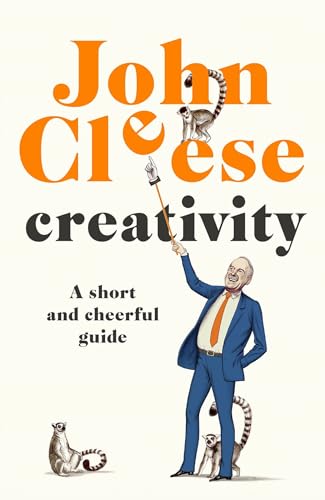

In one sentence
Creativity is not a rare inborn gift but a mode of thinking that can be encouraged by creating the right conditions: play, openness, time, and freedom from premature judgment. Once ideas emerge, deliberate analysis and revision are needed to select and improve them.
Overview
Cleese presents creativity as “new ways of thinking about things,” extending beyond art into ordinary problem-solving. His central distinction is between fast, purposeful reasoning and a slower, more associative mode of thought. Creative work benefits from letting the slower process operate, then returning to conscious evaluation. The book is deliberately brief—around 112 pages—and works more as an encouraging essay than as a comprehensive theory or research manual.
Core ideas
Create conditions rather than wait for inspiration
The practical question is not whether you are inherently creative, but whether your environment permits experimentation. Playfulness, curiosity, and reduced fear of looking foolish make unusual connections more likely. Cleese treats creativity as trainable through repeated use, not as an identity reserved for artists.
Use both ‘hare’ and ‘tortoise’ thinking
Fast, logical thinking is useful for decisions and execution; slower, less deliberate rumination is better suited to ambiguous or complicated problems. Work on a problem, then give the mind time away from it—possibly overnight—without assuming that inactivity means nothing is happening. Cleese connects this idea to Guy Claxton’s Hare Brain, Tortoise Mind.
Separate generating from judging
Early ideas are fragile. If criticism arrives too soon, you may eliminate possibilities before they have developed. First allow alternatives and playful associations; later switch into analytical mode to test, organize, and refine them. This is a change of mental posture, not a rejection of rigor.
Incubation is part of the work
A block or a period of apparent non-progress is not automatically failure. After focused effort, stepping away can allow unconscious associations to continue working. The useful pattern is: engage seriously, pause, return, and inspect what has changed.
Creative confidence needs humility
Overconfidence can reduce experimentation and make people settle too quickly on their first solution. Conversely, excessive self-criticism prevents ideas from developing. The productive stance is provisional confidence: treat ideas as testable candidates rather than as proof of either genius or incompetence.
The final product requires conscious craft
Unconscious insight supplies possibilities; conscious judgment determines whether they work. The guide therefore does not equate creativity with spontaneous ideas. Selection, structure, cutting, and revision remain necessary, especially for writing and comedy.
Practical takeaways
- Define the problem, gather material, and make an initial deliberate effort before expecting ideas to appear.
- Protect a period in which you can play with possibilities without having to defend them immediately.
- When stuck, change modes: stop forcing an answer, take a walk, sleep on it, or work on something else.
- Keep idea generation and evaluation in separate passes; use different sessions if necessary.
- Return to promising ideas with a critical question: what specifically makes this work, and what would make it clearer, funnier, stronger, or more useful?
- Treat editing as creative work rather than as an admission that the original idea failed.
- Use the book as a reset or encouragement, not as a complete method for creative research, collaboration, or project management.
Caveats and counterpoints
- The book is intentionally slim and is widely characterized as a brief, accessible set of reflections rather than an original or comprehensive account of creativity.
- Its examples and authority come primarily from Cleese’s experience as a writer, comedian, actor, and performer; the advice may transfer less directly to highly technical, collaborative, or materially constrained forms of creative work.
- The unconscious/incubation model is useful as a practical metaphor, but the book does not establish that every creative problem benefits from waiting, or that unconscious processing alone is sufficient.
- Playfulness and psychological safety can improve exploration, but deadlines, expertise, feedback, constraints, and sustained practice still determine whether ideas become competent finished work.
Questions worth revisiting
- Which of my current problems needs more deliberate analysis, and which needs time away from conscious effort?
- Where am I judging ideas before I have generated enough alternatives?
- What conditions make me more willing to be silly, uncertain, or experimentally wrong?
- What is the next revision that would turn a merely interesting idea into a useful one?
- Am I using incubation productively, or using it to avoid the difficult work of testing and editing?
Return to this when…
Return when you feel creatively blocked, overly self-critical, or trapped in a single solution. The quickest refresher is: make a serious start, create room for play, pause without guilt, then come back with disciplined judgment.
Highlights
I think this basic rule applies everywhere: you are most likely to be creative in an area that you already know and care about.
Whenever you try to come up with something original, you will find that some days the stuff flows, and some days it doesn’t. When Graham Chapman and I started writing together we would get terribly frustrated and despairing when we hit a fallow period—sometimes a whole morning or even a day when we produced nothing really good. But then we noticed that, despite this, we had a consistent average: every week we wrote about fifteen to eighteen minutes of good stuff. All we had to do was to sit there, whether it flowed or it didn’t, and by Friday evening we would have enough. We came to understand that the blockages weren’t an interruption in the process, they were part of it. For example, when you eat, the bit where the fork returns empty to your plate isn’t a failure. It’s just part of the eating process.
The anthropologist Gregory Bateson once said, “You can’t have a new idea ’til you’ve got rid of an old one.” This insight helped me to view my fallow periods as preparatory to the fertile ones, and therefore as an inseparable part of the whole creative process. When the juices are not flowing, don’t beat yourself up and wonder if you should retrain as a priest. Just sit around and play, until your unconscious is ready to cough up some stuff. Getting discouraged is a total waste of your time.
The key thing is to start, even if it feels as though you’re forcing yourself through an emotional roadblock.
Now, feeling creative isn’t exactly an emotion. It’s a frame of mind. But if you’re in the wrong frame of mind—if you’re distracted or worrying about something else—it follows that you’re not going to be creative.
On one occasion, when my friend the great screenwriter Bill Goldman was helping me with a script, he advised me to “kill my darlings,” a phrase he said he’d borrowed from William Faulkner. I was slightly taken aback, but I think I now understand what he meant rather better than I did at the time! His point was that any good work of art will change—sometimes in major ways—during the course of its creation. At the beginning of the process a writer may get a great idea—one that they particularly like. This is their “darling.” Inevitably, as the project develops, parts of the story will change and that “darling” may not fit well into the new version of the narrative. A good writer will jettison it. A less good writer will hang on to it, so hindering the transition of the story to its new form.
References
- Creativity: A Short and Cheerful Guide by John Cleese | Goodreads
- 12min.com
- CREATIVITY | Kirkus Reviews
- goodreads.com
- 0.12min.com
- Reviews - Creativity: A Short and Cheerful Guide | The StoryGraph
- thekeypoint.org
- joyfulpublicspeaking.blogspot.com
- toomuchtowrite.com
- books.google.com
- bekindbesafeberesponsible-note.godaddysites.com
- books.google.com