
In one sentence
Creative organizations perform better when their structure is designed around human motivation, shared ownership, learning, and the quality of the work—not around conventional hierarchy, status, or managerial control.
Overview
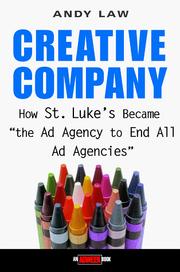
Law tells the story of St. Luke’s, founded by advertising professionals who wanted to preserve excellent creative work while escaping the workplace norms of large agencies. The agency experimented with employee ownership, minimal hierarchy, shared responsibility, project-based work, and an office culture intended to develop people rather than merely extract output. The book is part origin story, part managerial argument, and part challenge to the advertising industry. Its evidence is primarily the founders’ experience and St. Luke’s reported growth, including annual billings above $90 million during a notable three-year period. The earlier British edition appeared in 1998 under the title Open Minds; the Wiley edition was published in 1999.
Core ideas
Design the company around the work
St. Luke’s treats organizational design as a creative problem. Instead of assuming that agencies need familiar departments, ranks, desks, and chains of command, Law asks what arrangements help people produce better ideas and take greater responsibility.
Ownership changes the psychological contract
Employees are presented not simply as staff but as employee-owners. The intended effect is to connect autonomy, accountability, financial results, and the long-term health of the organization. Ownership is therefore cultural as well as economic.
Flatten hierarchy, but do not remove responsibility
St. Luke’s pursued an unusually flat structure and unconventional decision-making. The point was not that everyone can decide everything effortlessly; it was to move judgment closer to the work and make authority something exercised rather than merely inherited from rank.
Versatility is a creative asset
Law emphasizes curiosity, experimentation, and the development of hidden talents. People are encouraged to learn beyond narrow job descriptions, allowing the organization to discover capabilities that a rigid specialist structure might suppress.
Culture is an operating system
Fun, trust, openness, and shared purpose are not treated as decorative benefits. They are supposed to influence recruitment, collaboration, decision quality, learning, and the willingness to take creative risks.
Growth should include personal growth
The company’s success is measured not only through billings or client work but through the development of the people inside it. This later becomes an explicit theme in Law’s writing about St. Luke’s: personal development is placed ahead of, or at least treated as a condition for, business development.
The model is a provocation, not a universal template
The book’s strongest value is as a design challenge: identify which assumptions in your organization are historical habits rather than necessities. Its arguments are less a controlled proof than an account of one unusually ambitious experiment.
Practical takeaways
- Ask of every layer of management: does it improve the work, or merely preserve status and control?
- Give people meaningful responsibility together with meaningful information, influence, and consequences.
- Treat role boundaries as hypotheses. Let people contribute across disciplines when that improves the work or develops capability.
- Make ownership concrete: involve people in decisions, results, and trade-offs rather than using “ownership” as motivational language alone.
- Build recurring forums for collective judgment instead of relying exclusively on top-down approvals.
- Recruit for curiosity, generosity, adaptability, and creative courage—not only for polished experience.
- Use experiments to test cultural and structural ideas; do not announce a new culture without changing routines, incentives, and authority.
- Separate the inspiring principle from the specific St. Luke’s mechanism. A flat structure may work in a creative agency and fail where safety, compliance, scale, or highly specialized expertise dominate.
Caveats and counterpoints
- Law is a founder and chairman describing his own organization, so the book naturally privileges the founding vision and successful elements of the experiment. It should be read as an involved case study, not neutral organizational research.
- The book’s central claims are closely tied to late-1990s advertising: agency culture, creative labor, client relationships, and the economics of billings. Some practices may not transfer directly to other industries or to much larger organizations.
- Flatness can conceal informal hierarchy. Charisma, reputation, access to founders, and control of scarce information may matter as much as the formal org chart.
- The St. Luke’s story has competing interpretations. A later Independent report described the agency’s democratic, employee-owned ideal but also reported conflict and a substantially different account from former employee Ramchandani. That disagreement is important: the lived culture may not have matched the founder’s account.
- The book celebrates experimentation, but experimentation can create ambiguity, meeting overload, slow decisions, and uneven accountability unless decision rights are explicit.
Questions worth revisiting
- Which parts of my organization exist because they are useful, and which exist because they are conventional?
- Would greater ownership change behavior here, or would it merely add responsibility without real power?
- Where do informal hierarchies already exist, and are they healthier or less accountable than formal ones?
- What capabilities are hidden by narrow job titles and rigid reporting lines?
- What would we have to stop doing—not just start doing—to make a more creative culture credible?
- Which St. Luke’s practices depend on a small, highly motivated group and would break at our scale?
- How would a skeptical employee describe the gap between the organization’s stated culture and its actual incentives?
Return to this when…
Return to this book when redesigning a creative team, questioning hierarchy, considering employee ownership, or trying to connect culture with operating structure. Revisit the caveats alongside the inspiring parts, especially when the proposed solution is “make everything flatter” without specifying authority, accountability, and evidence of effectiveness.
References
- Creative Company: How St. Luke's Became "the Ad Agency to End All Ad Agencies" - Andy Law - Google Books
- obnb.uk
- ci.nii.ac.jp
- goodreads.com
- goodreads.com
- econbiz.de
- thriftbooks.com
- Experiment at Work: Explosions and Experiences at the Most Frightening ... - Andy Law - Google Books
- abebooks.com
- readinglength.com
- Commercial breakdown | The Independent | The Independent
- abebooks.com