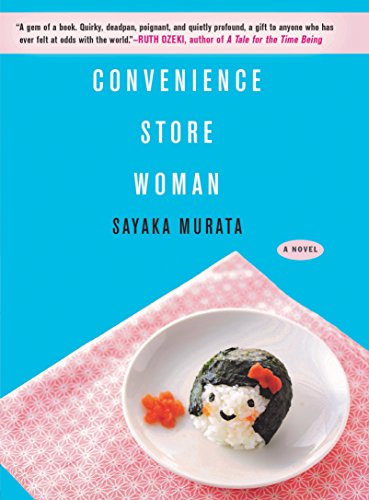

In one sentence
The novel asks whether a life should be judged by its conformity to social expectations or by the person’s own experience of meaning. It satirizes “normality” without offering an uncomplicated alternative: Keiko’s chosen identity is both genuinely sustaining and shaped by a society that leaves little room for difference.
Overview
Keiko has worked at the same convenience store for eighteen years, where manuals, rhythms, uniforms, and scripted interactions give her a stable role. Outside work, relatives and former coworkers treat her unmarried status and part-time employment as evidence that something is wrong. The arrival of Shiraha—a hostile, exploitative coworker who attacks social conventions while embodying their ugliest assumptions—creates a crisis that forces Keiko to reconsider what she is protecting. The plot remains compact, deadpan, and increasingly unsettling rather than conventionally sentimental.
Core ideas
“Normal” as a social performance
Keiko experiences ordinary interaction as a set of rules to learn and imitate. The store’s procedures make this performance explicit, revealing that supposedly natural adult behavior is often scripted, policed, and rewarded by others.
The convenience store as ecosystem and identity
The store is not merely a workplace: it supplies Keiko with language, timing, purpose, and belonging. Its repetitive order contrasts with the ambiguity of family and romantic life. Critics have read this attachment as both comic and sincere—a form of love for a functioning world.
Gendered milestones and social usefulness
Pressure falls especially heavily on Keiko because adulthood is measured through marriage, motherhood, and career status. The novel exposes how concern for an unmarried woman can become surveillance, coercion, and a demand that she reassure everyone else.
Outsider perspectives are not automatically liberating
Shiraha’s contempt for convention may sound rebellious, but his worldview is parasitic and self-serving. Murata separates rejection of social norms from ethical independence: opposing conformity does not by itself make someone humane or free.
Deadpan narration and moral unease
Keiko’s flat, literal perspective makes disturbing thoughts and social cruelty appear with the same calm clarity as stocking shelves. This creates productive uncertainty: readers must decide whether they are laughing at Keiko, with her, or at the world that cannot accommodate her.
Ambiguous agency
Keiko is neither simply a victim of society nor a triumphant icon of self-acceptance. Her choices are deliberate, but they are also constrained by limited alternatives and by the categories society makes available. This tension gives the novel more bite than a straightforward “be yourself” message.
Practical takeaways
- Notice how often “concern” about another adult is really a demand for reassurance, conformity, or social legibility.
- Separate a role’s prestige from its actual fit. Keiko’s work is socially undervalued but psychologically and practically meaningful to her.
- Be wary of treating every unconventional person as secretly waiting to become conventionally fulfilled—or every rebel as morally admirable.
- Ask whether your idea of independence is genuinely self-chosen or merely another approved identity.
- When rereading, track the language of usefulness, normality, damage, and adulthood; those terms show how the surrounding culture evaluates people.
Caveats and counterpoints
- The novel’s critique is sharper than its psychological realism. Keiko’s unusual perspective is deliberately stylized, and some readers may find her interiority more like a satirical instrument than a fully explained consciousness.
- Shiraha is effective as a pressure point and embodiment of misogynistic entitlement, but reviewers have noted that he is less fully realized than Keiko.
- The book should not be treated as a diagnostic portrait of autism or neurodivergence. It leaves Keiko’s difference deliberately unnamed; imposing a clinical explanation can narrow the novel’s broader social argument.
- Its ending resists a simple emancipatory reading. The novel does not cleanly resolve whether Keiko has escaped social pressure, redefined it, or found a workable way to inhabit it.
Questions worth revisiting
- What does the convenience store provide that family, romance, and professional advancement do not?
- Does Keiko genuinely reject society’s values, or does she simply prefer one social system whose rules are clearer?
- How does the novel distinguish nonconformity from selfishness, exploitation, or refusal of responsibility?
- Are the people pressuring Keiko acting out of care, fear, vanity, or some mixture of all three?
- What does the novel ask readers to reconsider about part-time work and the meaning of a successful adult life?
- Does the deadpan tone create empathy for Keiko, distance from her, or both at once?
Return to this when…
Return to it when thinking about conformity, workplace identity, gendered expectations, neurodivergence and representation, or the difference between a life that looks acceptable and one that feels inhabitable.