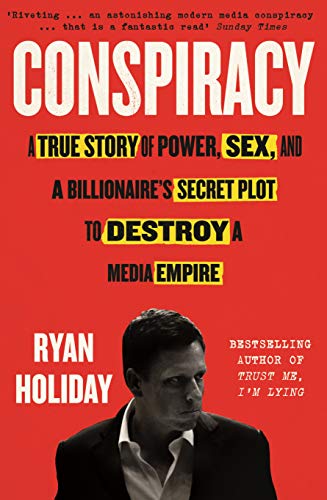

In one sentence
Holiday presents the Gawker affair as an unusually disciplined conspiracy: a patient, covert coalition used money, litigation, intermediaries, and timing to attack an apparently invulnerable institution. The book’s larger claim is that coordinated intrigue can accomplish what ordinary competition cannot—but the strongest criticism is that Thiel’s victory damaged his own stated goals and left the Internet’s deeper problems intact.
Overview
The central conflict began with Gawker’s 2007 outing of Peter Thiel, followed by its 2012 publication of excerpts from a secretly recorded Hulk Hogan sex tape. Thiel secretly funded a network of lawsuits, including Hogan’s case, which produced a $115 million verdict in 2016 and ultimately helped force Gawker Media into bankruptcy. Holiday gained unusual access to Thiel, Nick Denton, Hogan, lawyers, and other participants, and tells the story as both investigative narrative and study of power.
Core ideas
A conspiracy is an organization built around secrecy and coordination
Holiday distinguishes vague conspiracy theories from deliberate conspiracies: concrete actors choose a goal, divide roles, preserve secrecy, and sustain effort over time. The practical advantage is concentration—many people can be influenced without understanding the whole plan.
Patient strategy can defeat institutional confidence
Gawker believed its money, legal posture, and cultural authority made it difficult to threaten. Thiel’s side instead accumulated resources, waited for a viable plaintiff, tested arguments, and treated the lawsuit as one operation in a longer campaign. The lesson is not merely ‘be patient,’ but ‘build options before acting.’
Proxies create both reach and deniability
Thiel did not publicly attack Gawker himself. Hogan supplied the plaintiff and personal injury; lawyers supplied the legal mechanism; funders and intermediaries supplied distance. This let each participant pursue a partial objective while concealing the campaign’s full strategic purpose.
Narrative control is part of victory
Winning the legal battle did not settle what the public thought had happened. Thiel could describe the campaign as defense of privacy and deterrence, while opponents saw revenge, censorship, or billionaire control of the press. Holiday’s story shows that post-victory interpretation can determine whether a success is regarded as legitimate.
Secrecy reduces accountability and increases collateral damage
The covert structure made it easier to use questionable allies and tactics without having to defend them publicly. A major criticism of Holiday’s treatment concerns the book’s brief, ambiguous discussion of Gamergate: even limited cooperation or opportunistic alignment could undermine Thiel’s stated desire to make the Internet less abusive and chaotic.
Institutions can be defeated by their own self-image
Gawker’s identity as an aggressive, fearless publisher encouraged it to dismiss warning signs and treat privacy objections as weakness. Its commitment to provocation became a strategic liability when opponents exploited the legal and moral vulnerabilities created by that posture.
Practical takeaways
- Separate the immediate objective from the larger mission: destroying an opponent may be achievable while improving the surrounding system remains impossible.
- Before entering a conflict, identify who benefits, who supplies resources, who bears visible risk, and whether the apparent dispute is part of a larger campaign.
- Do not mistake secrecy for strength. Confidentiality can protect a plan, but it also prevents correction, accountability, and honest testing of assumptions.
- Model the opponent’s incentives rather than relying on their public identity. Gawker’s confidence and Thiel’s privacy concerns both concealed vulnerabilities.
- In reputational conflicts, prepare the explanation of your actions before the decisive event. The public story may outlast the operational victory.
- Use proxies cautiously: they can provide specialization and distance, but their motives and behavior may damage the principal’s cause.
- When an opponent seems uniquely responsible for a broad social problem, test whether removing that opponent would actually solve the problem—or merely satisfy the desire for retribution.
Caveats and counterpoints
- This is a narrative account, not a neutral legal or media-ethics study. Holiday had extensive access to Thiel and presents the affair through the lens of strategy and intrigue.
- The book’s central strategic interpretation is contested. Alyssa Rosenberg argues that Thiel killed Gawker but failed to create a more private or decent Internet, making the conspiracy an operational success but a broader failure.
- The Gamergate discussion is a significant limitation: the book reportedly leaves unclear how much the conspirators initiated, encouraged, or merely benefited from that movement.
- The legal outcome should not be treated as proof that every Gawker practice was illegitimate or that billionaire-funded litigation is a generally healthy corrective to journalism. It demonstrates the power of litigation backed by extraordinary resources.
- Holiday’s access to the participants improves the narrative but may also make the conspirators’ self-justifications unusually prominent.
Questions worth revisiting
- Was Thiel primarily defending privacy, seeking deterrence, or pursuing revenge—and can those motives be separated in practice?
- At what point does privately funding a public lawsuit become an attack on press freedom rather than support for a legitimate plaintiff?
- Did Gawker’s editorial culture make its collapse deserved, strategically predictable, or simply exploitable?
- What evidence would distinguish an autonomous online movement from a campaign that is being quietly amplified by interested actors?
- If a secret campaign succeeds but produces a worse public narrative, has it actually succeeded?
- Which parts of this strategy depend on billionaire-scale resources and therefore cannot be generalized to ordinary organizational life?
Return to this when…
Return to these notes when evaluating covert influence campaigns, billionaire philanthropy or litigation, media power, privacy-versus-public-interest disputes, or any conflict where the visible lawsuit may be only one move in a much longer strategy.
Highlights
There are no grand, towering bookcases befitting a billionaire in the New York City apartment of Peter Thiel, yet the space is defined by books. They lie in neatly arranged stacks of different heights on nearly every table. Colorful paperbacks and ancient hardcovers about economics, chess, history, and politics fill sets of small, modern shelves in the corners and against the walls. If you look closely, on the shelf closest to the chef’s kitchen and the arched windows that look out over Union Square Park, there is a small white-spined edition of a book by a sixteenth-century political theorist and Florentine diplomat, worn from use. It is not The Prince, which many people—rich and ordinary alike—pretend to have read, though it is by the same author, Niccolò Machiavelli. This more obscure volume consists of 142 chapters of five-hundred-year-old musings and analysis on the works of a Roman historian two thousand years deceased. Even the title is boring: Discourses on Livy.
It is 2016 and he has shocked the world by doing so. Which is what brought me here, to Thiel’s apartment for dinner, in a year in which even the pope has come out to denounce irresponsible journalism as a form of terrorism. I can see the copy of Discourses over his right shoulder as he describes his personal war against Gawker in defense of a right he believes it threatened—privacy—and for what that privacy offers—the space to be peculiar, to think for oneself and to live as one wishes.
“We live in a world where people don’t think conspiracies are possible,” Thiel would tell me. “We tend to denounce ‘conspiracy theories’ because we are skeptical of privileged claims to knowledge and of strong claims of human agency. Many people think they are not possible, that they can’t be pulled off.”
Where others saw science fiction, you’ve always seen opportunities—for real, legitimate business. You’re the kind of person who is a libertarian before that word had any kind of social respectability. You’re a conservative at Stanford. You’re the person who likes Ayn Rand and thinks she’s something more than an author teenage boys like to read. You were driven to entrepreneurship because it was a safe space from consensus, and from convention. How do you respond to social shaming? You hate it.
Instead, he begins with, “One view of these things is that . . . ,” and then proceeds to explain the exact opposite of what he happens to personally believe. Only after he has finished, with complete sincerity and deference, describing how most people think about the issue, will he then give you his opinion, which almost always happens to be something radically unorthodox—all of it punctuated with liberal pauses to consider what he is saying as he is saying it. Even when he does describe his opinion, he prefaces it with “I tend to think . . .” or “It’s always this question of . . . ,” as if what he is about to tell you is simply capturing where his opinion falls the majority of the time when running a thought exercise on the topic, as if he is always in the process of deciding what he thinks. And this is simply the process for articulating what he thinks.
Twenty-five hundred years ago, Thucydides would say that the three strongest motives for men were “fear, honor, and self-interest.” Fear. Honor. Self-interest. All covered. Which is the truest of them for Thiel? Does it matter?
A start-up is, in Peter’s definition, “a small group of people that you’ve convinced of a truth that nobody else believes in.”
An investor tells me that with each investment, Peter Thiel likes to ask: What do I know about this company that other investors don’t know? In other words: Do we have an edge? It’s only with some sort of informational asymmetry, goes the thinking, that one can not only beat the market but dominate it, and get the kind of return that takes a $500,000 check and turns it into a billion.
It had been in front of an audience in 2009, as he was quietly exploring the Gawker situation, that Thiel had been asked about one of his strange investments that many people were sure would not work out. “That’s a good thing,” he said. He liked hearing that criticism. “We don’t need to really worry about those people very much, because since they don’t think it’s possible they won’t take us very seriously. And they will not actually try to stop us until it’s too late.”
“If you think of what you’re doing too probabilistically where you have all these different steps, and there’s a chance that all these steps fail, then the conspiracy is very complicated, like a Rube Goldberg contraption, where something is just going to break down for one reason or another,” Peter explains. “What Mr. A convinced me of in 2011 was that this is not a statistical concatenation of probabilities—it was that if we simply executed on a few of these things correctly you would win.”
The great Sun Tzu said that you must know your enemy as well as yourself. To not know yourself is dangerous, but to not know your enemy is reckless or worse. Because without this knowledge, you are unaware of the opportunities your enemy is presenting to you, and worse, you are ignorant of the opportunities you present to those who wish to do you harm.
Thiel’s team would have had no idea about this fuller context until all the depositions were completed, until they looked at the first answer to the first question by each Gawker employee: “Have you ever been deposed in a Gawker matter before?” “No, I have not.” That initial hunch—that secret edge that Thiel had first suspected—that no one had ever truly challenged these people before was confirmed. “At that point,” Thiel said, “we knew that we had gotten further than anybody else. It was a sample size of one. If you thought of it as a ten-step secret plan, and the deposition was Step 3, and you could get to Step 3, very deterministically, if you have a halfway decent lawsuit, you can get the person deposed. If it turned out that he was deposed many times before, that would’ve been a less good fact. When we were the very first person to ever get there it suggests that nobody even tried. We are in terra incognita here. This undiscovered country.”
“The things that I think I’m right about,” Thiel said, “other people are in some sense not even wrong about, because they’re not thinking about them.”
“Psychologically, there is this weird thing where you want to brag about these things that you’re not supposed to,” Thiel would say to me. Freud explained this phenomenon a hundred years ago: “He that has eyes to see and ears to hear may convince himself that no mortal can keep a secret. If his lips are silent, he chatters with his finger-tips; betrayal oozes out of him at every pore.” This is how Peter justified the few friends he told and how he suspects he was eventually discovered. Just as rules are meant to be broken, it seems, secrets are meant to be shared.
“The truest way to be deceived is to think oneself more knowing than others” is La Rochefoucauld’s maxim.
There were plenty of illicit or untoward things they could have done secretly, but to what end? At what cost? “I think there’s always this question,” Thiel would say. “I do think you always want to think about, you know, when this ultimately comes out. Is it defensible? And I think all the things that we did were defensible. And so secrets aren’t necessarily forever. You have to live with it coming out at the end.”
The Russians call this maskirovka—the art of deception and confusion. It is as old as strategy itself. Undermine your enemy, Sun Tzu advised 2,500 years ago. “Subvert him, attack his morale, strike at his economy, corrupt him. Sow internal discord among his leaders; destroy him without fighting him.”
“We thought our strategies couldn’t be seen as attacks,” Peter Thiel explains. “We did
falls headfirst into the other without even knowing. Nero poisoned a suspicious, paranoid rival not by putting poison in his food, because each dish was tested by an attendant. Instead, he arranged for the man to be served a harmless but very hot bowl of soup. It was in the cold water,
Nero poisoned a suspicious, paranoid rival not by putting poison in his food, because each dish was tested by an attendant. Instead, he arranged for the man to be served a harmless but very hot bowl of soup. It was in the cold water, requested and poured in by the man himself, that deadly poison was delivered. Without this suppressive cover, the countermove is too obvious: when you know where the enemy is going, you go there and block them.
Being feared, Machiavelli says, is an important protection against a conspiracy. The ultimate protection, he says, however, is to be well liked. Not simply because people who love you are less likely to want to take you down, but because they are less likely to tolerate anyone else trying to, either. If a prince guards himself against that hatred, Machiavelli writes, “simple particular offenses will make less trouble for him . . . because if they were even of spirit and had the power to do it, they are held back by the universal benevolence that they see the prince has.”
“At the end of the day you had to go all in on the things that were most likely to work,” Thiel said. The Hogan case was it. “At some point the word ‘strategy’ becomes a euphemism for procrastination. A lot of different plans, a lot of different plans, and they will take a long time and you never—” and there he cut himself off as he so often does. So I’ll finish it for him.
“From an economically rational perspective Denton was very misaligned with everybody else by 2015,” Peter would say. “It was like a textbook example of a Marxist exploitation. He had the most equity in it and he had a lot to lose, whereas the slave wages they were paying their writers meant that the writers had nothing to lose.”
“We were not all perfectly aligned by any means,” Thiel explains about the setup between him and Hogan, between Mr. A and the lawyers, between the lawyers and everyone else, “but it was the evil nature of our enemy that was somehow super galvanizing. Even as it got to be this bigger, more complicated thing, we were able to achieve a certain unity of purpose over time.”
“There was real second guessing,” Peter explains. “Are we totally wrong about everything here? And were our timelines wrong? Maybe none of our cases are going to work and maybe this whole plan doesn’t make sense.”
“The conversation in early 2015 was ‘We are going to bankrupt you. We are going to destroy you, we will run out the clock. Doesn’t matter if you have a good or bad case. You’re going to run out of money.’ They made that argument against Hulk Hogan,” Thiel says. “‘You will get no justice because you have no money.’”
Peter had known that if he could get over this hurdle, eventually Gawker would be exhausted. “It’s going to be a marathon,” he would say to his team, “we just can’t conk out. There are all these psychological things Gawker is going to try to do to get us to not fight as hard and we can’t let them influence us. I’m not going to try to reach a compromise. I’m not going to try to talk to them.”
“The polemical way to say this is that, what sort of investigative journalism outlet can’t even aggressively investigate the conspiracy directed against it?” Peter would say.
“The external positioning for a year and a half leading up to trial,” Thiel says of Gawker, “was that Hogan’s case was terrible, and if he won it would be a small amount that would get reversed on appeal. If you have a propaganda line that you keep telling people, there’s some point at which you have to start believing it.”
Daulerio invited them to.” “If you want to win, ‘ego is the enemy,’” Peter would say, “and the anti-ego thing we did was downgrade Harder’s role in the trial. Harder was not happy about this. It was the case of your lifetime and you get to have a much smaller part in it than you originally thought? But if we win, you get to take credit.”
I have heard Peter Thiel say over and over again that in the trial, Gawker argued the law while Hogan’s case argued the facts. “You argue the law to show how much you know about the law,” he would say, “but it’s not how you win a case in front of a jury.” Thiel the nonpracticing attorney grasped this instinctively in a way that the professional lawyers for the defense clearly missed.
population.” “PR can be powerful, it can be effective, but it can always backfire when you start to believe it too much. They needed to say they were sorry. If they had done that, they would’ve survived. Instead, they insisted on the right to be evil,” Thiel explained.
The hearts and minds have been won—the ones that matter, anyway. It was no longer a matter of who would win, only by how much. Machiavelli would say that a coup or a conspiracy can succeed only if the will of the people is on its side. “If you can convince a jury in Tampa that this is not the way the technological future should look,” Peter says to me, “they can tell history to stop.”
“We thought it was reasonable to bring those cases because Harder had just won and presumably there would be a lot more people talking to him and more plaintiffs looking to file with him after he had this spectacular success,” Peter says.
“We thought the point of maximum tension would be the trial and once we were done with that, you know, if they couldn’t figure it out at the trial they never would,” Peter says. He would also say that he thought the end of the trial would put them past the “point of maximum danger.”
Thiel knew the importance of finishing. He had written it in Zero to One. “It is much better to be the last mover,” not the first mover. “Grandmaster José Raúl Capablanca”—Thiel’s favorite chess player—“put it well: to succeed ‘you must study the endgame before everything else.’” The conspirators had studied it, but only so far as their maneuvering took to get the other man’s king on its side. What they failed to consider was that in any chess match between masters, there is always more than one game. Each requires its own unique plan.
Thiel expects to meet a sociopath, intent on manipulating him. “How do you negotiate with a sociopath? That was the question at the back of my mind,” he recalls. It is a question to which he actually had an answer. “You have to box them in, and make sure they have no leverage, because they will look for a way to wriggle out and double-cross you in one way or another.” Thiel clearly does not expect to see a human being walk in and sit down across from him.
to remember that contrarians are usually wrong.” It certainly looked that way, until November 10, and then I would get an email from Peter: “Contrarians may be mostly wrong, but when they get it right, they really get it right.”
“These people,” Thiel would lament, six months into Trump’s presidency, about the alt-right leaders he was now tainted with by association, “they are the most like Gawker. It’s not that they are willing to do anything in the name of the ideology, that’s the ends justifying the means. . . . The similarity is the nihilism: a mask for no ideology at all.”
He would end this story at the place so well captured at the end of one of his favorite novels, Arthur C. Clarke’s The City and the Stars: “There is a special sadness in achievement, in the knowledge that a longdesired goal has been attained at last, and that life must now be shaped towards new ends.”
“The idea of a conspiracy,” Thiel would say to me, “is linked with intentionality, with planning, working towards longer-term goals. In a world where you don’t have conspiracies maybe also those things disappear.”
it takes, to see it through. “It’s a question,” Thiel would say to me a little over a year after the verdict in one of our final interviews, “whether people want to learn lessons or want to teach lessons. Many of the people who have written about this would much rather teach lessons than learn lessons.”
References
- Book review of Conspiracy: Peter Thiel, Hulk Hogan, Gawker, and the Anatomy of Intrigue by Ryan Holiday - The Washington Post
- libcat.arlingtonva.us
- lifeclub.org
- goodreads.com
- books.max-nova.com
- app.thestorygraph.com
- tuningjohn.com
- grahammann.net
- goodreads.com
- business-standard.com
- journals.sagepub.com
- blinkist.com
- profilebooks.com