
In one sentence
Sega’s rise was not simply the result of better hardware or one charismatic executive. It came from a coordinated willingness to challenge Nintendo’s assumptions about pricing, software control, advertising, product maturity, and youth culture. The same internal divisions and strategic inconsistencies that later weakened Sega limited the durability of its victory.
Overview
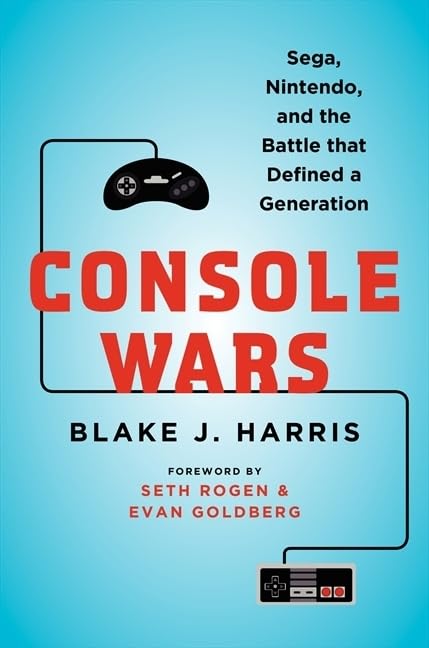
Harris presents the 1990s rivalry primarily through Sega of America, especially Tom Kalinske and his colleagues, while contrasting their entrepreneurial, aggressive style with Nintendo’s centralized culture of quality control and market protection. The narrative covers the Genesis’s transformation from an also-ran into Nintendo’s chief U.S. competitor; the creation and positioning of Sonic; battles over pricing, licensing, violence, and retailer power; and the growing importance of Sega’s Japanese parent company, third-party publishers, and Sony. The book’s dramatic arc ends around Kalinske’s 1996 resignation and Sega’s decline as a serious console contender.
Core ideas
Underdog advantage is often behavioral
Sega could take risks because it had less to lose. Its willingness to cut prices, pursue mature branding, attack Nintendo directly, and experiment with aggressive promotions helped it make competition visible and emotionally compelling.
Marketing can redefine a product category
Sega did not merely sell the Genesis as another game console. It positioned it as faster, edgier, and more culturally relevant to older children and teenagers. Sonic functioned as both a mascot and a concise statement of brand identity.
Distribution and policy matter as much as invention
The contest depended on retailer relationships, licensing rules, manufacturing capacity, pricing, release timing, and control over third-party developers. A technically capable product could still lose if the surrounding commercial system was weak.
A multinational company can be strategically divided
One of the book’s central tensions is between Sega of America’s market instincts and Sega of Japan’s authority. Local executives could understand U.S. consumers better yet lack the power to commit the corporation to a coherent long-term direction.
Competition can strengthen the incumbent
Sega’s attacks forced Nintendo to sharpen its own marketing, software lineup, and public positioning. Challenging a dominant firm may expand the market and improve the challenger’s visibility without permanently dislodging the incumbent.
Winning a generation is not the same as building a durable company
Sega’s success in the 16-bit era did not automatically translate into successful next-generation hardware. Add-ons, shifting plans, internal conflict, and poor strategic follow-through turned momentum into fragility.
Practical takeaways
- If you are the smaller competitor, attack the incumbent’s assumptions rather than copying its strengths.
- Translate a strategy into memorable signals: price, audience, product personality, launch timing, and a recognizable champion.
- Give local teams authority when success depends on cultural or market-specific judgment.
- Treat complements—software, developers, retailers, licensing, and accessories—as part of the product, not as secondary concerns.
- Use bold marketing to gain attention, but do not mistake attention and temporary share gains for a sustainable operating model.
- When a parent company and regional subsidiary disagree, resolve who owns strategy before momentum creates conflicting road maps.
Caveats and counterpoints
- This is a dramatized narrative history, not a neutral institutional account. Reviews generally find it highly entertaining and thorough, but also somewhat lopsided toward Sega and Kalinske.
- Harris reconstructed scenes and dialogue from interviews; he described the dialogue as being checked for voice, premise, or tone rather than necessarily reproduced verbatim. That makes the book vivid but means conversational details should not be treated as transcripts.
- The book emphasizes executives, marketers, and corporate strategy more than game designers, developers, or players. Readers seeking a technical history of the hardware or a broader account of global gaming will need other sources.
- Its stopping point gives the story a clean Kalinske-centered arc, but it compresses or excludes much of Sega’s later hardware decline and the wider historical forces behind Sony’s rise.
Questions worth revisiting
- Which of Sega’s successful moves were genuinely transferable strategies, and which depended on unusually favorable personalities and timing?
- Did Sega lose because of bad decisions, Japanese-American organizational conflict, weaker software economics, or a changing market?
- How much of the “David versus Goliath” framing reflects Sega’s real disadvantage, and how much is narrative construction?
- Would Sega’s strategy have remained effective if Nintendo had matched its advertising aggression earlier?
- What does the rivalry suggest about the limits of decentralized innovation inside a multinational corporation?
Return to this when…
Return to these notes when studying challenger strategy, brand positioning, platform competition, multinational organizational conflict, or the history of 1990s video games. Revisit the caveats before using the book as a source for exact dialogue, chronology, or balanced institutional history.
References
- Console Wars: Sega, Nintendo, and the Battle that Defined a Generation - Blake J. Harris - Google Books
- Console Wars: Sega, Nintendo, and the Battle That Defined a Generation by Blake Harris
- ci.nii.ac.jp
- en.wikipedia.org
- kirkusreviews.com
- openlibrary.org
- Console Wars: Sega, Nintendo and the Battle That Defined a Generation by Harris, Blake J. (2014) Paperback by Blake J. Harris | Goodreads
- si.edu
- play.google.com
- vitalsource.com
- Book Review: Console Wars - Sega, Nintendo, and the Battle That Defined a Generation | Nintendo Life
- nintendolife.com