
In one sentence
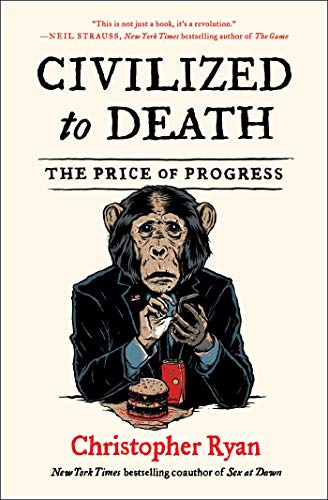
Ryan argues that the standard story of history—as a steady ascent from primitive misery to civilized abundance—is misleading. Many forms of modern suffering, including chronic disease, alienation, inequality, ecological destruction, overwork, and anxiety, are presented not as accidental flaws but as consequences of civilization’s organizing assumptions: scarcity, hierarchy, property, coercion, delayed gratification, and separation from nature.
Overview
The book is a wide-ranging polemic rather than a neutral survey. Ryan revisits the transition from mobile foraging to agriculture and settled society, then connects that transition to modern patterns in eating, education, parenting, sexuality, work, communication, medicine, politics, and death. His recurring contrast is between small-scale societies organized around sharing, autonomy, play, and social embeddedness, and modern institutions organized around production, obedience, competition, and accumulation. The proposed alternative is less a detailed political program than a change in values: recover human-scale communities, bodily and ecological limits, time for play, and skepticism toward “more” as a synonym for “better.”
Core ideas
Question the Narrative of Perpetual Progress
Ryan’s central target is the assumption that later, more technologically powerful societies are automatically healthier or happier. He asks readers to judge institutions by lived well-being, relationships, autonomy, and ecological sustainability—not by productivity, complexity, or control over nature.
Agriculture as a Major Trade-off
The shift to farming and permanent settlement is treated as a bargain: larger populations and food storage came with hierarchy, labor intensification, disease exposure, property conflicts, patriarchy, and reduced mobility. Ryan does acknowledge that agriculture could answer real pressures, including hunger, but emphasizes its costs.
Foragers as a Counter-model
Hunter-gatherers function as Ryan’s comparative baseline: relatively egalitarian, cooperative, mobile, socially integrated, and with more time for rest and play. The useful point is not that every foraging society was idyllic, but that human beings can organize life around values other than accumulation and domination.
Adaptation Is Not the Same as Well-being
Humans can adapt to crowded cities, sedentary work, processed food, screens, and chronic stress. Ryan argues that this flexibility can disguise harm: surviving or functioning within an environment does not prove that the environment suits human psychological or bodily needs.
Civilization Externalizes Its Costs
Modern systems can provide comfort and power while shifting costs onto bodies, relationships, poorer populations, and the nonhuman world. Convenience, medical technology, and abundant goods may coexist with loneliness, disease, ecological damage, and dependence on institutions people cannot meaningfully control.
Work, School, and Parenting Reproduce Compliance
Ryan treats many institutions as training systems for obedience and delayed living: children learn to follow schedules and authority; adults sell most of their waking time; parents become anxious managers of risk. His implied alternative favors autonomy, mixed-age social learning, practical competence, and more unstructured time.
The Book’s Rhetorical Method
Ryan assembles anthropology, psychology, history, health research, and contemporary examples to make a cumulative case. The method is memorable because it connects seemingly separate problems, but it also encourages selective evidence when examples that support the anti-civilization thesis receive more attention than counterexamples.
Reform Means Recovering Limits
The practical direction is not simply to abandon technology or return literally to prehistory. It is to recover features of small-scale life—reciprocity, face-to-face belonging, movement, ecological restraint, shared responsibility, and present-oriented time—while retaining tools that genuinely reduce suffering.
Practical takeaways
- When evaluating “progress,” ask: progress for whom, measured how, and at whose ecological or social expense?
- Separate genuine improvements—such as sanitation, analgesia, emergency medicine, and some forms of communication—from the broader ideology that equates novelty and growth with flourishing.
- Treat chronic stress, sedentary work, social isolation, ultra-processed food, and constant digital stimulation as environmental-design questions, not merely individual failures of discipline.
- Protect recurring time for play, movement, face-to-face relationships, and activities whose value is not productivity.
- Prefer reciprocal networks and local competence over total dependence on distant institutions where practical and safe.
- Use hunter-gatherer comparisons as provocative questions about human needs, not as ready-made blueprints for contemporary policy.
- Look for trade-offs before celebrating efficiency: a system that saves time may also remove autonomy, skill, community, or ecological resilience.
Caveats and counterpoints
- The book’s strongest weakness is its romanticization of hunter-gatherer life. Reviews note that Ryan underplays infant and maternal mortality, violence, illness, insecurity, and the diversity among foraging societies.
- Its evidence selection is widely characterized as one-sided. Publishers Weekly describes the argument as relying on a selective set of anthropological and psychological studies, while Kirkus calls its claims broad generalizations.
- The comparison can blur important distinctions between agriculture, states, industrial capitalism, and contemporary American life; treating them as one continuous “civilization” weakens causal precision.
- Lower mortality, public sanitation, literacy, and modern medicine are not adequately weighed against the harms Ryan emphasizes. The book is more persuasive as a critique of what modern societies value than as a balanced account of historical welfare.
- The proposed remedies are less developed than the diagnosis. A review in Undark specifically notes that the solutions are brief compared with the book’s extensive argument against civilization.
Questions worth revisiting
- Which parts of modern life are genuinely incompatible with human well-being, and which could be redesigned without rejecting technological society?
- Does the book distinguish adequately between civilization itself and particular forms of hierarchy, capitalism, patriarchy, or state power?
- How much of the apparent forager advantage reflects small population size, mobility, and ecological conditions that cannot be reproduced at global scale?
- When does adaptation represent resilience, and when does it merely conceal harm?
- What concrete institutions could provide modern medicine and sanitation while restoring autonomy, reciprocity, and ecological limits?
- Which claims should be checked against less romantic accounts of foraging societies and against evidence of long-term improvements in health and life expectancy?
Return to this when…
Return to this book when you need a sharp counterweight to technological solutionism, economic-growth thinking, or the assumption that institutional complexity equals human progress. Pair it with more balanced anthropology and history when assessing its empirical claims; its most durable value is as a diagnostic lens for asking what modern systems demand, what they damage, and what they fail to provide.
References
- bookmarks.reviews
- CIVILIZED TO DEATH | Kirkus Reviews
- publishersweekly.com
- Civilized to Death | Book by Christopher Ryan | Official Publisher Page | Simon & Schuster
- goodreads.com
- Extolling the Virtues of the Hunter-Gatherer Lifestyle
- libraryjournal.com
- tiagovf.medium.com
- psychologytoday.com
- psychologytoday.com
- befreed.ai
- wclc2019.iaslc.org