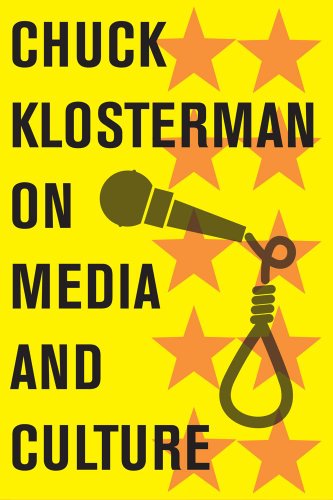

In one sentence
The collection’s recurring position is that media does not merely reflect culture: it supplies the stories, categories, fantasies, and interpretive habits through which people understand reality. Klosterman’s method is less to deliver a single theory than to expose the strange assumptions beneath familiar cultural forms.
Overview
This is an ebook sampler/repackaging rather than a newly conceived, continuous work. Its thirteen essays come from three earlier books and vary considerably in subject and approach. The collection moves from sexuality and celebrity to serial killers, journalism, piracy, video games, advertising, interviews, and truth-telling. Its coherence comes mainly from Klosterman’s recurring interest in how people convert chaotic experience into recognizable stories. The publisher lists the collection at 145 pages, published by Scribner on September 14, 2010.
Core ideas
Media is a meaning-making system
Advertisements, news reports, television, music, and celebrity culture do not simply transmit information. They frame what counts as important, desirable, normal, authentic, or memorable. Klosterman repeatedly asks what changes when people become conscious of those framing mechanisms.
People want narratives, even when reality is incoherent
Essays on crime, journalism, celebrity, and personal testimony examine the pressure to make events legible. A story with motives, symbols, and a satisfying shape can feel more convincing than an accurate account that remains ambiguous or incomplete.
Self-awareness does not automatically defeat persuasion
The advertising essay, originally from Eating the Dinosaur, considers how consumers can recognize a commercial’s emotional manipulation and still respond to it. Awareness may become part of the performance rather than an escape from it.
Interviews are performances by both parties
In “Something Instead of Nothing,” the interview is treated as a social technology: people explain themselves for approval, therapy, self-definition, or the chance to control their public identity. The interviewer’s questions and the subject’s evasions jointly produce a narrative rather than simply uncovering facts.
Obsession reveals cultural values
The essays’ unusual subjects—serial killers, porn, pirates, video games, and pop stars—are not random curiosities. Extreme or supposedly trivial objects make hidden assumptions easier to see: what society fears, what it excuses, what it commercializes, and what it treats as meaningful.
Irony and sincerity coexist uneasily
Klosterman often adopts a comic, self-conscious voice while pursuing serious questions about truth, belief, taste, and identity. The humor creates distance, but the underlying subjects are frequently moral or existential rather than merely amusing.
The collection’s form is itself significant
Because the essays were previously published and gathered from three books, the book should not be read as a tightly argued manifesto. It is better understood as a curated cross-section of Klosterman’s media criticism, with repetition of motifs but uneven depth and no final synthesis.
Practical takeaways
- When analyzing media, ask not only “Is this true?” but also “What story is this format encouraging me to accept?”
- Treat advertising as an attempt to sell an association or lifestyle, not merely a product; notice the emotional identity being attached to the object.
- In interviews and public statements, separate factual disclosure from performance, self-protection, reputation management, and the desire to be understood.
- Use strange or marginal cultural objects as diagnostic tools: they can reveal assumptions that mainstream examples conceal.
- Expect ambiguity. Klosterman’s essays often generate better questions than conclusions, so record the question or tension that remains after each piece.
- Read the collection selectively if desired: the essays stand largely on their own, and the book’s repackaged structure makes it suitable for short, discontinuous reading.
Caveats and counterpoints
- The book is not a unified contemporary survey of media. It was published in 2010 and reprints essays from earlier collections, so some technologies, celebrities, advertising campaigns, and cultural references are historically dated.
- Its arguments are essayistic and exploratory rather than systematically researched. Klosterman’s memorable connections are interpretive provocations, not necessarily representative evidence.
- The collection’s subjects and tone can be provocative, especially around pornography, violence, celebrity, and gender. The comic framing may sharpen an observation but can also make ethical or political implications feel less fully examined.
- Some readers may find the repackaging frustrating: the essays duplicate material from Sex, Drugs, and Cocoa Puffs, Chuck Klosterman IV, and Eating the Dinosaur rather than offering new work. This limitation is reflected in the publisher’s description itself.
Questions worth revisiting
- Which cultural objects does Klosterman treat as more revealing than they initially appear—and why?
- Does recognizing an advertising technique make a person less susceptible, or merely more sophisticated at participating in it?
- When does a compelling narrative become a distortion of reality?
- Are interviews primarily methods of discovering truth, or rituals through which people construct acceptable versions of themselves?
- Which essays depend most heavily on their early-2000s cultural context?
- Where does Klosterman’s ironic voice clarify an argument, and where might it shield the argument from accountability?
Return to this when…
Return to this collection when you want a quick Klosterman-style prompt for examining familiar media from an oblique angle—especially advertising, celebrity, journalism, or the boundary between truth and narrative. For a more sustained argument, read the original source collection, particularly Eating the Dinosaur, from which several of the book’s most conceptually focused essays are drawn.
References
- Chuck Klosterman on Media and Culture: A Collection of Previously Published ... - Chuck Klosterman - Google Books
- Chuck Klosterman on Media and Culture eBook by Chuck Klosterman | Official Publisher Page | Simon & Schuster
- simonandschuster.biz
- play.google.com
- parents.simonandschuster.com
- cultura.com
- goodreads.com
- goodreads.com
- simonandschuster.com
- overdrive.com
- barnesandnoble.com
- books.apple.com
- simonandschuster.biz
- cs.umd.edu
- books.google.je