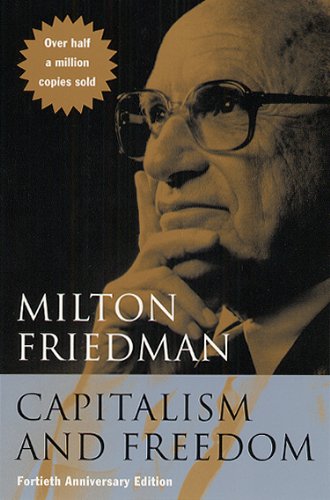

In one sentence
Competitive capitalism disperses economic power, making political dissent and individual choice more feasible. Friedman treats economic freedom as valuable in itself and as a necessary—though not automatically sufficient—condition for political freedom. Government has legitimate functions, but its interventions should be narrowly justified and designed to preserve choice rather than replace it.
Overview
The book develops a classical-liberal framework and then applies it to major policy areas. Friedman argues that voluntary exchange generally coordinates interests without central direction; that concentrated state control threatens pluralism; and that many well-intentioned interventions create dependency, protect established groups, or produce worse unintended effects. His proposed alternatives include monetary rules, freer trade, school vouchers, abolition or reduction of licensing barriers, a negative income tax, and a volunteer military. The edition commonly catalogued by the University of Chicago Press is a 202-page work first published in 1962.
Core ideas
Freedom requires dispersed power
A market economy separates economic decisions across many people and organizations. That dispersion gives individuals alternatives to dependence on a single political authority and helps sustain independent institutions, dissent, and exchange of ideas.
Government is necessary but dangerous when overextended
Friedman does not argue for no government. He assigns it responsibility for law, property rights, contract enforcement, national defense, and some problems involving technical monopoly or effects imposed on others. The danger begins when government substitutes administrative command for voluntary choice.
Voluntary exchange is a coordination mechanism
When transactions are informed and voluntary, both parties expect to benefit. Prices transmit information and incentives without requiring a central planner to know everyone’s circumstances. This is the book’s central practical reason for preferring markets.
Monetary stability should not depend on discretion
Friedman is skeptical of activist monetary management and favors a predictable rule for money growth. His concern is that discretionary policy can amplify instability, invite political manipulation, and make inflation or deflation harder to control.
Trade restrictions usually protect producers at consumers’ expense
Tariffs and other barriers are presented as politically attractive because their benefits are concentrated among protected industries while their costs are dispersed among consumers and exporters. Freer trade is therefore both economically beneficial and a check on protectionist political coalitions.
Education illustrates the difference between financing and operating
Friedman accepts a public role in financing education because schooling may generate benefits for others and because children cannot choose entirely for themselves. But he argues that government need not operate schools directly: vouchers could finance families’ choices while encouraging competition among providers.
Markets can weaken, but do not automatically eliminate, discrimination
Because discrimination is costly when buyers, sellers, or employers forgo mutually beneficial transactions, competition can penalize it. Friedman’s argument is not that markets end prejudice; legal rules, private power, and social conditions can still sustain discrimination.
Licensing can restrict entry under the guise of protection
Occupational licensing may claim to protect consumers while limiting competition, raising prices, and protecting incumbent practitioners. Friedman distinguishes genuine information problems from licensing systems that let organized professions control entry.
Practical takeaways
- When evaluating a policy, ask: What voluntary arrangement is being displaced, who gains concentrated benefits, who pays dispersed costs, and what unintended incentives follow?
- Separate the question of who pays from the question of who provides. Public financing does not logically require public production.
- Treat claims of consumer protection skeptically when regulation is designed or administered by incumbent providers.
- Look for institutional designs that preserve exit, competition, and pluralism rather than relying on officials to make correct decisions for everyone.
- Use Friedman’s framework comparatively: assess not only market failures, but also government failures, information limits, lobbying, administrative incentives, and the difficulty of reversing interventions.
- For poverty policy, remember his preference for an income floor delivered through a negative income tax rather than a complex collection of narrowly targeted programs.
Caveats and counterpoints
- The book is an advocacy work, not a neutral survey of economic evidence. Its recurring presumption is that government failure is often more serious than market failure.
- The connection between capitalism and political freedom is historically contingent and contested. Markets may disperse power, but private wealth can also create political influence, dependency, or concentrated market power; economic freedom alone does not guarantee equal political voice.
- Friedman’s treatment of discrimination relies heavily on competitive pressures. That mechanism is weaker where discrimination is socially coordinated, where markets are highly concentrated, or where victims lack realistic alternatives.
- The proposed monetary rule, negative income tax, vouchers, and licensing reforms depend on implementation details that the book treats more briefly than their modern policy debates require.
- Many empirical examples and institutional conditions are specific to the United States of the mid-twentieth century. They should not be transferred uncritically to current economies, digital markets, healthcare systems, or education systems.
- The book’s definition of freedom emphasizes absence of coercion and expanded choice. Readers who define freedom more substantively—as security, capability, equality, or democratic self-rule—may find its argument incomplete.
Questions worth revisiting
- When does private economic power become coercive in a way that requires public intervention?
- What evidence would distinguish a genuine market failure from a government failure?
- Would school vouchers increase meaningful choice where neighborhoods, transportation, or information are unequal?
- Can a monetary rule remain credible during a financial crisis or major supply shock?
- How should the book’s anti-licensing argument handle occupations where mistakes create severe, irreversible harm?
- Does a negative income tax preserve dignity and incentives better than in-kind benefits, or does that depend on the benefit and recipient?
- What forms of inequality are compatible with the political freedom Friedman wants to protect?
Return to this when…
Return to the thesis and the chapters on education, discrimination, licensing, and poverty when comparing market-based and state-administered solutions. Revisit the caveats when applying Friedman to present-day policy, especially where private concentration, unequal bargaining power, externalities, or crisis conditions make the market-versus-government contrast less clean.
Highlights
In 1956, when I gave the lectures that my wife helped shape into this book, government spending in the United States—federal, state, and local—was equal to 26 percent of national income. Most of this spending was on defense. Non-defense spending was 12 percent of national income. Twenty-five years later, when the 1982 edition of this book was published, total spending had risen to 39 percent of national income and non-defense spending had more than doubled, amounting to 31 percent of national income. That change in the climate of opinion had its effect. It paved the way for the election of Margaret Thatcher in Britain and Ronald Reagan in the United States. They were able to curb Leviathan, though not to cut it down. Total government spending in the United States did decline slightly, from 39 percent of national income in 1982 to 36 percent in 2000, but that was almost all due to a reduction in spending for defense. Non-defense spending fluctuated around a roughly constant level: 31 percent in 1982, 30 percent in 2000.
To the free man, the country is the collection of individuals who compose it, not something over and above them. He is proud of a common heritage and loyal to common traditions. But he regards government as a means, an instrumentality, neither a grantor of favors and gifts, nor a master or god to be blindly worshipped and served. He recognizes no national goal except as it is the consensus of the goals that the citizens severally serve. He recognizes no national purpose except as it is the consensus of the purposes for which the citizens severally strive.
Freedom is a rare and delicate plant. Our minds tell us, and history confirms, that the great threat to freedom is the concentration of power. Government is necessary to preserve our freedom, it is an instrument through which we can exercise our freedom; yet by concentrating power in political hands, it is also a threat to freedom.
The preservation of freedom is the protective reason for limiting and decentralizing governmental power. But there is also a constructive reason. The great advances of civilization, whether in architecture or painting, in science or literature, in industry or agriculture, have never come from centralized government. Columbus did not set out to seek a new route to China in response to a majority directive of a parliament, though he was partly financed by an absolute monarch. Newton and Leibnitz; Einstein and Bohr; Shakespeare, Milton, and Pasternak; Whitney, McCormick, Edison, and Ford; Jane Addams, Florence Nightingale, and Albert Schweitzer; no one of these opened new frontiers in human knowledge and understanding, in literature, in technical possibilities, or in the relief of human misery in response to governmental directives. Their achievements were the product of individual genius, of strongly held minority views, of a social climate permitting variety and diversity.