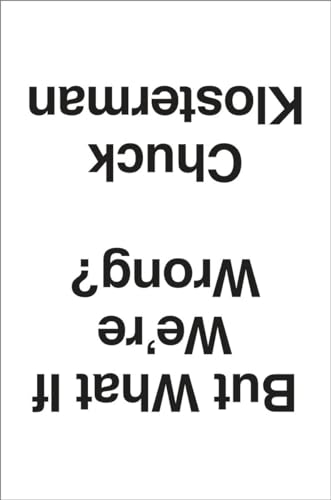

In one sentence
The present feels self-evidently real because we inhabit its assumptions. Klosterman’s thought experiment—viewing today as though it were already history—reveals that both factual beliefs and cultural judgments are unstable. The goal is not blanket skepticism, but greater humility about what seems obvious, inevitable, or permanently important.
Overview
Klosterman combines research, interviews, cultural criticism, and speculative scenarios. The book begins from two linked observations: scientific consensus can be overturned, and artistic reputations can radically change. His recurring example is the reversal of Moby-Dick’s reputation—from a poorly received nineteenth-century novel to a canonical American masterpiece. He extends this pattern to questions about cosmology, the future of television, the literary status of contemporary writers, the historical meaning of rock music, and which present-day figures or works may survive cultural selection.
Core ideas
Present knowledge is provisional, not neutral
People in every era mistake the dominant explanation for reality itself. Future observers may see our current models as limited historical frameworks rather than final descriptions. This applies to scientific theories, political assumptions, moral categories, and everyday common sense.
Objective and subjective wrongness differ
Klosterman distinguishes being factually mistaken—such as misunderstanding how nature works—from being culturally mistaken, such as overlooking an artist or misjudging a work’s importance. The mechanisms differ, but both show that consensus can change dramatically.
Cultural importance is selected retrospectively
A work’s long-term status is not simply a direct result of quality or immediate popularity. Later institutions, movements, technologies, and interpretive needs can make an overlooked work newly legible. Canon formation is therefore historical and contingent, not merely a delayed measurement of timeless merit.
The future will not share our categories
We tend to predict that future people will value the same distinctions we do. Klosterman instead asks whether categories such as ‘serious’ and ‘popular,’ ‘high’ and ‘low,’ or ‘art’ and ‘entertainment’ will remain meaningful. A future culture may reorganize the present around entirely different boundaries.
Prediction is less useful than perspective-shifting
The book is not primarily a forecast of which current beliefs will be overturned. Its method is a mental exercise: temporarily adopt the viewpoint of a distant historian, then notice which assumptions become visible. The value lies in unsettling certainty, not in guessing correctly.
Narrative shapes what survives
History is not remembered as an undifferentiated archive. People, events, and works become memorable when they fit compelling stories. This makes cultural memory powerful but also distorting: what survives may reflect narrative usefulness as much as intrinsic importance.
Uncertainty does not make all beliefs equal
A central limitation of the premise is that scientific claims and aesthetic judgments are not uncertain in the same way. A future paradigm shift does not imply that every fringe theory deserves equal weight, and a change in literary taste does not erase evidence about a work’s original reception.
Practical takeaways
- When an idea feels obvious, identify the historical conditions that made it obvious.
- Separate confidence from certainty: a belief can be well supported without being final.
- Ask which of your judgments are empirical and which are reputational, aesthetic, or cultural.
- Use historical reversals as humility checks, not as excuses for contrarianism.
- When forecasting, examine whether you are projecting today’s categories into the future.
- Distinguish ‘this may later be revised’ from ‘there is currently no good reason to believe it.’
- Pay attention to what institutions, technologies, and narratives are making visible or invisible.
Caveats and counterpoints
- The book’s range is its strength and its weakness: it generates provocative comparisons more readily than it develops a systematic theory of knowledge.
- Some speculative possibilities are entertaining thought experiments rather than serious predictions; they should not be treated as equally plausible scenarios.
- The retrospective viewpoint can exaggerate discontinuity. Future generations may inherit more of our institutions, technologies, and values than the book’s premise foregrounds.
- Cultural revaluation is not always benign or intellectually superior; later eras can discard valuable work, canonize fashionable work, or reinterpret the past through their own biases.
- The argument is most persuasive as a corrective to overconfidence, not as a claim that nearly everything we believe is likely to be false.
Questions worth revisiting
- Which beliefs do I treat as facts even though they depend on current cultural categories?
- What contemporary art or media might be difficult for future audiences to understand without our technological context?
- Am I using uncertainty to become more careful, or merely to seem sophisticated and contrarian?
- Which current reputations are sustained by institutions, publicity, or inherited narratives?
- What would a historian from 2126 find most strange about the way my era defines importance?
- Where should humility change my behavior, and where would excessive doubt prevent responsible action?
Return to this when…
Return to this book when you notice cultural consensus hardening into inevitability, when making predictions about what will last, or when you need a reminder that intellectual humility is not the same as indecision.