
In one sentence
Business success and failure are rarely explained by a single strategy or decision. Brooks shows how outcomes emerge from interacting incentives, imperfect information, organizational habits, personalities, legal rules, and luck. His method is not to prescribe a formula, but to make business judgment visible through vivid historical episodes.
Overview
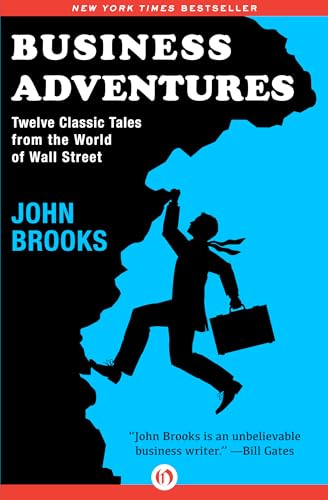
Originally published in 1969, the book gathers twelve essays, many first published in The New Yorker. The chapters cover the 1962 stock-market decline, Ford’s Edsel failure, the federal income tax, Texas Gulf Sulphur insiders, Xerox’s rise, the Salad Oil scandal, GE price-fixing, Clarence Saunders’s Piggly Wiggly stock corner, David Lilienthal’s business career, shareholder meetings, executive trade secrets, and the defense of sterling.
Core ideas
Markets are social systems, not just calculators
In “The Fluctuation,” price movements reflect expectations, fear, imitation, institutional constraints, and changing narratives—not merely changes in underlying value. A market can recover quickly without participants having gained better information, because confidence and liquidity can return.
Product-market fit cannot be separated from organizational judgment
The Edsel story is a caution against assuming that a large company, extensive research, and a major launch budget can overcome weak positioning, poor timing, internal politics, and a product that does not match customers’ self-conception. Scale magnifies a bad decision as efficiently as a good one.
Rules create incentives—and loopholes invite gamesmanship
The federal-tax chapter treats taxation as an evolving compromise among policy goals, political interests, administrative limits, and taxpayer behavior. Rules do not simply restrain conduct; they shape what professionals learn to optimize, evade, or reinterpret.
Information advantages become dangerous when governance lags
The Texas Gulf Sulphur episode examines insiders trading on material information and the uncertainty surrounding what executives, lawyers, regulators, and investors should disclose. The practical lesson is to define information controls and escalation procedures before a crisis, not while facts are still disputed.
Communication failure can be systematic
In the GE price-fixing case, Brooks uses “non-communication” to show how messages can be softened, misunderstood, or deliberately left ambiguous as they move through a hierarchy. Compliance depends not only on written rules but on whether people can safely surface uncomfortable interpretations.
Reputation is an economic asset, but not a substitute for controls
The Salad Oil scandal and the effort to make customers whole illustrate how trust, fairness, and institutional legitimacy affect whether a financial shock becomes a contained loss or a systemic crisis. A public-spirited response may preserve confidence, but it cannot erase weak verification mechanisms.
Institutions may change the game under pressure
The Piggly Wiggly corner presents a conflict between entrepreneurial daring and the rules of an established exchange. Saunders’s attempt to defeat short sellers exposes a recurring risk: a clever strategy can depend on counterparties continuing to honor the assumptions that make the strategy possible.
Leadership is a bundle of trade-offs, not a personality type
The Lilienthal profile presents business leadership as a second career requiring political judgment, persuasion, public legitimacy, and adaptation. Brooks resists a simple hero model: the same qualities that make a leader effective in public administration may create tensions in commercial life.
Practical takeaways
- When evaluating a strategy, separate the quality of the idea from the quality of its execution, timing, incentives, and organizational communication.
- For major launches, test whether the product fits customers’ identity and habits—not just whether research predicts demand.
- Treat compliance language as an operational system: clarify ambiguous terms, document escalation paths, and reward early reporting of bad news.
- Map who knows what, when they know it, and what duties follow. Information asymmetry becomes a governance risk when responsibility is unclear.
- In a crisis, calculate the value of preserving trust and market legitimacy alongside the immediate financial loss.
- At shareholder or stakeholder meetings, distinguish formal authority from practical power: persistent minority actors can shape the conversation.
- Assume that institutions and counterparties may react strategically to a successful maneuver; stress-test plans against rule changes and coordinated responses.
- Use historical case studies to improve pattern recognition, not to copy old tactics into new markets.
Caveats and counterpoints
- The book is historical financial journalism, not a current manual for securities law, tax compliance, corporate governance, or product management. Its legal and market terminology reflects mid-twentieth-century America.
- Brooks’s narrative emphasis favors memorable personalities and dramatic episodes. That makes institutional dynamics vivid, but it can understate slow structural forces, ordinary cases, and evidence that does not fit the story.
- The chapters do not yield a single theory of business success. Some emphasize communication, others incentives, ethics, regulation, or luck; the connections are interpretive rather than a formal framework supplied by Brooks.
- Several cases involve institutions and technologies that have changed substantially. The durable value lies mainly in the patterns—misaligned incentives, information gaps, overconfidence, and reputational contagion—not in treating the historical particulars as unchanged.
- Bill Gates’s praise helped revive the book, but it should not be mistaken for the book’s argument. Gates specifically valued Brooks’s refusal to reduce complex episodes to simplistic how-to lessons.
Questions worth revisiting
- Where did management mistake internal enthusiasm for external demand in the Edsel case?
- Which failures in the book came primarily from bad incentives, and which came from bad judgment under uncertainty?
- How could a modern company make “non-communication” visible before it becomes a compliance problem?
- When is making customers whole a wise investment in legitimacy, and when might it create moral hazard?
- What assumptions made the Piggly Wiggly strategy possible, and which counterparty actions could have invalidated them?
- Which of Brooks’s cases most resembles a current organization you know—and which important modern factor is missing from the comparison?
Return to this when…
Return to this book when you want a narrative refresher on how incentives, information, hierarchy, reputation, and institutional rules interact. The most useful chapters to revisit are “The Fate of the Edsel” for strategic overconfidence, “The Impacted Philosophers” for communication and compliance, “Making the Customers Whole” for crisis legitimacy, and “The Last Great Corner” for strategy under adversarial rules.
Highlights
was to be found in the Times Square office (at 1451 Broadway) of Merrill Lynch, Pierce, Fenner & Smith, the undisputed Gargantua of the brokerage trade. This office was plagued by a peculiar
scene—“The bears [that is, the sellers] are completely ruled by fear, trepidation, and nervousness. Rabbits become elephants, brawls in a tavern become rebellions, faint shadows appear to them as signs of chaos.”
“Never give anyone the advice to buy or sell shares, because, where perspicacity is weakened, the most benevolent piece of advice can turn out badly.”
But Krafve concedes today that he found it difficult thus to bend the creative process to the yoke of system, principally because many of the four thousand decisions he made wouldn’t stay put. “Once you get a general theme, you begin narrowing down,” he says. “You keep modifying, and then modifying your modifications. Finally, you have to settle on something, because there isn’t any more time. If it weren’t for the deadline you’d probably go on modifying indefinitely.”
Meanwhile, Krafve and his men held repeated sessions in a darkened room, staring, with the aid of a spotlight, at a series of cardboard signs, each bearing a name, as, one after another, they were flipped over for their consideration. One of the men thus engaged spoke up for the name Phoenix, because of its connotations of ascendancy, and another favored Altair, on the ground that it would lead practically all alphabetical lists of cars and thus enjoy an advantage analogous to that enjoyed in the animal kingdom by the aardvark.
In other, harsher words, the company would have saved itself money if, back in 1955, it had decided not to produce the Edsel at all but simply to give away 110,810 specimens of its comparably priced car, the Mercury.