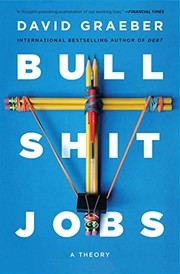

In one sentence
Graeber argues that supposedly efficient capitalist economies contain a large, politically produced layer of pointless employment. These jobs persist not because they create value, but because work is treated as a moral obligation, organizations reproduce hierarchy and bureaucracy, and elites prefer universal employment discipline to distributing the benefits of automation.
Overview
The book grew out of Graeber’s viral 2013 essay and reader testimonies about work that employees themselves considered socially useless. Its central distinction is between a “bullshit job” and a “shit job”: the former is pointless or pernicious, while the latter may be necessary but badly paid, insecure, or unpleasant. Graeber then develops a five-part taxonomy, explains why meaningless work produces shame and anxiety, traces its relationship to managerialism and finance, and considers alternatives including shorter working hours and basic income.
Core ideas
The worker’s judgment is central
A job qualifies when the person performing it cannot honestly justify why it exists—not merely because an outsider finds it boring, low-status, or inefficient. Graeber focuses on roles that are entirely or overwhelmingly pointless, rather than jobs containing some redundant tasks.
Five recurring types
Flunkies exist to make someone else appear important; goons manipulate, compete, or exert influence on behalf of an employer; duct tapers fix problems that should have been prevented; box tickers create evidence that something has been done; taskmasters supervise unnecessarily or generate pointless work for others. The categories can overlap.
Bullshit is different from bad work
A difficult, dangerous, underpaid, or socially undervalued job is not automatically a bullshit job. Graeber’s sharper target is work that has little or no useful purpose despite consuming the worker’s time and requiring a performance of seriousness.
Meaninglessness causes distinctive harm
When people believe their work should not exist, pay and status do not fully compensate for the loss of purpose. Workers may experience boredom, guilt, depression, humiliation, or the pressure to pretend that empty activity matters. The harm is moral and psychological, not simply economic.
Why pointless work persists
Graeber rejects the assumption that markets automatically eliminate waste. He links bullshit jobs to bureaucratic expansion, managerial hierarchies, financialization, status display, political pressure to preserve employment, and a work ethic that treats paid labor as a virtue in itself.
Useful work is often poorly rewarded
The book contrasts pointless administrative and status work with caring, domestic, maintenance, and socially necessary labor. Graeber’s broader political point is that compensation and prestige often track power, scarcity, or institutional status more than social usefulness.
Automation could be liberating—but may not be
Graeber revives the possibility that technology could reduce necessary labor and expand free time. He argues that societies instead often use productivity gains to intensify work or invent new administrative roles, because income remains tied to employment.
Practical takeaways
- When evaluating a job, ask two separate questions: Is it unpleasant or exploitative? Is it actually pointless? Do not confuse the categories.
- Use the five types as diagnostic prompts: Who benefits from this role? What would happen if it disappeared? Is the task repairing a preventable defect, proving compliance, displaying status, or generating work for others?
- Treat employee testimony as important evidence: workers often know whether a process creates value better than distant executives or official job descriptions.
- Look for organizational causes rather than blaming individual workers. A person may perform pointless work competently while the institution that created it is the real source of waste.
- Separate personal worth from occupational usefulness. The book’s critique is aimed at a social system that makes paid employment the main measure of dignity.
- For reform, Graeber points toward shorter working time, stronger public provision, democratic control over workplaces, and income security—especially universal basic income—rather than simply urging individuals to find more meaningful jobs.
Caveats and counterpoints
- Graeber’s categories are memorable but deliberately broad and sometimes rhetorically overstated; a role can be partly useful, indirectly useful, or useful under conditions the employee cannot see.
- His evidence is substantially built from anecdotes, correspondence, and perception surveys rather than a definitive measure of the share of bullshit jobs. One widely cited British survey found that 37% said their job made no meaningful contribution and 13% were unsure, but that is not the same as proving those jobs were objectively unnecessary.
- The book’s claim that particular occupations—such as managers, lawyers, marketers, or assistants—are often bullshit should not be read as saying every job in those occupations is useless. Later empirical research explicitly tests this distinction and notes that many workers in such occupations consider their work socially useful.
- Critics argue that Graeber sometimes treats alienation, bureaucratic frustration, social harm, and objective uselessness as too closely connected. The book is strongest as a vocabulary and provocation; it is less conclusive as a quantified theory of labor markets.
- Universal basic income and other proposed remedies receive political and ethical discussion, but the book does not settle practical questions about funding, inflation, public services, bargaining power, or how society would decide what work is genuinely necessary.
Questions worth revisiting
- Which tasks in my work would disappear without harming anyone—and which merely feel pointless because their value is indirect or poorly communicated?
- Is the problem my occupation, my organization, a particular manager, or a process that could be redesigned?
- Who has the power to define “useful” work, and whose caring or maintenance labor is being discounted?
- Would income security give people more freedom, or would organizations create new forms of status competition and compulsory activity?
- What would a shorter-work society need besides technology: redistribution, public services, workplace democracy, or cultural change?
Return to this when…
Return to the five types when a workplace process feels absurd: flunky, goon, duct taper, box ticker, or taskmaster. Return to the caveats when using the book to judge an entire profession or when treating survey perceptions as proof of objective social uselessness.
References
- Bullshit Jobs - David Graeber
- Books: Bullsh*t Jobs. The Rise of Pointless Work and What We Can Do About it: Are You A ‘Duct Taper’? - PMC
- davidgraeber.org
- davidgraeber.org
- Bullshit Jobs | Book by David Graeber | Official Publisher Page | Simon & Schuster
- davidgraeber.org
- Bullshit Jobs: A Theory review – laboured rant about the world of work | Economics | The Guardian
- The Bullshit-Job Boom | The New Yorker
- researchgate.net
- simonandschuster.net
- liamchingliu.wordpress.com
- sobrief.com
- journals.sagepub.com