
In one sentence
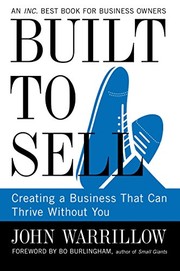
A business is more valuable—and gives its owner more freedom—when it can consistently create results without the founder’s personal involvement. “Built to sell” is therefore less about preparing for a transaction than designing the company as a transferable asset from the beginning.
Overview
The book is structured as a fictional story rather than a conventional management manual. Alex runs a small marketing agency and initially treats his own relationships, judgment, and availability as essential advantages. Ted, an experienced entrepreneur, helps him convert those founder-dependent strengths into an operating model other people can learn and repeat. The published contents move from crisis and diagnosis through implementation, management, growth, and the sale process.
Core ideas
Build a company, not a job
If customers buy access to the owner, or employees need the owner to resolve every important issue, the owner may have created employment rather than an independent asset. The first diagnostic question is: what would break if I disappeared for three months?
Choose a narrow specialty
Warrillow argues that service firms become more valuable when they stop accepting every kind of work and become unusually good at one clearly defined offering. Specialization improves positioning, pricing power, training, and repeatability; it can also mean deliberately refusing attractive but distracting projects.
Make the offer teachable, valuable, and repeatable
The book’s central design test is whether the offering can be taught to employees, is differentiated enough to avoid commodity price competition, and can generate repeat purchases. These criteria connect transferability, customer value, and economic durability.
Productize the process
Document the steps, standards, decisions, and quality checks required to deliver the core service. The aim is not bureaucracy for its own sake; it is to turn tacit founder knowledge into an operating method that competent employees can execute consistently.
Separate selling from doing
A founder who remains the only salesperson preserves personal control but creates a major buyer risk. Build a sales process and multiple salespeople so revenue does not depend on one person’s relationships or memory.
Prefer recurring, predictable revenue
Repeat business makes planning easier and reduces the risk a buyer sees in starting from zero each month. Warrillow’s approach favors contracts, subscriptions, maintenance, or other structures that make repurchase natural—though recurring revenue is valuable only when customers remain satisfied and retention is real.
Install management before the exit
A buyer needs evidence that the company can make decisions, serve customers, and maintain standards without the founder. That requires delegating authority, creating incentives, and retaining managers through the transition—not merely naming someone an executive near closing.
Treat the sale as a process, not an event
The company should be made sellable well before an offer arrives. The book frames preparation around reducing owner dependence, clarifying the offer, strengthening revenue quality, developing a team, and presenting credible growth opportunities.
Practical takeaways
- Write down the one service or product you want the company to be known for; list the work you should stop accepting.
- Map delivery from signed contract to completed result. Mark every step that only the founder can perform, approve, or explain.
- Create a documented standard operating process, then test whether a capable employee can follow it without informal coaching.
- Measure what percentage of sales, customer relationships, and key decisions still depend on the founder.
- Build at least one repeat-purchase mechanism: renewal, retainer, maintenance, subscription, replenishment, or a defined follow-on service.
- Have more than one person responsible for selling and for major customer relationships.
- Give managers authority with explicit targets, incentives, and a reason to remain through a future ownership transition.
- Review customer concentration, revenue predictability, margins, and founder involvement as buyer-risk indicators—not just top-line growth.
Caveats and counterpoints
- The book is a compact parable, not a detailed valuation, legal, tax, or merger-and-acquisition manual. Its sale-process advice should be supplemented by qualified financial, legal, and transaction professionals.
- The model fits service businesses especially well, but not every company should narrow to one offering. Some firms need a portfolio for risk management, cross-selling, innovation, or customer expectations.
- Recurring revenue can be misleading when retention is weak, contracts are easily canceled, margins are poor, or delivery costs rise faster than renewals.
- Reducing founder dependence can reduce some forms of value if the founder’s reputation, relationships, or creative judgment are genuinely central to the customer proposition. The practical goal is to distinguish transferable value from irreplaceable personal value.
- A business can be operationally independent yet unattractive to buyers because of weak market demand, poor economics, customer concentration, regulatory exposure, or limited growth. Transferability is necessary for the book’s ideal outcome, not sufficient by itself.
Questions worth revisiting
- Which parts of my company are genuine systems, and which are habits held in my head?
- What would a buyer believe they were acquiring: a repeatable engine, or my personal labor and relationships?
- What narrow problem could we solve better than generalist competitors?
- How much revenue would disappear if I stopped selling today?
- Which customers would renew without a personal call from me?
- Who could run the business for six months, and what evidence supports that assumption?
- What should I stop doing first to force the organization to become less founder-dependent?
Return to this when…
Return to this book when the business feels busy but fragile, when every decision escalates to the founder, before hiring for growth, or at least several years before a possible sale. Its most useful reminder is that freedom and exit value come from the same design choice: making the company work reliably without you.
References
- books.google.com
- builttosell.com
- Built to Sell Summary Review | John Warrillow
- Built to Sell Summary, Review PDF
- PDF Summary: Built to Sell by BusinessNews Publishing | 9782511022344
- Built to Sell by John Warrillow: 9781591845829 | PenguinRandomHouse.com: Books
- leapaheadapp.com
- Built to Sell: Creating a Business That Can Thrive Without You - John Warrillow - Google Books
- chaptercuts.com
- summarypedia.org
- pulserevops.com
- openlibrary.org