
In one sentence
Marketing fails when customers must work too hard to understand what a business offers. Miller’s remedy is disciplined clarity: frame the customer’s desired transformation as the story, and position the brand as a credible guide who helps make that transformation possible.
Overview
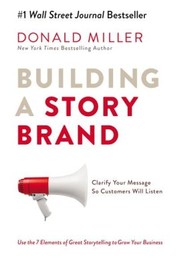
The book moves from diagnosing confusing, self-focused marketing to introducing the seven-part StoryBrand framework, then applies it to a BrandScript, websites, calls to action, company culture, and a broader marketing roadmap. Its practical emphasis is message design rather than brand identity, market research, pricing, or channel strategy. The central framework is: character, problem, guide, plan, call to action, failure, and success.
Core ideas
Make the customer the hero
The customer—not the company—is the protagonist. Marketing should begin with what the customer wants and the change they seek, rather than the brand’s history, features, or internal achievements.
Clarify the problem at three levels
Miller distinguishes the external problem—the practical obstacle—from the internal problem—the frustration or emotional burden beneath it—and the philosophical problem, the sense that the situation is somehow wrong. Stronger messaging connects the offer to more than the surface inconvenience.
Act as the guide
The brand’s role is supportive, not heroic. It should communicate empathy (“we understand the problem”) and authority (“we can help”), without overshadowing the customer’s goals.
Use the SB7 sequence
- A character wants something; 2) has a problem; 3) meets a guide; 4) receives a plan; 5) is called to action; 6) avoids failure; and 7) reaches success. The sequence is a filtering tool for deciding what belongs in the message.
Reduce cognitive friction
A message should quickly answer: What do you offer? How will it improve the customer’s situation? What should they do next? Miller favors plain language, prominent benefits, and repeated direct calls to action over cleverness or excess information.
Turn the framework into assets
The BrandScript is intended to guide practical materials: website copy, one-liners, sales language, email, brochures, and social content. The website should make the offer, value, plan, and next step immediately visible.
Connect marketing with internal alignment
Miller extends the framework beyond customer acquisition: a shared story can help employees understand the organization’s purpose, role, and direction. This is presented as an implementation benefit, not a substitute for management or operational systems.
Practical takeaways
- Write one sentence describing the customer’s desired outcome—not your company’s process.
- Name the customer’s external, internal, and philosophical problems; use the internal problem to make the message emotionally relevant.
- Describe your brand as a guide using evidence of competence and language that demonstrates understanding.
- Create a three-step plan that makes buying or starting feel less risky.
- Use a direct primary call to action, plus a lower-commitment option for prospects who are not ready.
- State both the positive transformation and the cost of remaining stuck, without using fear dishonestly.
- Audit every major communication: Can a stranger identify the offer, benefit, plan, and next action within seconds?
- Treat SB7 as a message-clarifying checklist, then test the resulting copy with real customers rather than assuming the framework guarantees conversion.
Caveats and counterpoints
- The book is a practical messaging playbook, not a comprehensive marketing strategy; it gives limited attention to segmentation, positioning research, competitive dynamics, pricing, distribution, experimentation, or proof of demand.
- Its story model is intentionally simplified. Critics note that forcing every business into the same seven-part structure can create formulaic, interchangeable marketing, especially when every brand presents itself as the wise guide.
- The framework is most naturally suited to offers involving a recognizable customer problem and desired transformation. It may be less useful for low-involvement commodities, complex multi-stakeholder purchases, public-interest communication, or brands whose value depends on community and identity rather than a simple solution path.
- The book’s confident claims should be treated as practitioner advice rather than independently established evidence of universal customer psychology or guaranteed revenue growth.
Questions worth revisiting
- What does my target customer want in concrete, observable terms?
- What frustration or emotional burden sits beneath the obvious problem?
- Why should the customer trust us as a guide rather than merely notice us as another vendor?
- Can our plan be explained in three simple steps?
- Is our call to action specific enough that a customer knows exactly what to do next?
- Does the message promise a credible transformation, or merely list features?
- Where would this framework oversimplify the customer’s real decision process?
- What customer interviews, usability tests, or conversion data would confirm or challenge the revised message?
Return to this when…
Return to this book when a website, pitch, campaign, or sales script feels cluttered or self-centered. Revisit the SB7 checklist before rewriting copy; then pair it with customer research, competitive positioning, proof, and testing so clarity supports a sound offer rather than disguising a weak one.
References
- Building a Storybrand: Clarify Your Message So Customers Will Listen - Donald Miller - Google Books
- goodreads.com
- Building a StoryBrand: Clarify Your Message So Customers Will Listen by Donald Miller - DigitalMarketer
- digitalmarketingservices.pro
- openlibrary.org
- kadlac.com
- Building a StoryBrand by Donald Miller — Review & Summary | Editors Reads
- purposefocuscommitment.com
- alexjhughes.com
- 601media.com
- StoryBrand - Make Your Message So Clear, Customers Can't Ignore You - StoryBrand
- storybrand.com
- cdn.cokesbury.com