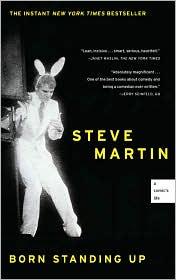

In one sentence
Martin presents comedy as a craft built through obsessive practice, sustained experimentation, and ruthless removal of anything conventional—not as a simple expression of innate talent. Fame arrives as a consequence of finding an original act, but success also creates exhaustion, isolation, and pressure that eventually make leaving stand-up necessary.
Overview
The book covers Martin’s formative years and his stand-up career rather than his entire life. It follows his early exposure to magic and comedy at Disneyland and Knott’s Berry Farm, his writing work on The Smothers Brothers Show, the gradual invention of his absurdist stage style, his rapid rise in the 1970s, and his decision to stop performing stand-up in 1981.
Core ideas
Originality requires subtraction
Martin’s breakthrough comes when he stops imitating established comedians and removes familiar structures—especially expected premises and punch lines. The aim is not merely to be strange, but to make the audience laugh without being able to reduce the method to a conventional joke formula.
Obsession can substitute for early confidence
The memoir emphasizes repetition, study, testing material, and persistence. Martin’s career is portrayed less as a smooth discovery of genius than as a long process of accumulating stage experience and learning what produced the desired response.
A persona is constructed, not simply revealed
His famous stage identity—confident, apparently uninhibited, and “wild”—is treated as a deliberately engineered performance. The contrast between the public character and the private experiences of fear, anxiety, and loneliness gives the memoir much of its tension.
Audience confusion can be productive
Martin repeatedly tests the boundary between performer and audience expectations. His act succeeds by controlling timing, theatricality, language, and surprise rather than by explaining the joke or supplying a stable comic point of view.
Success can validate the work while damaging the worker
The career arc complicates the usual success narrative: becoming a major draw does not resolve insecurity or make the performing life sustainable. The same relentless commitment that creates the act contributes to fatigue and the need to leave it.
Practical takeaways
- Study the field you want to enter, then identify the conventions you are willing to reject.
- Treat originality as an editing problem: remove borrowed, predictable, or over-explanatory elements.
- Test ideas in real conditions; audience response is information, not merely approval or rejection.
- Separate the effectiveness of a persona from your private identity; a successful role can still be psychologically costly.
- Do not confuse persistence with an obligation to continue indefinitely. Ending a successful phase can be a rational artistic decision.
Caveats and counterpoints
- This is a selective, retrospective memoir about Martin’s stand-up years, not a comprehensive autobiography; later film, music, and family life receive little attention.
- Martin is notably restrained about some personal relationships, so the memoir offers controlled candor rather than exhaustive disclosure.
- The book’s account is strongest as an artist’s explanation of his own development. It should not be treated as a general formula for comedy: Martin’s unusual talent, historical moment, media access, and career opportunities matter.
- Its emphasis on discipline and obsession may understate structural advantages and survivorship; many equally persistent performers do not receive comparable opportunities or results.
Questions worth revisiting
- Which conventions in my own work am I following automatically rather than choosing?
- What would I remove if my goal were a distinctive effect instead of immediate comprehensibility?
- Am I using a persona as a tool, or have I begun treating it as my identity?
- What evidence would tell me that persistence is still productive rather than merely habitual?
- What costs would make a successful project no longer worth continuing?
Return to this when…
Return to this memoir when working on originality, performance, or deliberate practice—and when a success story needs to be read alongside its costs. It is especially useful before revising a creative project: Martin’s example turns “find your voice” into the more concrete task of studying conventions, testing alternatives, and cutting what is merely familiar.